Kiln lid hardware is easy to overlook until the lid stops closing correctly, becomes difficult to lift, develops excessive movement, or starts putting pressure on the refractory material.

A pottery kiln lid is more than a piece of insulation sitting on top of the chamber.
The lid, hinge system, handle, band, lifter and related hardware all have to work together while the kiln repeatedly heats and cools.
That thermal cycling matters.
Metal expands.
Refractory materials expand.
The lid becomes extremely hot during firing.
Then everything cools again.
Over hundreds of firing cycles, hardware can loosen, wear, bend or require adjustment.
For a kiln owner, the important thing is knowing which parts are structural, which are safety-related, which can be adjusted, and which should simply be replaced.
This guide explains the main types of kiln lid hardware, what each component does, common problems, maintenance considerations and what to inspect when buying a used kiln.
What Is Kiln Lid Hardware?
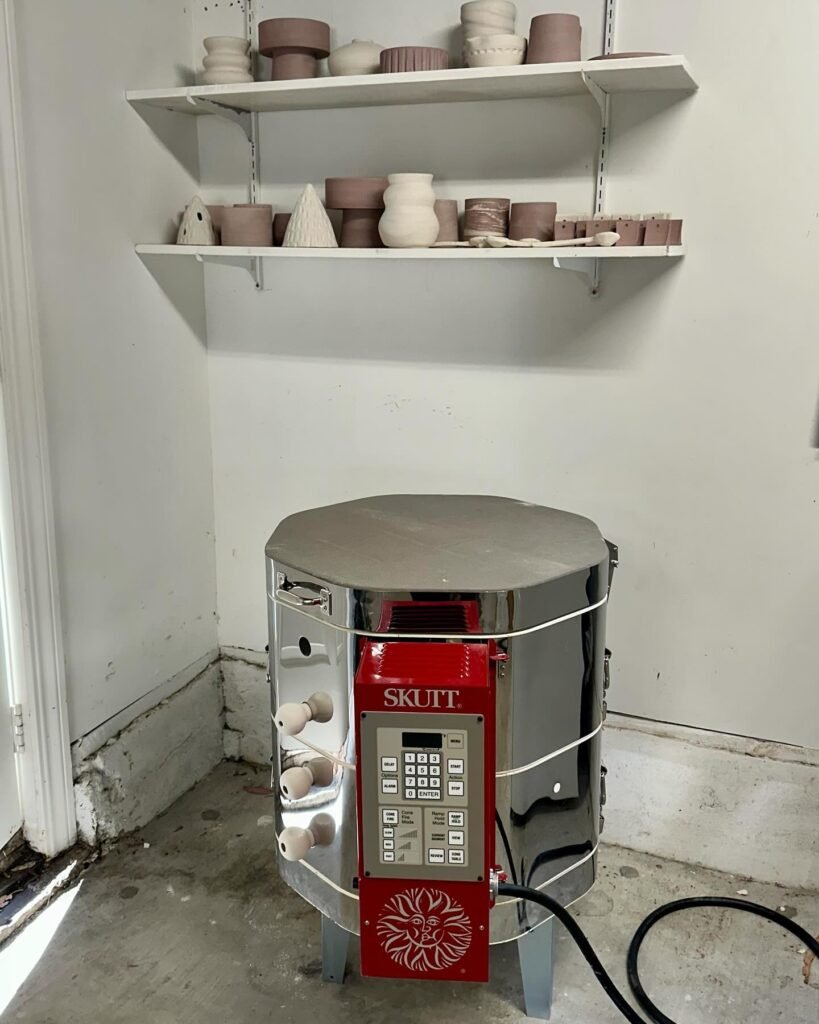
Kiln lid hardware is the collection of mechanical components that support, secure, lift, align or operate a kiln lid.
Depending on the kiln design, this can include:
- Lid bands
- Hinges
- Handles
- Lid lifters
- Latches
- Springs
- Brackets
- Fasteners
- Support hardware
- Lid safety mechanisms
- Hardware connecting the lid to the kiln body
Not every kiln uses all of these components.
A small top-loading kiln may have a simple handle and metal band.
A large production kiln may have a heavy-duty lid lifter or spring-assisted mechanism.
A front-loading kiln uses a door system rather than a traditional top lid.
The hardware therefore needs to be evaluated according to the kiln’s actual design.
Why Kiln Lid Hardware Matters
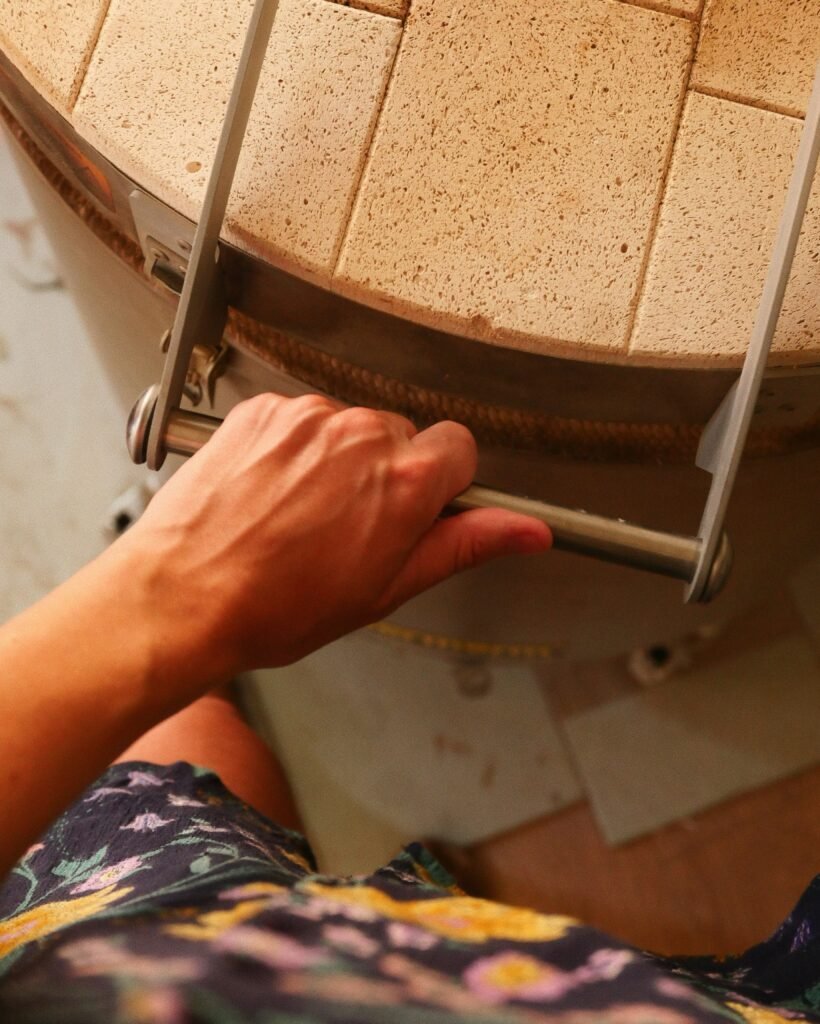
The lid has several important jobs.
It helps contain heat.
It protects the firing chamber.
It contributes to the kiln’s insulation system.
It may contain peepholes or venting features.
It may interact with a safety switch.
And it needs to open and close predictably.
If the hardware is loose or damaged, the lid may not sit correctly.
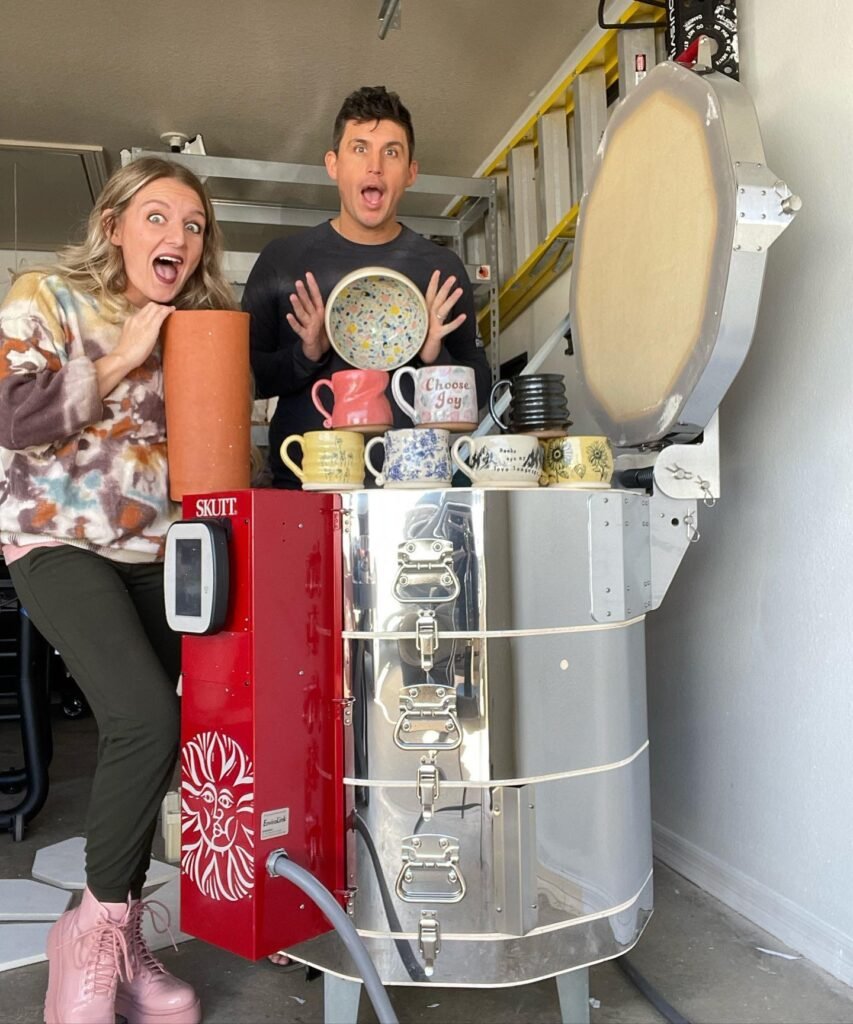
That can create problems with:
- Heat retention
- Lid alignment
- Safe operation
- Mechanical stability
- Insulation
- Firing consistency
- User safety
This does not mean every loose bolt is a major kiln failure.
But it does mean lid hardware should not be ignored.
The Main Types of Kiln Lid Hardware
The exact arrangement varies by manufacturer.
The most common components are:
Lid Band
A metal band can reinforce the perimeter of the lid and help maintain its shape.
Hinges
Hinges allow the lid to pivot open and closed.
Handle
The handle provides a safe gripping point for opening and closing the lid.
Lid Lifter
A lid lifter assists with heavy lids, reducing the effort required to open them.
Latch or Locking Hardware
Some kiln designs use hardware to secure the lid or door in a particular position.
Safety Hardware
Certain kilns incorporate an interlock or shut-off system that prevents the heating elements from operating when the lid is open.
The function of that system is different from ordinary mechanical hardware, but it can be physically associated with the lid assembly.
Kiln Lid Bands
The lid band is one of the most important pieces of kiln lid hardware on many top-loading kilns.
It provides mechanical reinforcement around the lid.
The refractory lid itself is not a steel component.
It can be relatively fragile compared with the surrounding metal shell.
The band helps support the lid structure.
Over time, however, the band can loosen.
The hardware securing it can also loosen or become damaged.
Skutt’s KilnMaster documentation specifically instructs owners to tighten the lid band and lid hardware regularly. (skutt.com)
That is an important maintenance point.
A lid band is not something you should adjust randomly every time you notice movement.
It should be maintained according to the manufacturer’s instructions for the particular kiln.
Why Does a Kiln Lid Band Need Adjustment?
Kilns experience repeated thermal cycling.
During firing, the kiln body and lid heat up and expand.
During cooling, they contract.
Over many cycles, mechanical fasteners can change tension.
The band can therefore require periodic inspection.
A loose band can allow unwanted movement.
An excessively tight or improperly adjusted band can also create problems.
The goal is not simply:
“Make the band as tight as possible.”
The goal is:
“Maintain the lid assembly according to the manufacturer’s specified adjustment.”
This distinction matters because refractory materials can be damaged by excessive mechanical pressure.
How to Tell If a Kiln Lid Band Needs Attention
Look for:
- Visible looseness
- Hardware that has backed out
- A lid that has become difficult to align
- Unusual movement
- Changes in the way the lid sits
- Damage around attachment points
- Bent hardware
- Cracked refractory material near the hardware
- A lid that no longer closes as it previously did
Do not immediately assume the band itself is the problem.
The lid may be damaged.
The hinge may be misaligned.
The kiln body may have shifted.
Or another component may have loosened.
Inspect the complete assembly.
Kiln Lid Hinges
Hinges allow the lid to rotate.
They sound simple.
But they carry significant mechanical loads, especially on large kilns.
A heavy lid creates substantial leverage around the hinge points.
This is why large kiln designs may incorporate additional lifting assistance.
When inspecting a hinge, look for:
- Bent metal
- Excessive side-to-side movement
- Loose fasteners
- Cracks around mounting points
- Corrosion
- Misalignment
- Difficulty opening or closing
A hinge that is becoming progressively harder to operate deserves attention.
Do not force it.
The refractory lid can be damaged if the mechanical system is forcing it into an unnatural position.
Can a Kiln Lid Hinge Be Replaced?
Often, yes, but the replacement needs to match the kiln design.
Do not assume that a generic hardware-store hinge is an acceptable substitute.
A kiln hinge needs to withstand:
- Repeated movement
- Heat exposure
- Lid weight
- Thermal cycling
- The specific geometry of the kiln
The mounting points also need to align correctly.
If a manufacturer provides replacement hardware for the kiln model, that is generally the appropriate starting point.
For older or discontinued kilns, identify the exact model before searching for replacement parts.
Kiln Lid Handles
The handle is one of the most frequently used components of the lid assembly.
Every firing cycle may involve:
- Opening the lid
- Closing the lid
- Loading
- Unloading
- Checking the kiln
- Inspecting ware
That repeated use makes the handle worth inspecting.
Look for:
- Loose mounting bolts
- Cracks
- Heat damage
- Missing hardware
- Excessive movement
- Damaged insulation around mounting points
A handle that is loose should not simply be ignored.
The handle is how you control a hot, heavy component.
Why Handle Position Matters
The handle needs to give you adequate leverage without placing unnecessary stress on the lid.
If the handle is bent or damaged, do not improvise by attaching another piece of metal wherever it seems convenient.
The lid is a thermal and structural component.
Its hardware should remain compatible with the manufacturer’s design.
If you need a replacement, identify the kiln model and obtain the correct component or an approved equivalent.
Kiln Lid Lifters
Large kiln lids can be difficult to lift.
This is where a lid lifter becomes valuable.
Skutt explains that some of its kiln lids can weigh as much as 120 pounds and developed its lid lifter to make opening heavy lids easier. The company also notes that the lifter can help extend lid life by changing the way the lid is lifted. (skutt.com)
This illustrates an important point:
A lid lifter is not merely a convenience accessory.
It can change the mechanical load placed on the lid.
That can matter in a production studio where the kiln is opened frequently.
When Should You Consider a Lid Lifter?
A lid lifter becomes particularly attractive when:
- The kiln lid is heavy
- The kiln is used frequently
- Multiple people operate the kiln
- The operator has difficulty lifting the lid
- The kiln is part of a production studio
- You want easier access to the chamber
Some manufacturers offer lid lifters as standard equipment on certain models and optional equipment on others.
Skutt, for example, lists lid lifters as standard on certain large kiln models and optional on others. (skutt.com)
Do not assume a lid lifter from one model can simply be transferred to another.
The mounting system matters.
Kiln Lid Hardware and Thermal Expansion
Thermal expansion is one reason kiln lids require carefully designed hardware.
The kiln becomes extremely hot.
The refractory material expands.
The metal structure expands differently.
When the kiln cools, those materials contract.
Paragon explains that a gap at the hinge side of certain front-loading kiln doors is intentional because the firebrick expands during heating. (paragonkilns.com)
The broader lesson is important:
Not every gap around kiln hardware is a defect.
Some clearances exist specifically to accommodate thermal expansion.
That is why you should not “fix” a gap simply because it looks unusual.
Check the manufacturer’s documentation first.
Why Does My Kiln Lid Have a Gap?
The answer depends on where the gap is and what kiln you have.
A gap can be:
- Intentional
- Caused by thermal expansion requirements
- Related to the hinge design
- A sign of misalignment
- Caused by damaged refractory material
- Caused by a loose or damaged hardware component
Paragon specifically states that a gap on the hinge side of certain front-loading kilns is normal and necessary for expansion. It also states that there should not be a gap at the latch side of that particular design. (paragonkilns.com)
So the correct approach is not to eliminate every visible gap.
Identify the kiln.
Identify the location.
Check the manufacturer’s instructions.
Then decide whether the gap is normal.
Kiln Lid Hardware and the Lid Seal
Some kiln designs use a relatively tight refractory-to-refractory fit.
Others use additional gasket or rope-style sealing systems.
The exact design varies.
Paragon, for example, uses ceramic rope gasket systems on some kiln designs to create a soft seal around the lid. (paragonkilns.com)
A seal can help manage heat loss and provide a compliant interface between components.
But not every pottery kiln uses a gasket.
Do not install a generic gasket around a kiln lid without confirming that the kiln was designed for one.
The refractory geometry and expansion behavior are part of the kiln’s design.
Kiln Lid Hardware and Heat Retention
Hardware itself is not the primary source of kiln insulation.
But hardware affects whether the lid remains properly positioned.
A misaligned lid can create unwanted openings.
A damaged hinge can prevent proper closure.
A loose band can affect the lid’s structural integrity.
A damaged refractory lid can also compromise the thermal enclosure.
This is why kiln lid hardware and insulation should be considered together.
If your kiln seems to be losing heat unusually quickly, do not automatically blame the elements.
Inspect the entire thermal enclosure.
Our Pottery Kiln Insulation guide explains how firebrick, ceramic fiber, lid construction and other factors affect heat retention.
Kiln Lid Hardware and Firing Performance
A small mechanical issue does not automatically cause poor firing.
But significant lid problems can affect the thermal environment.
For example:
- A lid that does not close correctly
- A damaged lid
- An improperly positioned lid
- A missing section of refractory material
- A major gap not intended by the manufacturer
can allow additional heat to escape.
That can affect firing time and temperature behavior.
If the kiln is suddenly taking much longer to fire, inspect the entire system rather than assuming the controller or elements are automatically at fault.
Kiln Lid Safety Hardware
Some kilns use a lid safety interlock.
The purpose is to prevent the heating elements from operating when the lid is open.
This is different from a normal hinge or band.
It is a safety system.
Skutt’s documentation describes a lid interlock system that disconnects power to the heating elements when the lid is opened. (skutt.com)
Never bypass or defeat such a system simply because it is inconvenient.
If the interlock is malfunctioning, diagnose the underlying problem.
Our Kiln Lid Safety Switch guide covers the system in more detail.
Kiln Lid Hardware Maintenance
Routine inspection is simple.
You do not need to disassemble the kiln after every firing.
Instead, periodically inspect:
Band
Check for looseness, damage and abnormal movement.
Hinges
Check for excessive play and alignment problems.
Handle
Check for loose or damaged mounting hardware.
Lifter
Check the mechanism for smooth operation and damage.
Fasteners
Check for components that have loosened.
Refractory Around Hardware
Look for cracks, missing material or unusual damage.
Safety Interlock
Confirm that it operates as intended.
The exact maintenance schedule should follow the manufacturer.
How Often Should Kiln Lid Hardware Be Checked?
There is no universal interval for every kiln.
A lightly used hobby kiln may require less frequent mechanical inspection than a production kiln opened several times every week.
A practical approach is to inspect the hardware periodically and whenever you notice a change in how the lid operates.
Check it especially after:
- Moving the kiln
- Transporting a used kiln
- Repairing the lid
- Replacing refractory material
- Installing a lid lifter
- Noticing unusual movement
- Hearing new mechanical sounds
A change in behavior is often more important than an arbitrary calendar interval.
Should You Lubricate Kiln Lid Hinges?
Do not automatically apply household lubricant.
The hinge may operate in a high-temperature environment, and the manufacturer may specify a particular maintenance procedure or no lubrication at all.
Some lubricants can attract dust or behave poorly when exposed to heat.
Check the manufacturer’s service instructions for your specific kiln.
If the hinge is binding, determine why rather than masking the problem with lubricant.
Tightening Kiln Lid Hardware
This is another area where more force is not necessarily better.
Refractory materials can crack under excessive mechanical pressure.
Metal hardware also needs appropriate tension.
Skutt instructs owners to tighten the lid band and hardware regularly, but the maintenance needs to be performed appropriately for the specific kiln. (skutt.com)
If you do not have the manufacturer’s instructions for an older kiln, identify the model before making significant adjustments.
What If the Kiln Lid Is Difficult to Open?
Several things could cause this.
Possible causes include:
- Misalignment
- Hinge problems
- Lid hardware damage
- Refractory expansion
- A damaged lid
- A failing lifter
- Warped components
- Foreign material interfering with the mechanism
Do not force the lid.
If the kiln is hot, the risk is even greater.
Allow it to cool appropriately according to the manufacturer’s instructions before investigating mechanical problems.
Our Kiln Cooldown guide explains why forcing a hot kiln open can be a bad idea.
What If the Kiln Lid Is Hard to Close?
First inspect the obvious.
Check whether:
- Pottery is too tall
- Posts are too high
- A shelf is incorrectly positioned
- The lid hardware has shifted
- The hinge is damaged
- Refractory material is interfering
- The lid has changed shape
- The kiln body is damaged
Never force the lid down onto pottery.
That can break ware and damage the lid.
Skutt’s loading guidance recommends maintaining clearance between ware and the lid. (skutt.com)
If the lid suddenly becomes difficult to close when the same loading arrangement previously worked, investigate the hardware and refractory components.
Kiln Lid Hardware on Used Kilns
Used kilns deserve extra attention.
A kiln may look fine from a few feet away while having worn hardware.
Before buying, inspect:
- Lid band
- Hinges
- Handle
- Lifter
- Fasteners
- Lid alignment
- Lid refractory condition
- Safety hardware
- Evidence of previous repairs
Open and close the lid if the kiln is cold and safe to operate.
Do not simply accept:
“It works fine.”
Operate the mechanism yourself.
Listen.
Feel for binding.
Check whether the lid moves smoothly.
Look at the mounting points.
If the lid requires unusual force, find out why before purchasing.
Our used pottery kiln inspection guide covers the broader inspection process.
What About Refurbished Kiln Lid Hardware?
If a kiln has been refurbished, ask what was done to the lid.
A refurbishment may include:
- New hardware
- Tightened hardware
- Repaired refractory
- New handle
- Adjusted band
- Serviced lifter
- Replacement hinges
But “refurbished” does not tell you what was actually done.
Ask for a component-level description.
This is especially important if you are paying a premium for refurbished equipment.
A seller who can explain what was inspected and replaced gives you much more useful information than a generic refurbishment label.
Can a Cracked Kiln Lid Be Repaired?
Sometimes.
Small cracks can be normal.
Skutt explains that hairline expansion cracks can form in its kiln lid refractory coating after the first few firings and describes these as normal. For larger cracks, it recommends a thin coating of refractory cement rather than large patch jobs. (skutt.com)
This illustrates why lid inspection requires context.
Not every crack means the lid needs replacement.
The size, location, depth and progression matter.
Our Kiln Lid Repair guide goes deeper into the refractory side of the problem.
When Should Kiln Lid Hardware Be Replaced?
Replacement makes sense when a component is:
- Cracked
- Bent
- Severely corroded
- Structurally damaged
- No longer holding alignment
- Excessively loose
- Difficult to operate
- Missing
- No longer supported by the manufacturer
Do not wait for complete failure if the component is supporting a heavy lid.
Preventive replacement can be much easier than dealing with a lid that falls or becomes misaligned.
Can You Use Generic Hardware?
Be cautious.
Some simple fasteners may have standard dimensions.
But the overall lid assembly is model-specific.
A generic hinge, bracket or lifter may not have the correct:
- Heat tolerance
- Strength
- Geometry
- Mounting points
- Clearance
- Operating range
The safest approach is to use manufacturer-specified replacement parts where available.
For discontinued kilns, identify the original component and determine whether the manufacturer or an experienced kiln service provider has an approved replacement.
Kiln Lid Hardware and Shipping
If you are buying a kiln online, think about the lid hardware before delivery.
Large kiln lids can be heavy.
Shipping and handling can damage:
- Handles
- Hinges
- Bands
- Lifter mechanisms
- Refractory edges
When a kiln arrives, inspect the lid before firing it.
Look for:
- New cracks
- Bent hardware
- Loose fasteners
- Damaged handles
- Misalignment
- Shipping impacts
Photograph any shipping damage before using the kiln and contact the seller or carrier according to the purchase terms.
Kiln Lid Hardware and Warranty
Warranty coverage depends on the manufacturer and component.
Do not assume every mechanical component has identical coverage.
Some failures may be manufacturing defects.
Others may be normal wear.
Others may result from abuse, improper installation or shipping damage.
Our Pottery Kiln Warranty guide explains how to evaluate parts, labor, exclusions and service coverage.
Keep the kiln’s model number, serial number and purchase documentation.
Those details make warranty and parts requests much easier.
A Kiln Lid Hardware Inspection Checklist
Before buying a kiln or returning an existing kiln to service, check:
Lid
☐ Opens smoothly
☐ Closes properly
☐ Sits correctly
☐ No major refractory damage
Band
☐ Secure
☐ No major corrosion
☐ No obvious deformation
☐ Hardware intact
Hinges
☐ Move smoothly
☐ No excessive play
☐ No bent components
☐ Mounting points intact
Handle
☐ Secure
☐ No cracks
☐ No excessive movement
Lifter
☐ Operates smoothly
☐ Supports the lid properly
☐ No damaged springs or mechanisms
Safety
☐ Lid interlock functions correctly if equipped
☐ No bypassed safety mechanism
Overall
☐ No unusual binding
☐ No unexplained gaps
☐ No hardware contacting hot components improperly
☐ Manufacturer documentation available
Common Kiln Lid Hardware Mistakes
Mistake 1: Tightening Everything as Much as Possible
Excessive force can damage refractory components.
Mistake 2: Assuming Every Gap Is a Problem
Some gaps are intentional and accommodate thermal expansion.
Mistake 3: Ignoring a Loose Lid Band
Small mechanical issues can become larger problems.
Mistake 4: Forcing a Stuck Lid
Find the cause.
Do not overpower the mechanism.
Mistake 5: Using Random Replacement Hardware
The component needs to match the kiln design.
Mistake 6: Ignoring the Lifter
A damaged lifter can make a heavy lid difficult and potentially unsafe to operate.
Mistake 7: Bypassing a Lid Safety Switch
Never defeat a safety interlock to keep the kiln running.
Mistake 8: Inspecting Only the Refractory
The mechanical hardware deserves inspection too.
Mistake 9: Ignoring Hardware When Buying Used
A functioning controller does not mean the lid assembly is in good condition.
Kiln Lid Hardware FAQ
What hardware holds a pottery kiln lid together?
Depending on the kiln, the assembly may include a metal lid band, hinges, brackets, fasteners, handles and sometimes a lid lifter or other support mechanism.
What does a kiln lid band do?
A lid band provides mechanical reinforcement around the lid and helps maintain the lid assembly’s structure. Some manufacturers require periodic inspection and adjustment.
How often should kiln lid hardware be checked?
Inspect it periodically and whenever the lid’s operation changes. Production kilns that are opened frequently may warrant more frequent inspections than lightly used kilns.
Why is my kiln lid difficult to close?
Possible causes include an incorrectly loaded kiln, damaged refractory material, misaligned hinges, loose hardware, a warped lid or another mechanical problem. Do not force the lid.
Why does my kiln lid have a gap?
Some gaps can be intentional and allow refractory materials to expand during firing. The location and kiln model matter. Check the manufacturer’s documentation before attempting to close or alter a gap.
Can a kiln lid hinge be replaced?
Often, yes. The replacement needs to be appropriate for the exact kiln design, including its weight, mounting geometry and operating environment.
What is a kiln lid lifter?
A lid lifter is a mechanical assistance system that makes opening a heavy kiln lid easier. Some large kilns include them as standard equipment while others offer them as options.
Can I install a lid lifter on any kiln?
No. Lid lifters are designed around particular kiln models and lid assemblies. Confirm compatibility before installation.
Can I use generic hardware to repair a kiln lid?
Do not assume that generic hinges, brackets or lifters are appropriate. Manufacturer-specified replacement parts are preferable when available.
Does kiln lid hardware affect firing?
Indirectly, it can. Hardware helps keep the lid correctly positioned and mechanically supported. A damaged or misaligned lid can affect the thermal enclosure.
Can a cracked kiln lid still be used?
Small hairline cracks can be normal on some kiln designs. Larger or worsening cracks require evaluation. The type and location of the crack matter.
Final Verdict
Kiln lid hardware may not be the first thing you think about when buying or maintaining a pottery kiln.
It should be.
The lid is exposed to repeated heating and cooling, and the mechanical hardware has to support that process without damaging the refractory components.
The important components include the lid band, hinges, handle, lifter, fasteners and, on some models, safety interlock hardware.
Inspect them periodically.
Keep the manufacturer’s adjustment instructions.
Do not overtighten hardware.
Do not force a stuck lid.
Do not assume every visible gap is a defect.
Do not bypass safety mechanisms.
And do not install generic replacement parts without confirming compatibility.
For a new kiln, good lid hardware is part of the overall construction quality.
For a used kiln, it is something you should physically inspect before buying.
For a kiln already in your studio, changes in lid movement are worth investigating before they become a larger mechanical or refractory problem.
The best kiln lid hardware is ultimately hardware that does its job without demanding attention every firing.
The lid should open predictably.
It should close correctly.
The hardware should remain secure.
The refractory should remain protected.
And any safety mechanism should work as designed.
That is what you want from a kiln lid: not complicated maintenance, but reliable mechanical support through hundreds of heating and cooling cycles.
