A damaged kiln floor does not automatically mean your pottery kiln is finished.
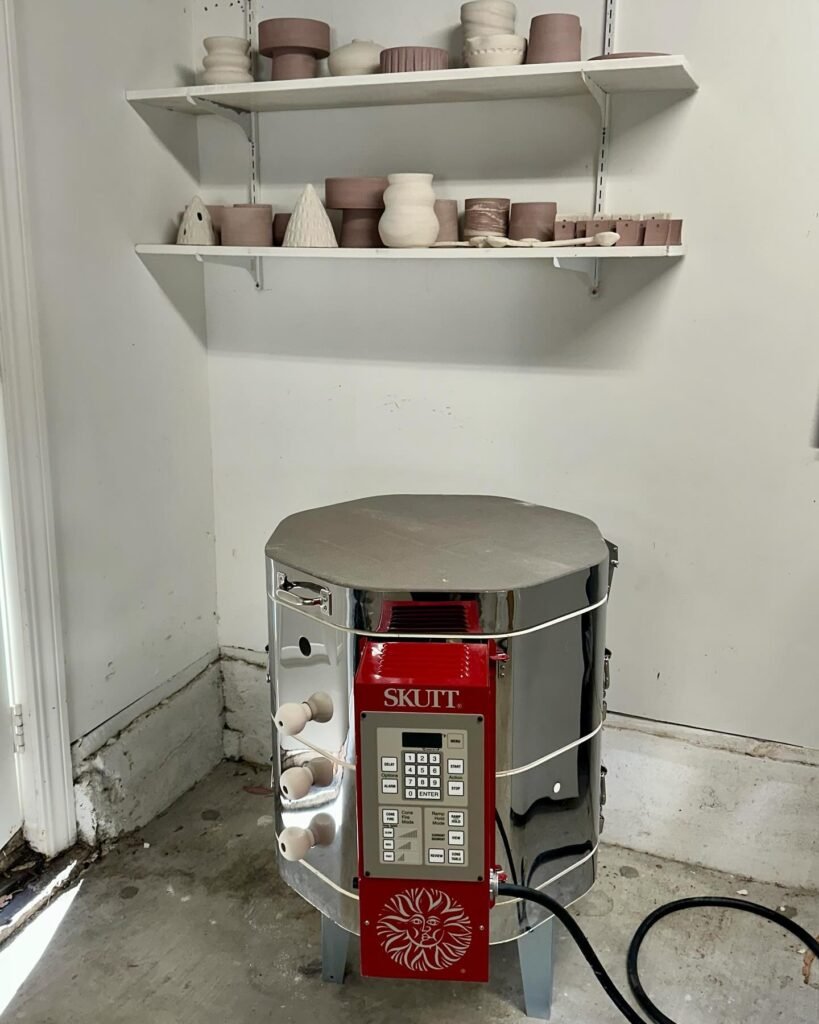
Small chips, holes, cracks, and glaze damage can sometimes be repaired without replacing the entire floor. In other cases, the damage is significant enough that replacing the floor is the safer and more practical option.
The important part is knowing the difference.
Kiln floor repair is usually about restoring a damaged refractory surface so it can continue supporting the kiln load and withstand repeated firing. It is not about making the floor look perfect.
Skutt’s repair documentation specifically provides instructions for patching damaged kiln floors. Its older KilnMaster documentation states that holes several square inches in area and up to about 5/8 inch deep can be patched using kiln patch after properly preparing the damaged area.
That gives potters a useful reference point, but it should not be treated as a universal repair limit for every kiln.
Different kiln designs use different floor materials, thicknesses, reinforcement, and construction.
Before repairing anything, identify the exact kiln model and consult its manufacturer.
What Is a Kiln Floor?
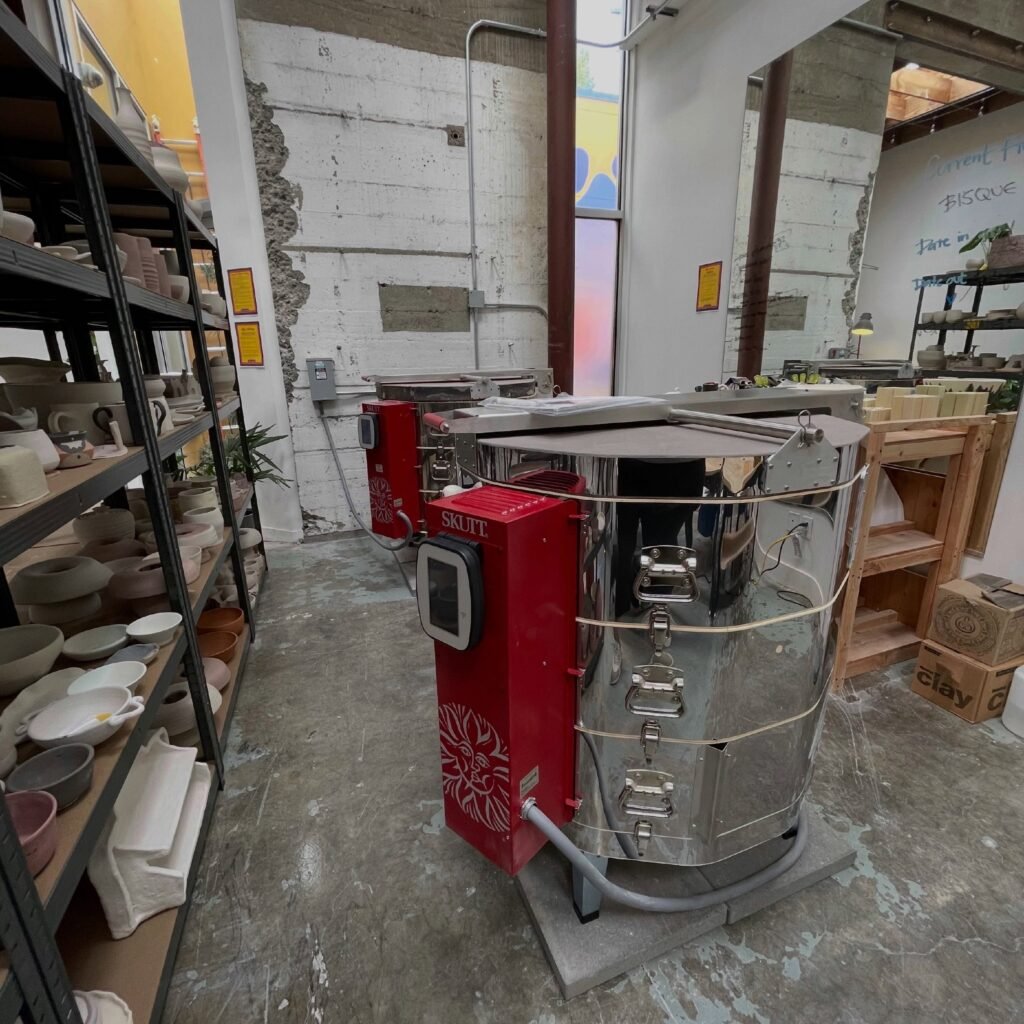
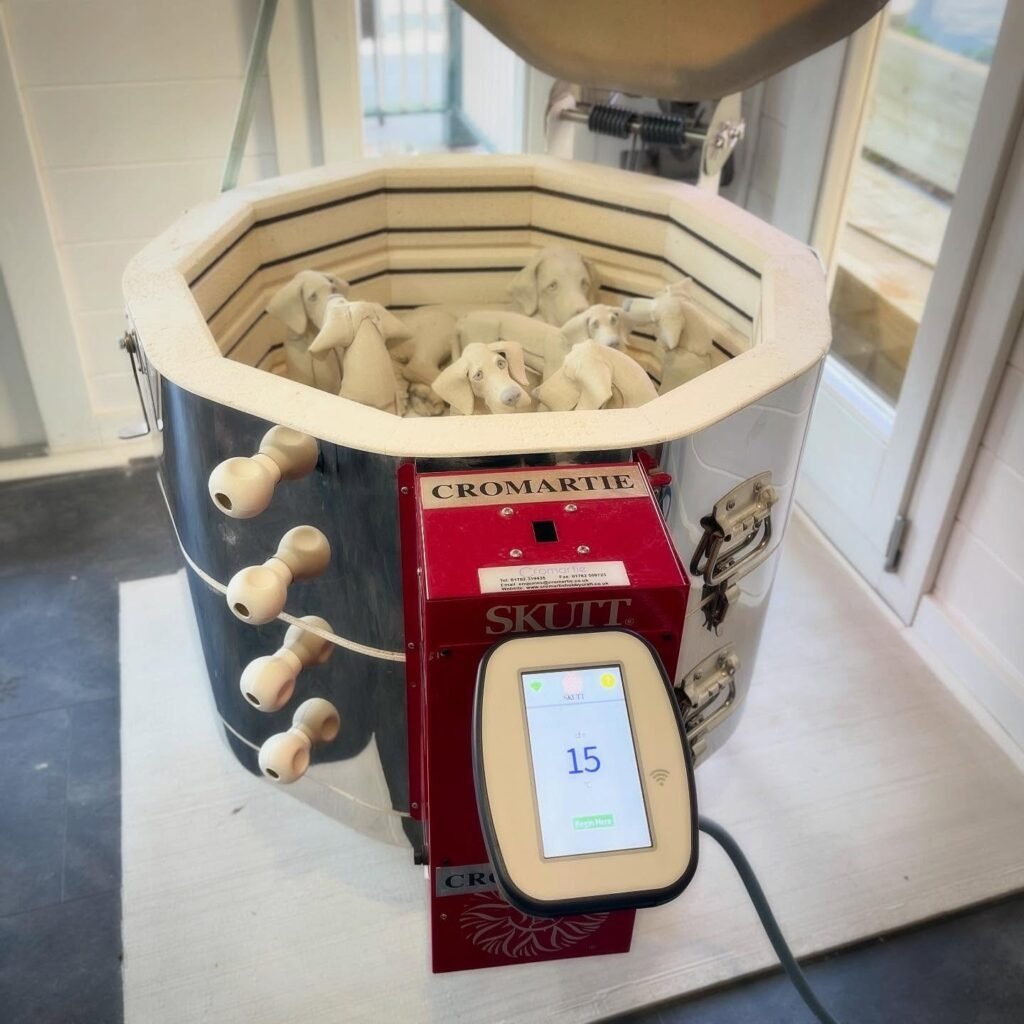
The kiln floor is the refractory slab or base supporting the firing chamber.
In a typical top-loading electric kiln, the floor supports the lower section of the kiln body and ultimately carries the weight of the shelves, posts, kiln furniture, and pottery loaded above it.
The floor also forms part of the thermal envelope.
It must withstand repeated heating and cooling without losing enough structural integrity to compromise the kiln.
Depending on the kiln, the floor may be constructed from insulating firebrick or another refractory material.
Some designs use a separate slab with a metal band or supporting structure around it.
This is why you should not assume that every kiln floor can be repaired in exactly the same way.
Why Kiln Floors Get Damaged
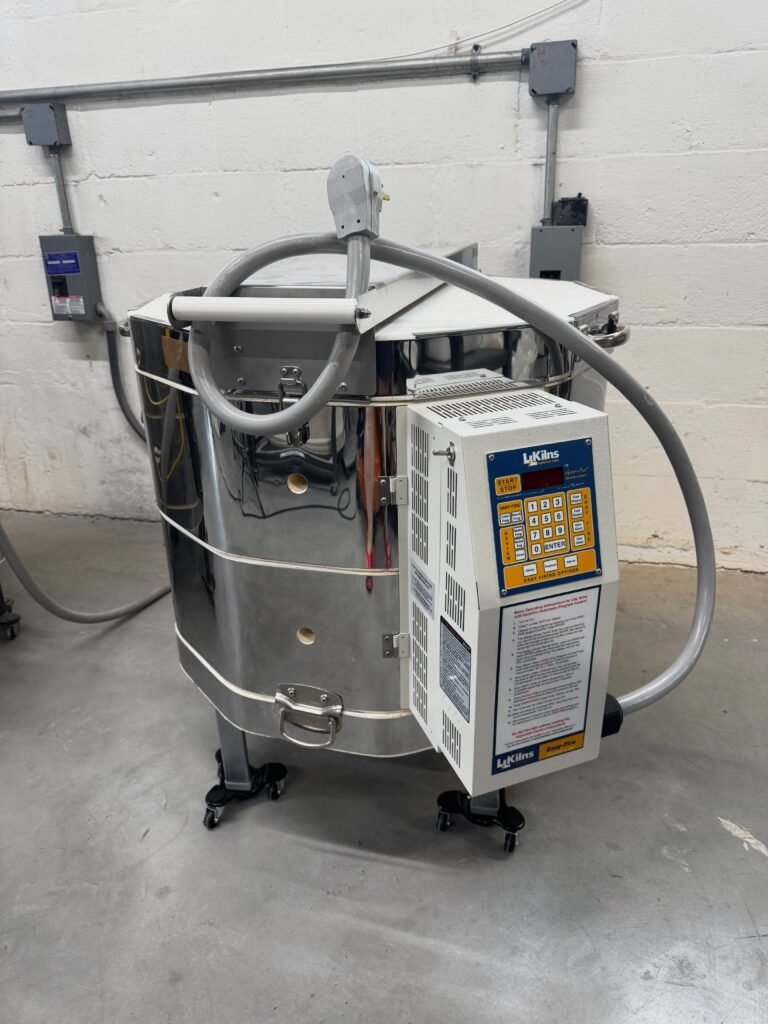
Kiln floors take a surprising amount of abuse.
Some damage happens during loading.
Some happens when pottery breaks.
Some happens when glaze drips.
Other damage accumulates gradually from years of firing.
Common causes include:
- Dropped kiln shelves
- Dropped posts
- Heavy pottery falling during loading
- Sharp tools striking the floor
- Glaze drips
- Glass or glaze melting onto the surface
- Scraping fused material from the floor
- Repeated thermal cycling
- Improper kiln furniture
- Moving the kiln
- General age and wear
Not every mark is a structural problem.
A small surface chip is very different from a deep hole extending through a significant portion of the floor.
Can a Kiln Floor Be Repaired?
Yes, in many cases.
The appropriate repair depends on the depth, size, location, and nature of the damage.
Skutt’s repair instructions specifically describe patching damaged areas of the kiln floor with kiln patch.
For older Skutt models, the manufacturer describes repairing holes up to approximately 5/8 inch deep by undercutting the damaged area, filling it with kiln patch, and sanding it smooth after drying.
That is useful manufacturer guidance for applicable Skutt kilns.
It does not mean every kiln floor with a 5/8-inch hole should automatically be patched.
A manufacturer may specify a different repair method for another model.
Kiln Floor Repair vs. Kiln Brick Repair
These two repairs sound similar, but they are not identical.
The kiln walls are often made from insulating firebrick with element grooves.
The floor is a separate structural component.
That difference matters because damage to a wall can affect heating elements, element grooves, insulation, or the kiln structure.
Floor damage primarily affects the base of the firing chamber.
The Kiln Depot’s kiln brick repair guide covers wall and brick damage separately.
When inspecting a kiln, evaluate the walls and floor independently.
What Does a Minor Kiln Floor Problem Look Like?
Minor damage can include:
- Small chips
- Shallow gouges
- Small holes
- Surface scratches
- Minor cracks
- Glaze residue that has not deeply penetrated the floor
These problems do not automatically make a kiln unsafe.
Insulating firebrick is relatively soft compared with ordinary masonry.
It can be damaged by normal studio accidents.
The important question is whether the damage compromises the kiln’s function or structure.
A cosmetic imperfection is not the same thing as a structural failure.
What Does Serious Kiln Floor Damage Look Like?
More serious damage can include:
- Deep holes
- Large sections broken away
- Loose pieces of floor
- Cracks extending through substantial portions of the slab
- Severe erosion
- A floor that is no longer level
- Damage extending through the slab
- Structural damage around the supporting frame
- Damage that causes the kiln body to sit unevenly
If the floor can no longer adequately support the kiln structure or kiln furniture, patching may not be enough.
At that point, replacement should be considered.
Glaze Drips and Kiln Floor Damage
Glaze is one of the most common sources of floor problems.
A glaze drip can melt and adhere to the kiln floor during firing.
Once cooled, it can become extremely difficult to remove.
The temptation is to attack it aggressively with a hammer, chisel, scraper, or other tool.
That can create a bigger problem.
You may remove the glaze and take a chunk of the kiln floor with it.
Skutt’s repair guidance specifically notes that glaze drips on a properly kiln-washed floor can often be removed without damaging the underlying surface.
This is one reason kiln wash matters.
The Kiln Depot’s kiln wash guide explains how kiln wash protects kiln shelves and other surfaces from glaze contamination.
Should You Scrape Glaze Off the Kiln Floor?
Be careful.
The goal is to remove the glaze without gouging the refractory surface underneath.
If a glaze drip is firmly attached, aggressive mechanical force can damage the floor.
Do not attack a fused drip simply because you want the floor to look smooth.
A small amount of cosmetic discoloration is generally less important than creating a large crater.
If the glaze has already damaged the refractory material, evaluate the resulting hole rather than continuing to remove material unnecessarily.
Can Kiln Wash Repair a Kiln Floor?
No.
Kiln wash is primarily a protective coating.
It is not the same thing as a structural kiln patch.
A kiln wash coating can help prevent glaze from bonding directly to a kiln shelf or other protected surface.
It should not be treated as a substitute for repairing a deep hole or structural damage in a kiln floor.
For actual kiln floor repair, use the material and procedure specified by the kiln manufacturer.
Do not make a thick layer of kiln wash and assume you have rebuilt the missing refractory material.
What Is Kiln Patch?
Kiln patch is a refractory repair material designed for repairing certain damaged areas of kiln insulation or refractory surfaces.
Skutt’s repair documentation specifically recommends kiln patch for applicable floor repairs.
The exact product and suitability depend on the kiln.
Do not substitute ordinary household filler, drywall compound, cement, plaster, or other materials simply because they are inexpensive.
A kiln floor operates at temperatures far beyond the range of ordinary building materials.
The repair material needs to be appropriate for the firing environment.
How to Repair a Small Kiln Floor Hole
For a kiln where the manufacturer permits this type of repair, the general process is straightforward.
1. Let the kiln cool completely
Never attempt refractory repair on a hot kiln.
2. Disconnect power
Follow the manufacturer’s safety procedure.
Skutt’s repair documentation emphasizes disconnecting the kiln from power before repair work.
3. Clean the damaged area
Remove loose material and debris.
The goal is to expose sound refractory material around the damaged section.
4. Undercut the edges if instructed
Skutt’s documented procedure calls for undercutting the damaged area so the patch has a better mechanical hold.
This creates an area where the patch can lock into the existing floor.
5. Apply the appropriate kiln patch
Fill the damaged area according to the product and kiln manufacturer’s instructions.
Do not simply pile material over loose or contaminated brick.
6. Level the repair
The repaired surface should be brought back to the appropriate level.
Skutt’s instructions call for sanding the patch smooth after it has dried.
7. Allow it to dry completely
Do not rush this stage.
Residual moisture in a refractory repair can create problems during the next firing.
8. Inspect before firing
Make sure the patch is firm, dry, and properly bonded.
9. Follow the manufacturer’s return-to-service instructions
If a manufacturer specifies a particular first firing after repair, follow it.
Why You Should Undercut a Damaged Area
Simply filling a hole from the top can create a weak repair.
The patch needs a suitable surface to bond to.
Undercutting creates a wider area beneath the surface, giving the repair material a mechanical shape that helps retain it.
This is why following the manufacturer’s repair geometry matters.
Do not improvise the shape simply to save a few minutes.
Can You Repair a Cracked Kiln Floor?
Sometimes.
A crack is not automatically equivalent to a hole.
First determine whether the crack is:
- Hairline
- Shallow
- Stable
- Widening
- Extending through the slab
- Associated with movement
- Accompanied by missing material
Small cracks can occur in refractory materials as they undergo repeated thermal cycling.
The key question is whether the crack affects the floor’s structural function.
If the floor is stable and the crack is minor, the manufacturer may consider it acceptable.
If the floor is separating, shifting, or losing substantial material, replacement may be more appropriate.
Is a Cracked Kiln Floor Safe?
There is no universal yes or no.
A small stable crack is very different from a floor that has broken into multiple pieces.
Skutt’s general kiln repair guidance notes that small cracks and chips in kiln brick do not necessarily affect kiln performance.
But the floor deserves its own inspection because it supports the kiln.
If you can see substantial movement, missing material, or structural separation, do not treat the damage as cosmetic.
When uncertain, send photographs and the kiln model information to the manufacturer or an experienced kiln technician.
When Should You Replace the Kiln Floor?
Replacement becomes more attractive when the floor has extensive structural damage.
Examples include:
- Large sections missing
- Deep damage beyond the manufacturer’s repair guidance
- Cracks that compromise structural stability
- A badly uneven or distorted floor
- Damage extending through the slab
- Repeated failure of previous patches
- A supporting structure that has been compromised
The manufacturer’s replacement recommendation should take priority.
Skutt replacement floors, for example, are available by specific kiln configuration rather than as one universal slab.
That illustrates an important point:
A replacement kiln floor needs to match the kiln.
Can You Flip a Kiln Floor Over?
For some kiln designs, yes.
Skutt’s older KilnMaster documentation states that certain kiln floors can effectively have a second life by being turned over after the original firing surface becomes unsuitable.
That can save money when the floor design permits it.
But do not assume that every kiln floor can be flipped.
The underside may have different hardware, reinforcement, insulation, or mounting features.
Before flipping a floor, verify that the manufacturer allows it for your exact kiln.
Why Floor Replacement Is Model-Specific
A kiln floor is not simply a round piece of firebrick.
Its dimensions and construction may depend on:
- Kiln diameter
- Number of sides
- Brick thickness
- Element configuration
- Stand design
- Metal band
- Hardware
- Control-box arrangement
- Manufacturer
- Model
Replacement suppliers list floors by kiln model or specific dimensions for this reason.
Measure before ordering.
Better yet, identify the exact model and serial information and match the replacement to the manufacturer’s parts information.
Kiln Floor Repair on a Used Kiln
The floor is an important inspection point when buying a used kiln.
A seller may photograph the walls and controller while overlooking the bottom.
Ask for photographs of the floor.
Look for:
- Glaze damage
- Deep holes
- Large chips
- Cracks
- Uneven surfaces
- Previous patches
- Evidence of scraping
- Burn marks
- Missing refractory material
A repaired floor is not automatically a reason to reject a used kiln.
In fact, a documented professional repair may be preferable to an apparently untouched kiln with serious hidden damage.
The question is whether the repair was appropriate and whether the remaining structure is sound.
The Kiln Depot’s used pottery kiln inspection guide covers the floor alongside the elements, controller, firebrick, lid, and electrical system.
What Does a Good Floor Repair Look Like?
A good repair should be:
- Firm
- Fully dried
- Properly bonded
- Relatively level
- Appropriate for the kiln’s operating temperature
- Free from loose debris
- Compatible with the surrounding refractory material
It does not need to be invisible.
The goal is function.
Do not spend hours making a repair cosmetically perfect while ignoring the underlying structure.
Can You Fire Immediately After Kiln Floor Repair?
Not necessarily.
The repair material needs to dry properly.
The exact drying requirements depend on the product and manufacturer.
Putting a freshly patched floor into a high-temperature firing can drive moisture rapidly out of the repair material.
That can damage the patch or surrounding refractory.
Follow the manufacturer’s instructions for drying and the first firing after repair.
If no specific instructions are available, contact the manufacturer rather than guessing.
Should You Sand a Repaired Kiln Floor?
Some manufacturers specifically recommend sanding a dried floor patch smooth.
Skutt’s repair instructions do.
The purpose is to return the repaired surface to a reasonably even condition.
But sanding refractory material creates dust.
Use appropriate respiratory protection and dust-control practices.
Do not aggressively grind away large amounts of firebrick simply to make the floor look perfectly smooth.
The objective is a sound, level repair.
What About a Warped Kiln Floor?
A warped floor deserves more attention than a simple chip.
Determine whether the apparent warping is actually the floor or whether the kiln stand or supporting surface is uneven.
Skutt’s installation documentation emphasizes keeping the kiln floor and stand level and ensuring that the kiln does not teeter.
An uneven support arrangement can place unnecessary stress on the kiln during firing.
Before replacing a floor because it appears uneven, inspect the stand and installation.
The problem may be underneath the kiln rather than inside it.
Kiln Floor and the Stand
The kiln floor and stand work together.
The stand needs to provide stable, even support.
The floor needs to sit correctly on that support.
If the kiln rocks or teeters, do not compensate by placing random objects directly under the kiln floor.
Skutt’s installation guidance specifically describes leveling the stand with firm shims beneath the stand legs rather than placing shims between the stand and kiln.
This distinction matters.
Improper support can transfer stress into the refractory structure.
Kiln Floor and Kiln Furniture
The floor also interacts with the kiln furniture.
The first shelf is usually elevated above the kiln floor using refractory posts.
That means the floor does not normally serve as the direct firing surface for your pottery.
The Kiln Depot’s kiln furniture guide explains how shelves and posts create the internal firing levels.
This is another reason to protect the floor.
You do not want dropped posts, shelves, or pottery damaging it unnecessarily.
Preventing Kiln Floor Damage
Prevention is considerably easier than replacement.
Use kiln wash appropriately
Kiln wash can help prevent glaze from permanently bonding to protected surfaces.
Load shelves carefully
Do not drag heavy shelves across the floor.
Lift them when possible.
Avoid dropping posts
A refractory post dropped onto the floor can chip it.
Keep glaze drips under control
Use appropriate kiln furniture and firing practices.
Clean carefully
Vacuum loose debris rather than scraping aggressively.
Do not use the floor as a work surface
The kiln floor is not a place to trim clay, mix glaze, or store tools.
Inspect regularly
Small damage is easier to deal with than major structural deterioration.
How Often Should You Inspect the Kiln Floor?
There is no universal monthly or yearly requirement.
Inspect it whenever you:
- Clean the kiln
- Load a new firing
- Remove a major glaze drip
- Replace kiln furniture
- Move the kiln
- Buy a used kiln
- Notice unusual firing behavior
- Complete a repair
Skutt’s service training documentation recommends regular cleaning and inspection of kiln components, including the floor and element grooves.
Routine inspection takes very little time.
A serious repair does not.
Cleaning a Kiln Floor
Loose debris should be removed carefully.
Skutt recommends vacuuming the floor and element grooves regularly.
Be careful around the elements and thermocouple.
Do not scrape aggressively.
Do not use household cleaning chemicals.
Do not flood the floor with water.
The objective is to remove loose contamination while preserving the refractory surface.
If the floor has a bonded glaze drip, determine whether it can be safely removed without damaging the refractory material.
What If the Floor Has a Glaze Drip That Will Not Come Off?
Do not keep attacking it indefinitely.
If the glaze is firmly fused, the safest solution may be to leave the remaining material and protect the area appropriately rather than gouging away large amounts of refractory.
If the drip has created a crater, evaluate the crater.
A small hole may be repairable.
A deep or extensive area may require more substantial work.
The Kiln Depot’s kiln wash article covers preventative protection against glaze damage.
Can You Use a Kiln Shelf as a Replacement Floor?
Do not assume so.
A kiln shelf and kiln floor serve different structural purposes.
A shelf is designed to support pottery and kiln furniture inside the firing chamber.
The kiln floor is part of the kiln’s structure.
It may interact with the stand, body sections, bands, control box, and other components.
Unless the manufacturer specifically approves a particular substitute, use the correct replacement floor.
Improvising a structural component is not a good place to save money.
What About a Metal Sheet Under the Kiln Floor?
A metal base or support plate may be part of a kiln’s original design.
That does not mean adding a random sheet of metal is an acceptable repair for damaged refractory.
The kiln’s insulation system, support structure, and floor design need to work together.
If the original base plate is damaged or missing, identify the correct replacement.
Do not turn an improvised support into a permanent repair without understanding the kiln’s construction.
Kiln Floor Repair and Refurbished Kilns
If a refurbished kiln has had floor work performed, ask for documentation.
Find out:
- What was damaged
- How deep the damage was
- What repair material was used
- Whether the floor was patched or replaced
- Whether the kiln was test fired afterward
- Whether the supporting structure was inspected
A refurbished kiln with a properly documented floor repair can still be useful equipment.
A seller who says “the floor was fixed” without explaining what was done gives you much less information.
The Kiln Depot’s refurbished pottery kiln guide covers how to evaluate refurbishment work more broadly.
A Practical Kiln Floor Inspection Checklist
Before firing, look over the floor.
Surface
Is it reasonably intact?
Cracks
Are there hairline cracks or major separations?
Holes
How deep are they?
Glaze
Are there fused glaze drips?
Patches
Are previous repairs solid?
Level
Is the surface reasonably stable?
Structure
Is the floor supporting the kiln properly?
Stand
Is the stand level and stable?
Debris
Is loose refractory material present?
Furniture
Are posts and shelves stable?
This inspection takes minutes.
It can prevent a small problem from becoming a major repair.
When a Kiln Floor Repair Is Not a DIY Job
Not every kiln repair belongs in a home studio.
Stop and get professional guidance if:
- The floor is structurally broken
- The kiln body is shifting
- The supporting frame is damaged
- Electrical components have been damaged
- The floor has severe heat damage
- The kiln has been dropped
- Multiple sections are compromised
- You are unsure whether the repair affects the kiln’s structural integrity
Skutt provides technical support and asks customers to provide the kiln model, voltage, phase, serial number, and details of the problem when requesting assistance.
Having that information available makes troubleshooting considerably easier.
Common Kiln Floor Repair Mistakes
Patching over loose material
A patch cannot reliably repair material that is still moving.
Remove loose material according to the manufacturer’s procedure first.
Using ordinary household filler
It is not designed for kiln temperatures.
Applying kiln wash as structural filler
Kiln wash is a coating, not a replacement for refractory material.
Making the patch too shallow
Follow the manufacturer’s repair method.
Firing before the repair is dry
Residual moisture can damage the repair.
Overworking the floor
Do not turn a small chip into a large crater while trying to achieve a perfect surface.
Ignoring the stand
An uneven stand can create problems that look like floor damage.
Replacing the floor unnecessarily
Not every crack requires replacement.
Evaluate the actual condition.
Frequently Asked Questions About Kiln Floor Repair
Can a kiln floor be repaired?
Yes, some kiln floors can be patched when the damage is within the manufacturer’s repair guidelines.
Skutt, for example, provides specific instructions for repairing certain damaged floor areas with kiln patch.
How deep can a kiln floor hole be patched?
Skutt’s older KilnMaster documentation gives approximately 5/8 inch as a repair depth for certain floor damage.
Do not treat that measurement as a universal limit for every kiln.
Check the instructions for your model.
Can I repair a cracked kiln floor with kiln wash?
No.
Kiln wash is primarily a protective coating.
It is not a structural repair material.
Can I use ordinary cement to repair a kiln floor?
Do not assume ordinary cement is suitable.
Use a refractory repair material specified for the kiln and temperature.
Should I replace a kiln floor with a large hole?
Possibly.
The answer depends on the hole’s size, depth, location, structural effect, and the manufacturer’s repair limits.
Can a kiln floor be flipped over?
Some kiln floors can be reused by turning them over.
Skutt’s older documentation describes this option for applicable kiln designs.
Verify that your specific kiln permits it before doing so.
Are small cracks in a kiln floor dangerous?
Not necessarily.
Small, stable cracks can occur in refractory materials.
The concern is substantial cracking, movement, missing material, or structural instability.
Can glaze permanently damage a kiln floor?
Yes.
Molten glaze can bond to refractory surfaces and may damage the surface if aggressively removed.
Proper kiln-wash use can reduce this risk on applicable surfaces.
Should a kiln floor be perfectly smooth?
No.
It needs to be structurally sound and reasonably level.
A kiln floor does not need to look new.
Can I fire immediately after repairing the floor?
Follow the repair material and kiln manufacturer’s drying instructions.
Do not assume a freshly patched floor is ready for a high-temperature firing.
Bottom Line
Kiln floor repair is often possible, but the right repair depends on the actual damage and the specific kiln.
A few chips or shallow holes are not the same as a floor that is cracked through, badly eroded, unstable, or structurally compromised.
Start by identifying the kiln model.
Then inspect the floor carefully.
Separate cosmetic damage from structural damage.
For applicable Skutt kilns, manufacturer documentation provides a clear example of how relatively small floor damage can be undercut, patched with appropriate kiln patch, and smoothed after drying.
But do not turn one manufacturer’s repair procedure into a universal rule.
If the damage exceeds the manufacturer’s repair guidance, replacement may be the better option.
And if you are buying a used kiln, inspect the floor just as seriously as the elements, controller, thermocouple, brick, lid, and electrical system.
A kiln does not need to look perfect to be useful.
It needs to be structurally sound, properly maintained, and safe to fire.
That is the real goal of kiln floor repair.
