If the pottery on one shelf is perfect while another shelf is underfired, the kiln may not be broken.
The problem may be kiln temperature uniformity.
Electric kilns naturally develop temperature differences between different parts of the firing chamber. The center can behave differently from the top and bottom. Loading density, shelf spacing, thermocouple placement, firing speed, shelf size, ventilation, and heating-element condition can all change how evenly heat is distributed.
That means an uneven firing does not automatically mean you need a new kiln.
Sometimes the solution is as simple as changing how you load it.
Sometimes the problem really is mechanical.
And sometimes the kiln is operating normally, but your expectations about temperature uniformity are unrealistic.
The first step is figuring out which situation you actually have.
Skutt states that its electric kilns are designed for uniform heat distribution, using balanced elements to compensate for natural heat loss through the lid and floor. The manufacturer also identifies loading, shelf separation, thermocouple placement, load density, firing speed, hold time, shelf size, ventilation, and witness-cone placement as factors affecting firing results.
Paragon likewise explains that the top and bottom of electric kilns tend to fire cooler and that manufacturers compensate for this through element design.
So if your kiln fires differently from top to bottom, start with the firing environment before assuming something has failed.
What Is Kiln Temperature Uniformity?
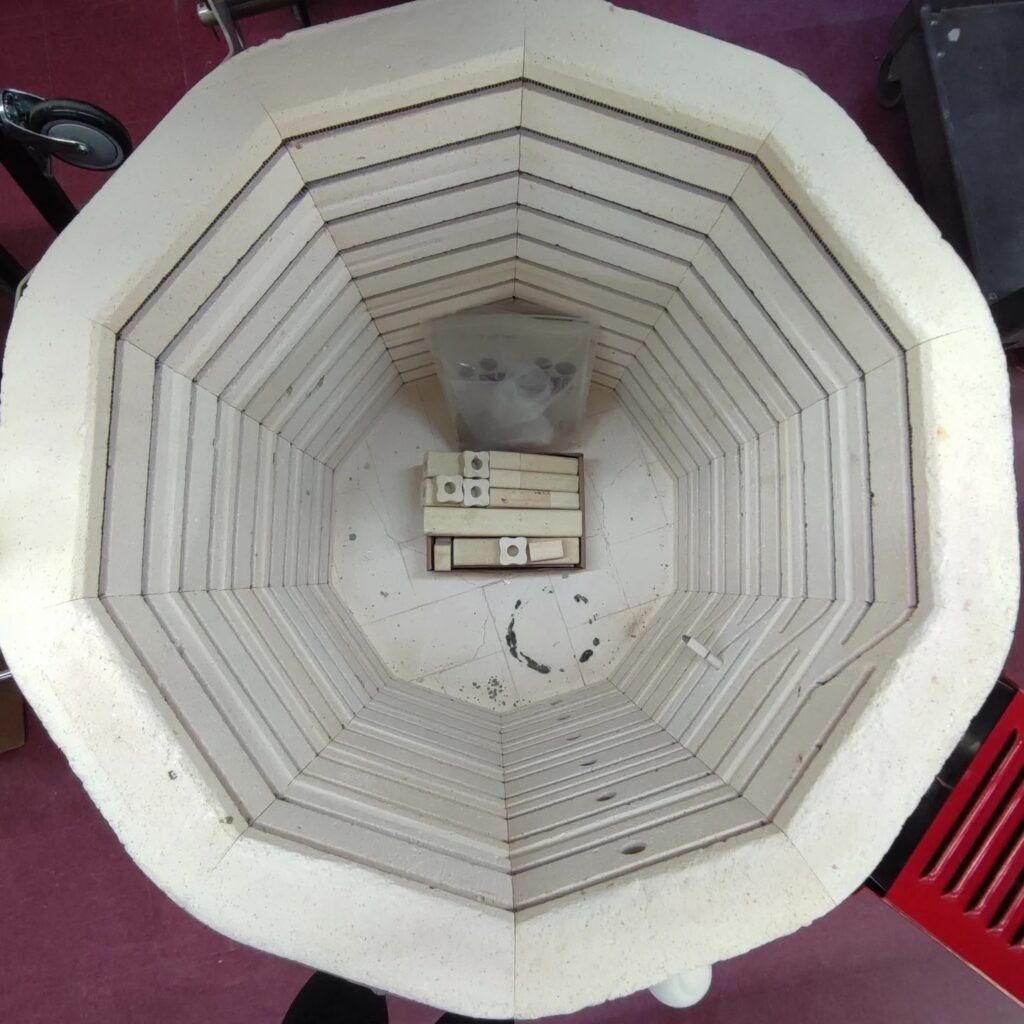
Kiln temperature uniformity describes how consistently heat is distributed throughout the firing chamber.
A perfectly uniform kiln would theoretically expose every part of every piece to exactly the same thermal conditions.
Real kilns do not behave that way.
There can be differences between:
- Top and bottom
- Center and outer areas
- Different shelf levels
- Areas close to elements
- Areas shielded by dense loads
- Sections near the thermocouple
- Different zones in a multi-zone kiln
The goal is not necessarily to eliminate every temperature difference.
The goal is to keep those differences within a range that produces reliable ceramic results.
That distinction matters.
A kiln can have excellent practical kiln temperature uniformity without every point inside the chamber being exactly the same temperature.
Why Kilns Do Not Fire Exactly the Same Everywhere
Heat moves through the kiln in several ways.
The elements radiate heat.
The kiln walls absorb and release heat.
Air movement contributes to heat transfer, particularly at lower temperatures.
The pottery itself absorbs heat.
Shelves absorb heat.
Posts and other kiln furniture also absorb heat.
The geometry of the kiln changes how all of these factors interact.
Skutt explains that the center of an electric kiln is naturally hotter, while the top and bottom tend to lose more heat through the lid and floor.
Paragon similarly explains that the bottom and top tend to remain cooler because the floor and lid are substantial thermal masses that absorb energy.
Manufacturers compensate for these tendencies through element design.
But loading can still override some of that compensation.
That is why kiln temperature uniformity is partly a kiln-design issue and partly a loading issue.
Why the Center of a Kiln Can Fire Hotter
The center of many electric kilns receives a favorable combination of heat from the surrounding elements.
The lid and floor also influence the thermal balance.
This can make the middle of the chamber behave differently from the top and bottom.
Skutt’s current loading guidance specifically notes that the center of the kiln tends to be the hottest area.
That is one reason the top and bottom sections may need different shelf spacing from the middle.
It is also why simply dividing a kiln into equal shelf levels does not always produce the most even result.
The physical arrangement matters.
Why the Top and Bottom Can Fire Cooler
The top and bottom of an electric kiln can lose heat differently from the center.
The lid absorbs heat.
The floor absorbs heat.
The surrounding structure also affects heat loss.
Manufacturers compensate by designing element layouts that provide additional heating in these areas.
But if shelves are packed tightly near the top or bottom, the pottery may still receive less radiant heat than intended.
Paragon explains that kilns tend to fire cooler at the top and bottom and that element output is adjusted to compensate.
This is normal kiln behavior.
The problem is when the difference becomes large enough to produce inconsistent results.
Kiln Temperature Uniformity Starts With Loading
One of the easiest ways to improve kiln temperature uniformity is to load the kiln correctly.
Skutt identifies loading as one of the biggest factors affecting how evenly a kiln fires.
That makes sense.
A kiln full of tightly packed shelves does not behave like an empty kiln.
A kiln with all the heavy pieces concentrated at the bottom does not behave like one with the mass distributed throughout the chamber.
A shelf positioned directly beneath another shelf with very little space between them restricts the way radiant heat reaches the ware.
Loading is therefore part of temperature control.
It is not simply a matter of fitting as much pottery as possible into the chamber.
Shelf Spacing and Kiln Temperature Uniformity
Shelf spacing can have a major effect on kiln temperature uniformity.
Skutt specifically warns that shelves stacked too tightly can make it more difficult for radiant heat to reach the ware evenly.
This is especially important near the top and bottom of the kiln.
If you squeeze shelves together because you want maximum capacity, you may create an apparently efficient load that actually fires less evenly.
The Kiln Depot’s kiln shelf spacing guide goes deeper into shelf height, post selection, thermocouple clearance, and loading patterns.
The basic principle is simple:
Do not optimize for the number of shelves. Optimize for the firing.
Why the Bottom Shelf Deserves Special Attention
The bottom shelf is closer to the kiln floor.
The floor absorbs heat.
That can make the bottom section behave differently from the center.
Skutt recommends placing the first shelf at least one inch above the kiln floor.
That space is not simply there to make loading easier.
It helps provide a more appropriate thermal environment around the bottom shelf.
If you place a shelf directly on the kiln floor, you change the way heat reaches the ware.
That can contribute to uneven firing.
Why the Top Shelf Deserves Special Attention
The top shelf is close to the lid.
The lid is another substantial thermal mass.
If the top shelf is packed too close to the lid, the ware may not receive the same radiant exposure as pottery in the center of the chamber.
Skutt’s loading guidance recommends leaving substantial clearance between the top shelf and the underside of the lid.
The exact arrangement depends on the kiln model and shelf configuration.
Do not treat one measurement as universal.
Use the manufacturer’s loading instructions for your kiln.
Load Density Affects Kiln Temperature Uniformity
Imagine two firings.
In the first, the kiln contains a relatively even distribution of mugs, bowls, and small pieces across several shelves.
In the second, most of the heavy pottery is concentrated on the bottom shelves while the upper chamber is nearly empty.
The two loads are not thermally equivalent.
Skutt specifically notes that uneven distribution of mass can produce uneven firing.
A dense section of pottery absorbs more heat.
That can change the local firing conditions.
This is why a kiln that fires beautifully one week can produce uneven results the next week even though nothing mechanical has changed.
The load changed.
How to Load a Partially Full Kiln
You do not have to fill every kiln shelf to achieve good kiln temperature uniformity.
In fact, a partially loaded kiln can fire very well when the ware is arranged intelligently.
Skutt’s current guidance suggests that if a load fills a substantial portion of the kiln, the work can be distributed through the chamber.
If the load is very small, concentrating it toward the center with appropriate shelf spacing can be more effective.
The exact strategy depends on the kiln.
The important point is to avoid creating extreme differences in density from one section to another.
Should You Fire a Nearly Empty Kiln?
Yes, if the firing is appropriate for your kiln and your work.
You do not need to postpone every firing until the kiln is completely full.
But a very small load should not necessarily be scattered randomly across every shelf.
If you only have a few pieces, think about where the kiln naturally fires most consistently.
Concentrating a small load in the appropriate central area can produce more predictable results.
Again, follow your manufacturer’s loading guidance.
Half Shelves Can Improve Air and Heat Movement
Half shelves are not only useful for fitting oddly shaped pottery.
They can also change the way heat moves around the kiln chamber.
Staggering shelves can create additional pathways through the firing chamber.
Skutt recommends leaving appropriate gaps between half shelves and staggering them where possible.
The goal is not to create a completely open kiln.
It is to avoid constructing a solid stack of shelves that blocks heat from reaching the pottery efficiently.
Shelf Size Matters
A shelf should fit the kiln properly.
A shelf that extends almost all the way to the kiln wall can restrict heat movement around its perimeter.
Skutt recommends approximately one inch or more of clearance between the shelf edge and kiln wall.
That clearance gives radiant heat and air more room to move.
If you have replaced your kiln shelves, check their dimensions.
Do not assume that a shelf is appropriate simply because it physically fits inside the chamber.
The Kiln Depot’s replacement kiln shelves guide covers the dimensions and condition issues to consider when replacing shelves.
Thermocouple Placement and Kiln Temperature Uniformity
The controller only knows the temperature being measured by the thermocouple.
That makes thermocouple position extremely important.
If pottery, a shelf, or another object is placed too close to the thermocouple tip, it can interfere with the temperature measurement.
Skutt recommends approximately two inches of clearance around the thermocouple tip.
That does not mean every kiln has exactly the same requirement.
Follow the manufacturer’s specification for your kiln.
The important concept is that the thermocouple needs to measure the chamber conditions without being excessively shielded by nearby objects.
Why You Should Not Put Pottery Against the Thermocouple
A thermocouple is a temperature sensor.
It needs to experience the kiln atmosphere in a way that represents the surrounding firing environment.
If a large piece of pottery sits directly beside it, the sensor may not behave as intended.
The controller then makes heating decisions based on a compromised measurement.
This can affect perceived kiln temperature uniformity.
If you consistently place pottery in the same position near the thermocouple, move it farther away and compare the firing results.
Witness Cones Are the Best Reality Check
Your controller displays temperature.
Your pottery experiences heatwork.
Those are related, but they are not identical.
Witness cones give you a physical record of how the firing affected the kiln load.
Skutt recommends self-supporting witness cones for evaluating firing results.
Orton manufactures the standard pyrometric cones widely used for this purpose.
Use witness cones at different locations when you are investigating uneven firing.
For example, you might place cones:
- Near the bottom
- Near the center
- Near the top
If the bottom cone bends significantly less than the center cone, you have evidence that the bottom experienced less heatwork.
That is much more useful than simply saying, “The bottom feels cooler.”
Where Should Witness Cones Go?
Cone placement matters.
Skutt recommends positioning witness cones roughly two inches from the kiln wall or thermocouple, rather than simply placing them in the exact center of a large shelf.
The goal is to make the cone representative of the heat environment being evaluated.
If a cone is placed behind a large piece of pottery, the pottery can shield it from radiant heat.
That can distort the result.
If you are testing kiln temperature uniformity, place your cones where they can actually measure the areas you are trying to compare.
How to Test Kiln Temperature Uniformity
You do not need sophisticated laboratory equipment.
A practical kiln test can be done with witness cones.
Step 1: Use the same clay and firing schedule
Do not change several variables at once.
Step 2: Place witness cones at multiple levels
Use comparable cones on the bottom, middle, and upper shelves.
Step 3: Keep the cone placement consistent
Avoid putting one cone directly behind a large piece while another sits in open space.
Step 4: Run the firing normally
Do not deliberately change the firing speed just for the test unless that is part of your testing plan.
Step 5: Inspect the cones after cooling
Compare how far each cone bent.
Step 6: Record the results
Write down the shelf location and cone result.
Step 7: Repeat if necessary
One unusual firing does not automatically prove a permanent kiln problem.
A repeatable pattern is much more useful.
What Does an Uneven Cone Pattern Tell You?
Suppose the top cone is slightly cooler, the center cone is fully mature, and the bottom cone is significantly cooler.
That pattern suggests the kiln is not distributing heat evenly enough for your current loading arrangement.
Now change the loading.
Increase spacing where appropriate.
Reduce density in the cooler area.
Run another firing.
If the cone pattern improves, the original problem was probably at least partly related to loading.
If the same area remains substantially cooler, mechanical troubleshooting becomes more important.
What If Only One Shelf Fires Cold?
That is a valuable clue.
If the entire bottom of the kiln consistently fires cool, the issue may relate to normal kiln heat distribution, loading, elements, or the floor.
If one specific region of one shelf repeatedly fires cool while the rest of the kiln behaves normally, investigate:
- Nearby element condition
- Element connections
- Shelf position
- Load density
- Shelf size
- Thermocouple relationship
- Air movement
- Controller or zone behavior
A localized problem is different from a normal top-to-bottom temperature gradient.
Can Bad Elements Cause Uneven Firing?
Absolutely.
A heating element that has deteriorated significantly or a circuit that has stopped functioning can create a cooler section.
This is where kiln temperature uniformity becomes a diagnostic tool.
If a kiln suddenly develops a cold zone that did not exist before, do not immediately rearrange every shelf.
Look at the heating system.
The Kiln Depot’s kiln elements guide covers slow firing, visible element damage, and other signs of element deterioration.
A change in firing pattern is important evidence.
Can a Bad Relay Cause Uneven Firing?
Yes.
A relay controls power to a heating circuit.
If a relay fails or behaves intermittently, part of the kiln may not heat correctly.
In a multi-zone or independently controlled system, the relationship can be even more direct.
If one zone repeatedly fires differently from the others, the relays and associated circuits deserve consideration.
The Kiln Depot’s kiln relay troubleshooting guide explains the symptoms associated with relay problems.
Can a Bad Thermocouple Cause Uneven Firing?
A thermocouple problem can affect temperature control.
If the controller receives an incorrect temperature signal, it may make inappropriate heating decisions.
But do not automatically blame the thermocouple whenever you see uneven firing.
Check the physical loading and witness-cone results first.
Then consider the thermocouple, wiring, controller, and heating system.
The Kiln Depot’s kiln thermocouple guide explains common thermocouple failure signs and replacement considerations.
Can a Kiln Vent Improve Temperature Uniformity?
It can influence temperature distribution.
Skutt notes that a downdraft ventilation system can help mix air within the kiln chamber and may have a slight effect on heat uniformity.
That does not mean a vent is a universal cure for uneven firing.
A badly loaded kiln remains badly loaded.
A failed element remains failed.
A poorly positioned shelf remains poorly positioned.
Ventilation should be installed and operated according to the kiln and vent manufacturer’s instructions.
The Kiln Depot’s kiln ventilation guide covers the primary purpose and installation considerations for kiln ventilation.
Does Firing Slower Improve Kiln Temperature Uniformity?
It can.
A slower firing gives the kiln more time to distribute heat and allows the ware to respond more gradually.
Skutt specifically identifies firing speed as one factor affecting firing uniformity.
This does not mean that every firing should be as slow as possible.
Your clay and glaze determine the appropriate firing schedule.
The correct principle is:
Use a firing schedule appropriate to the materials and work, not simply the fastest schedule the kiln can survive.
Can a Hold Improve Temperature Uniformity?
A short hold at peak temperature can help equalize heatwork in some situations.
Skutt notes that a short hold of approximately 5 to 15 minutes can help even out heatwork when one section is slightly cooler than another.
That does not mean adding a long hold is the correct fix for every uneven firing.
A hold adds heatwork.
If the center of the kiln is already hot, extending the hold can push that region further into overfiring while the cooler region catches up.
Use witness cones to see what is actually happening.
Don’t Use Hold Time to Hide a Broken Kiln
This is an important distinction.
Suppose the bottom shelf suddenly becomes dramatically cooler than normal.
You add 45 minutes of hold time.
The bottom finally reaches maturity.
But now the center is significantly overfired.
You have not repaired the kiln.
You have compensated for a hardware problem by overfiring part of the load.
If a hold becomes increasingly long just to achieve normal firing results, investigate the kiln itself.
Skutt’s own documentation recommends contacting the manufacturer if required hold times become excessive.
How Kiln Temperature Uniformity Changes With Load Shape
The physical shape of your pottery changes how heat reaches it.
Large plates can shield the area behind them.
Tall vases can alter airflow and radiant exposure.
Dense groups of mugs can absorb more heat than an open shelf.
Flat tiles packed closely together can create a very different thermal environment from loosely spaced sculpture.
That means there is no single “perfect” loading pattern for every type of pottery.
The best load is one that distributes both physical mass and thermal exposure sensibly.
Large Platters and Uneven Firing
Large flat ware deserves special attention.
A large platter can extend across much of a shelf and occupy a significant portion of the kiln’s radiant environment.
Skutt’s older loading guidance recommends positioning large flat pieces carefully relative to the heating elements.
If a large piece consistently fires differently from smaller pieces, examine its position relative to the elements and surrounding shelves.
Do not automatically increase the firing temperature.
You may simply be creating an unfavorable thermal environment around the piece.
Tall Kilns Need More Thoughtful Loading
Tall kilns can be extremely useful.
They can also make kiln temperature uniformity more sensitive to shelf arrangement.
A tall chamber naturally has more opportunity for temperature differences between the top, center, and bottom.
That is why balanced element designs and appropriate shelf spacing matter.
A tall kiln should not simply be filled from bottom to top using identical post heights.
Adjust the arrangement to the ware and manufacturer’s loading recommendations.
What If the Top Is Always Cold?
Start with loading.
Check:
- Top shelf clearance
- Shelf size
- Top shelf density
- Distance from the lid
- Witness cone placement
- Element condition
If the top is consistently cooler across multiple properly loaded firings, investigate the heating system.
Do not simply increase the final temperature without evidence.
What If the Bottom Is Always Cold?
Again, start with loading.
Check:
- Bottom shelf height
- Floor clearance
- Bottom shelf density
- Element condition
- Witness cone position
- Kiln floor condition
Skutt specifically recommends keeping the first shelf above the kiln floor rather than placing it directly on the slab.
If the bottom remains significantly cooler after correcting the load, inspect the elements and electrical circuits.
What If the Center Is Too Hot?
The center being somewhat hotter than the top and bottom is not necessarily abnormal.
It becomes a problem when the difference is large enough to affect the work.
You can sometimes reduce the effect through load distribution.
A denser load in a hot area can absorb more heat.
A lighter load in a cooler area can allow it to catch up.
But this is not a replacement for repairing failed components.
Use witness cones to determine whether the difference is actually significant.
Can Kiln Temperature Uniformity Be Perfect?
No practical electric kiln should be expected to produce perfectly identical heatwork everywhere.
The useful objective is consistent enough firing for your clay, glaze, work, and production requirements.
Some ceramics are more forgiving than others.
Some glazes tolerate small differences.
Others show noticeable changes with relatively small variations in heatwork.
That is why witness cones remain useful even with sophisticated digital controllers.
You are not trying to prove that the kiln is mathematically perfect.
You are trying to understand how it actually fires.
Zone-Control Kilns
Some larger or more advanced kilns use multiple temperature zones.
Instead of relying on one thermocouple for the entire chamber, zone-control systems measure temperatures in different sections.
Paragon’s Sentry documentation describes multi-zone systems that measure individual zones and adjust heating separately to improve temperature uniformity.
This can provide more control over differences between sections of the kiln.
But zone control does not eliminate the need for proper loading.
A badly packed shelf can still affect the pottery sitting on it.
Is Uneven Firing Normal in a New Kiln?
A new kiln should not automatically be assumed to have a defect because witness cones show some variation.
All kilns have physical thermal characteristics.
However, substantial or unexpected differences should be investigated.
Start with:
- Manufacturer loading instructions
- Shelf spacing
- Load density
- Cone placement
- Firing schedule
- Element condition
- Thermocouple placement
If the kiln is new and continues to produce significant unexplained variation after proper loading, contact the manufacturer.
Document the cone results.
Photos of the cones are useful.
Is Uneven Firing Normal in a Used Kiln?
A used kiln deserves more scrutiny.
Elements age.
Relays wear.
Thermocouples can drift.
Insulation deteriorates.
Previous owners may have used different firing schedules.
If you are buying a used kiln, ask whether the seller can demonstrate a firing.
Use witness cones to evaluate the firing rather than relying solely on the controller display.
The Kiln Depot’s used pottery kiln inspection guide covers the broader inspection process.
A Better Way to Diagnose Uneven Firing
Do not change five things at once.
This is where many potters make troubleshooting harder than it needs to be.
Instead:
First firing: establish the problem.
Second firing: correct the loading.
Third firing: investigate mechanical components if the pattern remains.
This gives you evidence.
For example:
Firing 1: bottom cone underfires.
Firing 2: bottom load reduced and shelf raised appropriately.
Result: bottom cone improves.
That strongly suggests loading contributed to the problem.
Compare that with:
Firing 1: bottom cone underfires.
Firing 2: corrected loading produces the same bottom cone result.
Now mechanical investigation becomes more important.
That is actual troubleshooting rather than guessing.
A Practical Kiln Temperature Uniformity Test
For a kiln that appears to be firing unevenly, use this simple protocol.
Load consistently
Use similar ware distribution across the chamber.
Use witness cones
Place comparable cones at different shelf levels.
Keep the firing schedule unchanged
Do not change ramp rate and hold time simultaneously.
Keep shelf spacing sensible
Follow the manufacturer’s recommended loading pattern.
Fire normally
Do not deliberately manipulate the kiln.
Allow it to cool normally
Do not open the kiln prematurely.
Photograph the cones
Take a photograph before unloading if practical.
Record the locations
Write down which cone was on which shelf.
Repeat
If the pattern is repeatable, you have useful evidence.
What to Do After Finding a Cold Zone
If the cold zone is predictable, change the loading strategy first.
Reduce the density there.
Increase appropriate shelf spacing.
Make sure the shelf is not blocking the elements.
Check thermocouple clearance.
Then fire again.
If the zone remains cold, investigate the equipment.
Check:
- Elements
- Element connections
- Relays
- Thermocouple
- Controller
- Electrical supply
Do not keep compensating with longer and hotter firings indefinitely.
When Uneven Firing Means You Need Service
Get professional or manufacturer assistance when:
- One section suddenly becomes much cooler
- A previously reliable kiln changes behavior
- Elements appear damaged
- A relay may have failed
- The controller reports repeated errors
- The kiln struggles to reach temperature
- One zone behaves differently from another
- Electrical connections show signs of overheating
- Correct loading does not solve the problem
The Kiln Depot’s kiln error code guide is useful when unusual temperature behavior is accompanied by controller warnings.
The Biggest Mistakes That Destroy Kiln Temperature Uniformity
Packing shelves too tightly
More pottery does not automatically mean a better firing.
Concentrating all the heavy ware in one area
Mass distribution matters.
Blocking the thermocouple
The controller needs an accurate temperature measurement.
Using shelves that are too large
Insufficient clearance can restrict heat movement.
Ignoring witness cones
The controller cannot tell you everything about heatwork.
Using excessive hold time
A long hold can compensate for mild differences, but it can also overfire hotter areas.
Blaming the kiln immediately
Loading is often the first variable to investigate.
Blaming loading forever
If proper loading does not fix a repeatable cold zone, inspect the hardware.
Frequently Asked Questions About Kiln Temperature Uniformity
Why does my kiln fire unevenly?
Common causes include shelf spacing, load density, shelf size, thermocouple placement, firing speed, element condition, relay problems, and normal differences between the top, center, and bottom of the chamber.
Why is the bottom of my kiln cooler?
The floor absorbs heat, and the bottom of an electric kiln naturally tends to lose heat differently from the center. Manufacturers compensate through element design, but loading can still create additional differences.
Why is the center of my kiln hotter?
The center often has a more favorable radiant-heating environment than the top and bottom. This is normal to some degree.
How do I test kiln temperature uniformity?
Use witness cones at different shelf levels and compare the amount of bending after the same firing.
Can shelf spacing affect kiln temperature?
Yes.
Shelves stacked too closely can restrict radiant heat from reaching the ware evenly.
Can a bad element cause a cold spot?
Yes.
A deteriorated or failed heating element can reduce heating in a particular section.
Can a bad thermocouple cause uneven firing?
It can affect temperature control, but uneven firing should not automatically be blamed on the thermocouple. Loading and heating components should also be evaluated.
Does a kiln vent improve temperature uniformity?
A downdraft vent can influence heat distribution, but it is not a universal solution for uneven firing.
Should I add more hold time if the bottom is underfired?
Possibly for a mild, known temperature difference, but do not use increasingly long holds to compensate for a suspected mechanical problem.
Are hot and cold spots normal?
Some temperature variation is normal.
The issue is whether the variation is large enough to affect the firing results.
Bottom Line
Kiln temperature uniformity is not about making every point inside the chamber exactly the same temperature. It is about producing consistent heatwork throughout the areas where your pottery is loaded.
Start with the things you can control.
Load the kiln evenly.
Use sensible shelf spacing.
Leave appropriate clearance around the thermocouple.
Keep shelves away from the kiln walls.
Do not concentrate all the heavy ware in one section.
Use witness cones at multiple levels when you are diagnosing a problem.
Then look at the firing schedule.
If a short hold improves a mild difference, that may be useful.
If you need increasingly long holds to make one section mature, investigate why.
And if a cold or hot zone appears suddenly in a kiln that previously fired evenly, take it seriously.
Check the elements.
Check the relays.
Check the thermocouple.
Check the controller.
Check the electrical supply.
A good kiln should give you predictable results, but the kiln itself is only one part of that equation.
The load is part of the firing system.
The shelves are part of the firing system.
The firing schedule is part of the firing system.
The witness cones tell you what actually happened.
Once you start treating kiln temperature uniformity as something you can measure and troubleshoot rather than simply accept or blame on the kiln, uneven firing becomes much easier to diagnose.
And that is the real goal: not a theoretically perfect kiln, but a kiln that gives you repeatable results you can trust.
