Kiln shelf spacing looks like a small detail until you start getting uneven firing, crowded shelves, tall pieces that will not fit, or pottery sitting too close to the elements.

The basic idea is simple: kiln shelves are separated by refractory posts, and the height of those posts determines how much vertical space each firing level gets.
But there is more to it than simply choosing the shortest posts that will fit your pottery.
Shelf spacing affects how efficiently you use the kiln chamber, how much radiant heat reaches each shelf, how much room your pottery has, and how easily you can build different loads.
Skutt specifically notes that tightly packed shelf layers can make it harder for radiant heat to penetrate evenly, particularly near the top and bottom of the kiln. Its loading guidance recommends different spacing at different levels rather than treating every shelf gap identically.
That means the goal is not to fit the maximum number of shelves.
The goal is to create a stable, practical loading arrangement that gives your pottery enough room and allows the kiln to fire properly.
What Is Kiln Shelf Spacing?
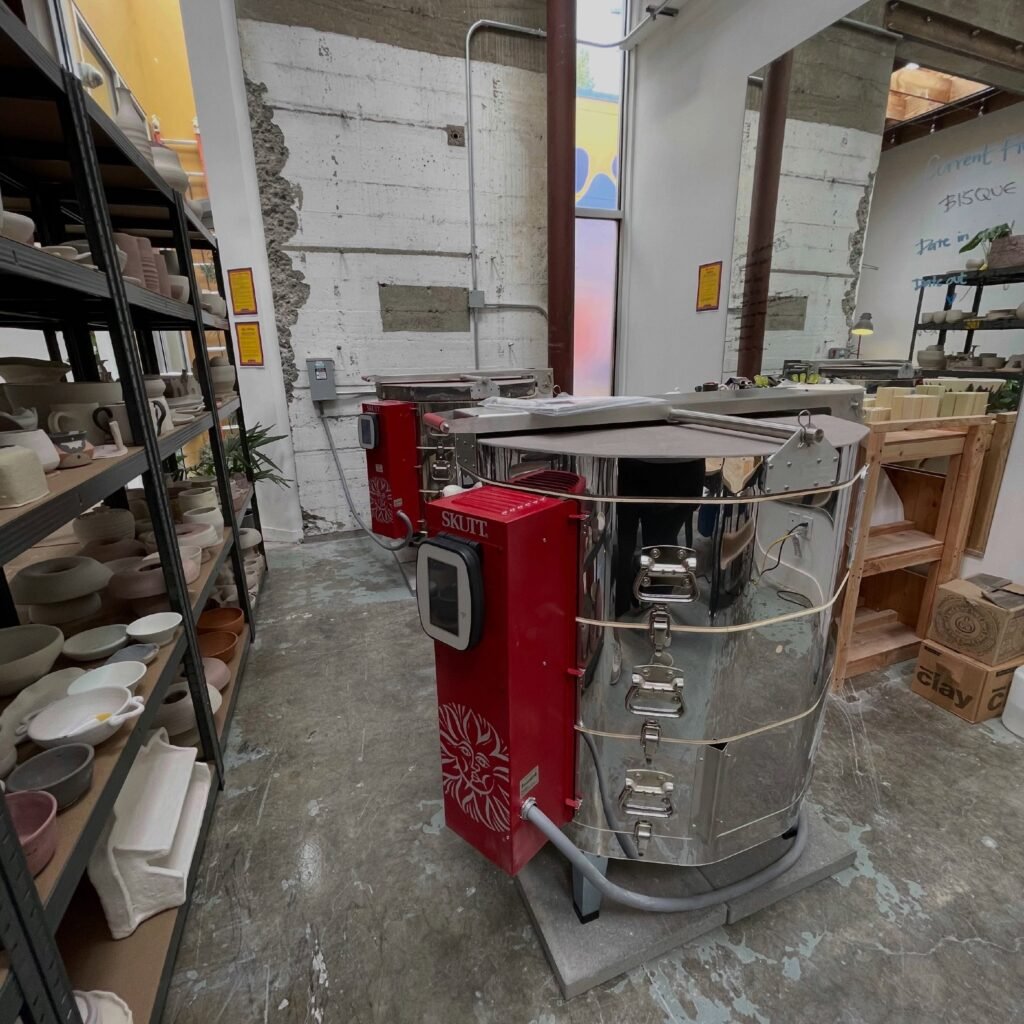
Kiln shelf spacing is the vertical distance between one kiln shelf and the next.
That distance is normally created by kiln posts.
For example, if you place a 3-inch post between two shelves, you create approximately 3 inches of vertical separation between the shelf surfaces.
A 6-inch post creates substantially more room.
The concept becomes important because pottery comes in very different shapes.
A load of small mugs may require relatively little vertical space.
A tall vase may require several times as much.
A kiln used for both types of work therefore benefits from adjustable shelf spacing rather than a permanently fixed configuration.
The posts allow you to change the interior arrangement from firing to firing.
Why Kiln Shelf Spacing Matters
Poor kiln shelf spacing can cause several problems at once.
If shelves are too close together, you may:
- Restrict radiant heat reaching the ware
- Make loading more difficult
- Reduce clearance around the pottery
- Interfere with thermocouple readings
- Increase the chance of uneven firing
- Make it difficult to accommodate taller pieces
If shelves are spaced excessively far apart, you may:
- Waste usable kiln volume
- Reduce the number of pieces you can fire
- Make small loads less efficient
- Leave large unused sections of the chamber
The solution is not maximum spacing or minimum spacing.
It is appropriate spacing.
Your kiln, shelf configuration, pottery and firing schedule all matter.
How Kiln Posts Control Shelf Spacing
Kiln posts are the adjustable building blocks of your kiln furniture.
They sit beneath shelves and hold them at specific heights.
Skutt currently sells posts in a range of heights and recommends three posts for each shelf in typical applications, with additional support potentially required for larger shelves.
The important thing is that post height should be chosen according to the pottery being fired.
Short posts are useful for short ware.
Tall posts are useful for tall ware.
You can also keep several post heights available so you can change your configuration without buying new shelves every time your firing load changes.
What Is the Ideal Kiln Shelf Spacing?
There is no single spacing measurement that works for every kiln and every firing.
That is the first thing to understand.
A kiln loaded with flat tiles needs a different arrangement from one loaded with 12-inch vases.
A kiln firing small bowls can use tighter spacing than one firing large sculptures.
The manufacturer’s loading recommendations also matter.
Skutt’s current guidance, for example, recommends using a 1-inch post beneath the first shelf and then using taller posts between certain upper layers. It also recommends leaving significant space near the top of the kiln so the upper shelf receives adequate radiant heat.
So instead of asking:
“What is the correct kiln shelf spacing?”
ask:
“What spacing gives my pottery enough room while allowing the kiln to heat the load effectively?”
That is the more useful question.
Kiln Shelf Spacing for the First Shelf
The first shelf should not normally sit directly on the kiln floor.
You need posts between the kiln floor and the first shelf.
Skutt recommends 1-inch posts for this first layer. The purpose is not simply to create additional storage space. Raising the shelf allows heat to reach the underside of that shelf rather than placing it directly against the kiln floor.
This small gap is easy to overlook.
A new kiln owner may see the kiln floor as a perfectly good place to put a shelf.
But the shelf is part of the kiln’s heat environment.
How you position it affects the firing conditions around the ware.
For that reason, follow the furniture arrangement recommended for your particular kiln.
Kiln Shelf Spacing Between Middle Shelves
The middle of the kiln generally gives you more flexibility.
This is where you can often adjust kiln shelf spacing most aggressively according to the size of your work.
Small pieces can allow tighter spacing.
Low pieces can be grouped together.
Tall pieces can have an entire shelf level removed or moved upward.
However, do not treat the middle of the kiln as a free-for-all.
You still need enough room around the pottery.
You also need to consider the thermocouple.
Skutt recommends approximately 2 inches of clearance around the tip of the thermocouple so that shelves, posts or pottery do not interfere with temperature measurement.
That is an important detail when planning your shelf arrangement.
Kiln Shelf Spacing Near the Top of the Kiln
The uppermost shelf deserves special attention.
It can be tempting to use every available inch of the kiln chamber.
That can be a mistake.
Skutt’s current firing guidance recommends keeping the uppermost shelf approximately 5 inches below the underside of the lid so that the shelf has sufficient exposure to radiant heat from the elements.
In other words, the top of the kiln should not automatically be treated as wasted space that needs filling.
The shelf needs appropriate exposure to the kiln’s heating system.
If you compress the top shelf too close to the lid, you may be trading a little extra capacity for less favorable firing conditions.
Kiln Shelf Spacing for Tall Pottery
Tall pottery is where shelf spacing becomes most obvious.
Imagine a vase that is 11 inches tall.
Trying to create an 11-inch shelf gap does not automatically solve the problem.
You also need clearance above the piece.
The piece must not touch the shelf above it.
You also need to account for the shelf thickness and the geometry of the kiln.
This is why a tall piece may require removing an entire shelf level rather than simply changing one post.
Sometimes the most efficient kiln load is not the one containing the greatest number of shelves.
It is the one that combines different heights intelligently.
For example, you might dedicate the lower portion of the kiln to tall vases while using the remaining space for smaller bowls.
That is one of the biggest advantages of adjustable kiln shelf spacing.
Kiln Shelf Spacing for Mugs and Small Bowls
Small pottery allows much tighter loading.
If your mugs are only a few inches tall, you may be able to use several shelf levels.
That can dramatically increase the number of pieces fired in one cycle.
But again, “as close as possible” is not the goal.
You still need appropriate heat circulation and clearance.
Skutt notes that shelf layers that are too tightly packed can make radiant heat penetration more difficult.
So if you are firing a large batch of small pieces, experiment within the manufacturer’s recommended loading pattern rather than simply filling every possible gap.
Kiln Shelf Spacing for Plates and Platters
Flat work creates a different problem.
You generally need less vertical space than you would for tall vases.
But the shelves themselves become more important.
Large platters need enough horizontal room.
You may be able to use relatively short posts between shelves, but the pottery still needs enough clearance above and below it.
Half shelves can be useful here because they allow more flexible loading.
Skutt notes that half shelves can provide additional loading options and allow shelves to be staggered when appropriate.
That can be particularly useful when a kiln contains pieces of different heights.
Kiln Shelf Spacing With Half Shelves
Half shelves are not simply smaller versions of full shelves.
They change how you can organize the kiln.
Suppose one side of the kiln contains a tall sculpture while the other side contains several small bowls.
With appropriately configured half shelves, you may be able to create different vertical zones.
This can be much more efficient than forcing the entire kiln into one shelf height.
But half shelves still require proper support.
Skutt’s furniture guidance notes that half shelves can share support posts on a common layer, while the exact configuration depends on the kiln and furniture design.
Do not improvise a half-shelf arrangement simply because the pieces appear to fit.
The support system needs to remain stable.
How Many Posts Should Support a Kiln Shelf?
For many standard shelf configurations, three posts are used.
There is a reason for this.
Three points establish a stable plane without the rocking that can occur with poorly positioned four-point arrangements.
Skutt recommends three posts per shelf in typical applications and notes that larger shelves may need additional support.
Paragon’s ceramic kiln guidance similarly recommends three posts for separating shelves and emphasizes keeping stacked posts vertically aligned.
However, do not assume that every shelf in every kiln uses exactly three posts.
Large shelves and manufacturer-specific furniture systems can require different arrangements.
Follow the shelf manufacturer’s recommendation for the specific configuration.
Should Kiln Posts Be Directly Above Each Other?
Yes, when stacking posts, vertical alignment is important.
If one post is directly above another, the load transfers more predictably through the kiln furniture.
If posts are offset significantly, the shelf can become less stable.
Paragon specifically warns that vertically offset posts can make shelves less stable and more susceptible to stress and warping at high temperatures.
Think of your shelf system as a stack of structural layers.
You want the supports to form a stable path through the load.
Do not randomly move posts around from one level to another without considering what is supporting what.
Can You Stack Kiln Posts?
You can stack kiln posts in many kiln furniture systems.
But that does not mean stacking is always the best option.
Skutt notes that posts can be stacked to increase height, while also stating that using a single post that accommodates the required height provides greater stability.
That is a useful distinction.
If you need a 6-inch gap and have a 6-inch post, using that single post is generally preferable to stacking three 2-inch posts.
Stacking becomes useful when you need a nonstandard height or want greater flexibility from the post assortment you already own.
Stability should come first.
Kiln Shelf Spacing and Heat Circulation
The kiln is not just a hot box.
The arrangement of shelves and pottery affects how heat reaches the ware.
When shelves are packed too tightly, they can interfere with radiant heat reaching the pottery.
This is particularly important at the top and bottom of the chamber.
Skutt’s current loading guidance specifically identifies shelf separation as a factor that can influence firing uniformity.
That means you should not judge your kiln shelf spacing only by how much pottery you can physically fit.
A load that contains more pieces but fires inconsistently is not necessarily a more efficient load.
Kiln Shelf Spacing and the Thermocouple
The thermocouple measures temperature inside the kiln.
It therefore needs to be able to sense the chamber environment without being excessively obstructed by nearby shelves or pottery.
Skutt recommends approximately 2 inches of clearance around the thermocouple tip.
When building your shelf arrangement, locate the thermocouple first.
Then make sure your shelf, posts and pottery do not crowd it.
This becomes particularly important in the middle shelf levels.
If you change your furniture configuration significantly from one firing to another, check the thermocouple area again.
How Much Space Should Be Above the Pottery?
Your pottery should never simply be squeezed into the gap.
You need clearance between the piece and the shelf above it.
The exact amount depends on the piece, kiln design and manufacturer’s guidance.
The pottery must also remain safely away from the heating elements and other kiln components.
A piece that barely fits when the kiln is cold is not a good loading arrangement.
Remember that you are dealing with a high-temperature environment.
Leave practical clearance rather than forcing a piece into the last available inch.
What Happens if Kiln Shelves Are Too Close?
Excessively tight kiln shelf spacing can create several problems.
The most obvious is that your pottery may physically not fit.
But even when everything fits, the firing environment can suffer.
Tightly packed shelves can make it more difficult for radiant heat to reach the ware evenly.
Skutt identifies this as a potential cause of uneven firing, particularly around the top and bottom shelf levels.
The answer is not necessarily to double every shelf gap.
Instead, look at the entire loading pattern.
The top, bottom and middle of the kiln may need different spacing.
What Happens if Kiln Shelves Are Too Far Apart?
The opposite problem is wasted chamber space.
If you use unnecessarily tall posts for every shelf, you may only fit two or three layers into a kiln that could accommodate more.
That reduces your firing capacity.
For a studio producing a lot of small work, this can become expensive because you may need additional firings to accomplish the same amount of production.
This is where having multiple post heights becomes valuable.
You can use the shortest practical spacing for low pieces and increase the gap where necessary for taller work.
How to Build a Better Kiln Load
A good loading process starts before you put the first shelf into the kiln.
Step 1: Identify your tallest pieces
Separate the tall pottery from the small pieces.
Step 2: Measure the pieces
Do not rely on memory.
Measure the actual height of the tallest ware.
Step 3: Plan the shelf levels
Decide which levels need tall spacing and which can use shorter posts.
Step 4: Check the kiln elements
Make sure the pottery and shelves have appropriate clearance from the elements.
Step 5: Check the thermocouple
Make sure the shelf arrangement does not crowd the thermocouple tip.
Step 6: Build stable shelf supports
Use the recommended number and arrangement of posts.
Step 7: Check the top and bottom levels
Do not automatically use the same spacing everywhere.
Step 8: Inspect the load before closing the kiln
Look for anything that is leaning, touching, or positioned too close to another component.
That takes a few minutes and can prevent an expensive mistake.
Kiln Shelf Spacing for a Mixed Load
Mixed loads are where flexible furniture becomes particularly valuable.
Imagine a firing containing:
- Four tall vases
- Ten mugs
- Six bowls
- Several small test pieces
You do not need the entire kiln to have the same shelf spacing.
Instead, organize the kiln into zones.
One section can accommodate taller ware.
Another can contain smaller pieces.
Half shelves can sometimes make this easier.
The objective is to use the kiln volume efficiently without creating cramped shelf levels.
When Should You Buy More Kiln Posts?
If you regularly change your loading configuration, additional posts can be worthwhile.
A basic furniture kit may give you several post heights.
Skutt’s furniture information explains that furniture kits include different post heights to provide flexibility when loading different types of ware.
Additional posts become particularly useful if:
- You fire both tall and short pieces
- You use half shelves
- You frequently change shelf levels
- You fire large platters
- You fire sculpture
- You own a taller kiln
You do not necessarily need dozens of posts.
You need the heights that correspond to the work you actually make.
Kiln Shelf Spacing and Furniture Kits
If you are buying a kiln for the first time, a properly matched furniture kit can simplify the entire process.
A furniture kit generally combines shelves and posts selected for a particular kiln.
Skutt describes its furniture kits as combinations of properly sized shelves and post assortments recommended for specific kiln models.
That can be easier than trying to assemble every component individually.
Individual pieces make more sense when you already own a kiln and only need a replacement or a few additional components.
The Kiln Depot’s existing kiln furniture guide covers the broader question of what shelves, posts and stands you need.
Kiln Shelf Spacing for a Used Kiln
Used kilns require one additional step.
Check whether the furniture that came with the kiln actually belongs to that kiln.
A used kiln may be sold with:
- Missing shelves
- Mixed shelves
- Incorrect posts
- Damaged furniture
- Furniture from another kiln
Do not assume that everything included in a used-kiln sale is compatible.
Identify the kiln model first.
Then verify the shelf dimensions and furniture specifications.
If the kiln is missing furniture, the cost of replacing shelves and posts should be included in your total purchase calculation.
The Kiln Depot’s used pottery kiln guide covers other inspection points to consider before buying.
When Should You Replace Kiln Posts?
Inspect posts periodically.
Look for:
- Cracks
- Chips
- Severe warping
- Damaged ends
- Unstable surfaces
- Significant glaze buildup
A post does not need to look brand new to remain usable.
But if it rocks on a flat surface or has significant structural damage, it deserves closer inspection before being returned to service.
The cost of a replacement post is small compared with the value of a kiln load.
Do not gamble an entire firing on questionable kiln furniture.
Kiln Shelf Spacing Mistakes to Avoid
1. Using the same post height everywhere
Your pottery is not all the same height.
Your shelf arrangement does not need to be either.
2. Packing shelves as tightly as possible
Maximum capacity is not the same thing as optimal firing.
3. Ignoring the top shelf
The upper shelf can need more clearance than the middle levels.
4. Crowding the thermocouple
Leave appropriate clearance around the thermocouple according to the manufacturer’s guidance.
5. Randomly offsetting stacked posts
Keep support columns properly aligned.
6. Using damaged posts
Replace questionable furniture rather than hoping it survives another firing.
7. Buying posts without checking the shelves
The posts and shelves need to function as one system.
8. Buying only one post height
If your pottery varies significantly in size, multiple heights can make your kiln much more flexible.
A Practical Kiln Shelf Spacing Checklist
Before every firing, check:
Pottery height: What is the tallest piece?
Shelf height: Is there enough room above each piece?
Element clearance: Is the pottery safely positioned relative to the elements?
Thermocouple: Is the tip unobstructed?
Posts: Are they stable and undamaged?
Alignment: Are stacked posts properly aligned?
Top shelf: Is there adequate clearance below the lid?
Bottom shelf: Is the first shelf properly raised?
Shelf condition: Are shelves stable and suitable for the firing?
Load balance: Is the kiln loaded sensibly rather than heavily concentrated in one area?
These checks take very little time.
They can also prevent an otherwise avoidable firing problem.
Frequently Asked Questions
What is the best kiln shelf spacing?
There is no universal measurement. The correct kiln shelf spacing depends on the height of your pottery, kiln design, shelf configuration and manufacturer’s loading recommendations.
Can kiln shelves be too close together?
Yes. Excessively tight spacing can restrict radiant heat reaching the ware and can contribute to uneven firing, particularly near the top and bottom of the kiln.
Can kiln shelves be too far apart?
Yes. Excessive spacing wastes usable chamber volume and can reduce the number of pieces you can fire at once.
What size kiln posts should I use?
Use post heights that give your pottery adequate vertical clearance while maintaining a stable shelf arrangement. Keeping several post heights available is useful if you regularly fire different types of pottery.
How many posts do I need per kiln shelf?
Three posts are commonly used for standard shelf configurations. Larger shelves or manufacturer-specific furniture systems may require additional support.
Can I stack kiln posts?
Many kiln furniture systems allow posts to be stacked, but a single post of the required height is generally more stable when available.
Should kiln posts line up?
Yes. When posts are stacked, vertical alignment improves stability and load transfer. Paragon specifically recommends vertically aligned posts.
How much space should be left above the top shelf?
Follow your kiln manufacturer’s loading recommendations. Skutt currently recommends approximately 5 inches between the uppermost shelf and the underside of the lid in its loading guidance.
Should I use the same shelf spacing for every firing?
No. Adjust the configuration according to the pottery in the kiln. A load of mugs may need very different spacing from a load of tall vases.
Final Takeaway
Good kiln shelf spacing is about balance.
You want enough room for your pottery without wasting the kiln chamber.
You want stable shelves without creating unnecessary support structures.
You want efficient use of space without packing shelves so tightly that heat distribution becomes more difficult.
And you want a furniture arrangement that can change when your pottery changes.
The most useful setup is therefore not necessarily the one with the greatest number of shelves.
It is the one that gives you enough flexibility to fire the work you actually make.
Start with your tallest piece.
Measure it.
Plan your shelf levels around the pottery.
Use appropriate posts.
Keep stacked supports aligned.
Leave the necessary clearance around the thermocouple and heating elements.
Give the top and bottom shelf levels appropriate space.
And follow the loading recommendations for your specific kiln.
If you are starting from scratch, a properly matched furniture kit can simplify the process. If you already own the kiln, individual shelves and posts can let you build a configuration around your actual firing habits.
The Kiln Depot’s replacement kiln shelf guide is useful when your shelves need replacing, while the pottery kiln setup guide covers the wider installation and studio considerations.
The point is simple:
Do not load the kiln to see how much pottery you can physically cram inside it. Load it so the kiln can do its job properly.
That is what good kiln shelf spacing is really about.
