Choosing the right pottery kiln size comes down to three things: the size of your work, how much pottery you fire at once, and how often you fire.
Buy too small and you may spend your time running half-empty firing cycles because your work no longer fits.
Buy too large and you can end up paying for chamber space, electrical capacity and equipment that your studio rarely uses.
The right pottery kiln size is therefore not the biggest kiln you can afford. It is the smallest kiln that comfortably handles your normal workload while leaving reasonable room for growth.
For reference, current Skutt models range from the 2.6 cubic-foot KM-818 to the 7 cubic-foot KM-1027 and 9.9 cubic-foot KM-1227. Those differences are substantial enough to change the electrical installation, physical footprint and firing workflow.
Pottery Kiln Size at a Glance
| Kiln capacity | Typical use | Good fit for |
|---|---|---|
| Around 2–3 cu. ft. | Small batches | Beginners, hobbyists, compact studios |
| Around 4–5 cu. ft. | Medium batches | Growing home studios |
| Around 6–8 cu. ft. | Regular production | Serious home and small studios |
| Around 9–10 cu. ft. | Large batches | Production and high-volume studios |
| 12+ cu. ft. | Very high production | Larger commercial or institutional studios |
These are practical categories rather than universal rules.
The correct pottery kiln size depends on the dimensions of your actual work and the amount of pottery you fire.
What Does Pottery Kiln Size Actually Mean?
When manufacturers describe kiln size, they usually refer to the internal chamber volume in cubic feet.
That number is useful.
But it does not tell you everything.
Two kilns can have similar cubic-foot capacities but different internal dimensions.
One may be wider and shorter.
Another may be narrower and taller.
That difference matters if you make:
- Large bowls
- Tall vases
- Platters
- Sculptures
- Tiles
- Large planters
A potter making small mugs may care mostly about total shelf area.
A sculptor may care much more about chamber height.
That is why you should never choose a kiln based only on cubic feet.
How to Choose the Right Pottery Kiln Size
Start with your largest regular work.
Measure it.
Then estimate how much shelf space your normal firing requires.
Finally, consider how often you want to fire.
For example, a potter making six mugs per week has very different requirements from a studio producing 50 pieces.
Your pottery kiln size should reflect the workload you actually expect, not an imaginary future production level.
A useful buying sequence is:
- Determine your firing temperature.
- Measure your largest pieces.
- Estimate your normal batch size.
- Determine your preferred firing frequency.
- Check available electrical service.
- Measure the installation space.
- Choose a kiln with some reasonable room for growth.
That process eliminates many unsuitable models before price becomes the deciding factor.
What Size Pottery Kiln Does a Beginner Need?
Beginners often make the mistake of assuming that a larger kiln is automatically a better investment.
It is not.
If you are learning pottery and mainly making mugs, bowls, small plates and test pieces, a compact kiln can be more practical.
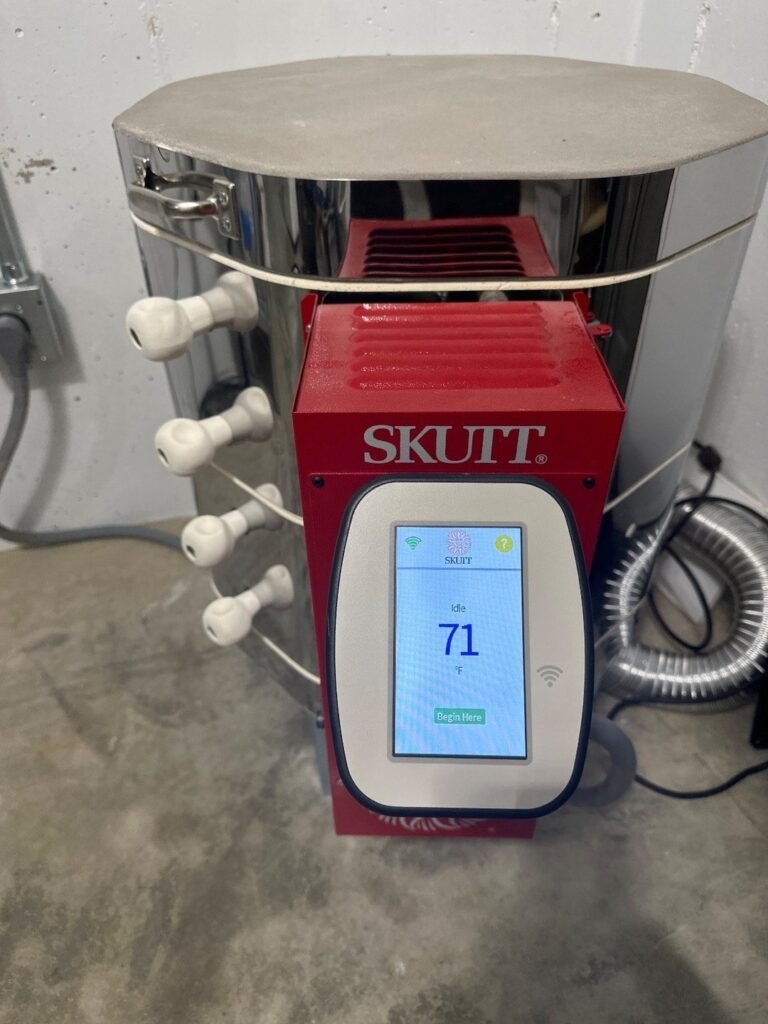
The Skutt KM-818 is a useful example. The current model has a 2.6 cubic-foot chamber measuring approximately 18 inches wide, 18 inches deep and 18 inches high. Skutt lists the 240V version at 26.7 amps and 6,400 watts, with a Cone 10 maximum temperature rating.
That gives a beginner considerably less equipment and electrical infrastructure to manage than a much larger kiln.
The important question is whether that chamber will still work for your pottery six months or two years from now.
What Size Pottery Kiln Is Best for a Home Studio?
Home studios usually need to balance capacity against space and electrical requirements.
A medium-sized kiln can be a useful compromise.
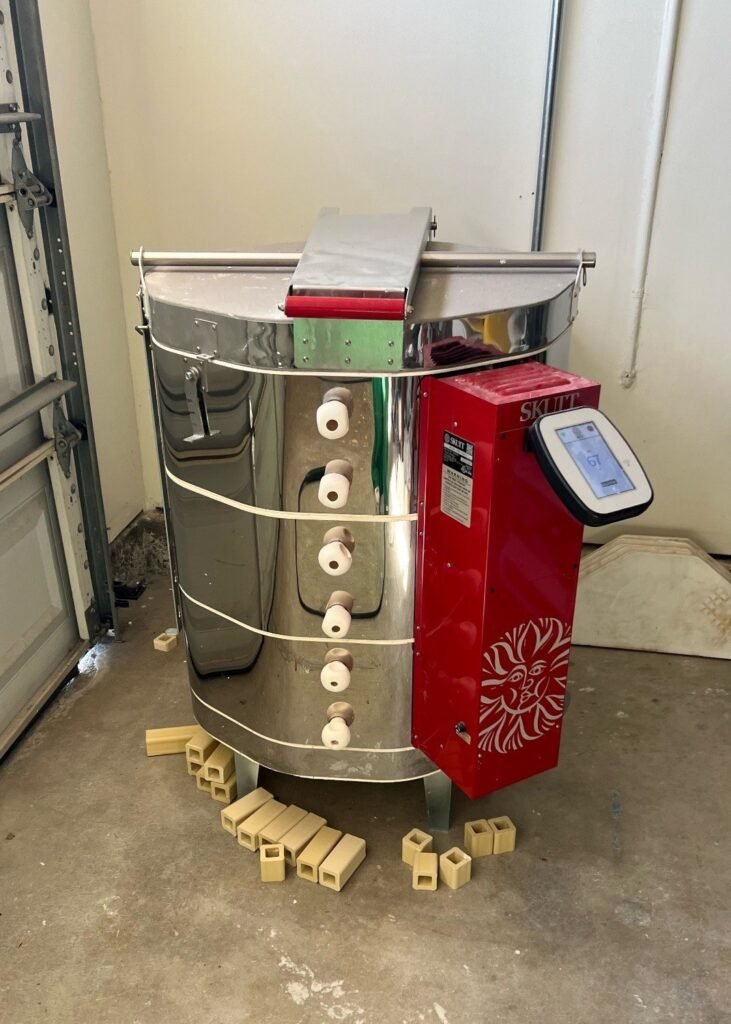
The Skutt KM-1018, for example, has a 4.6 cubic-foot chamber with an internal opening of approximately 23 by 23 inches and an 18-inch chamber height.
That gives substantially more room than a 2.6 cubic-foot kiln without moving all the way into the 7- or 10-cubic-foot class.
For a home studio, the ideal pottery kiln size often sits somewhere in the middle because it gives you room to grow without requiring a production-scale installation.
But the electrical service still has to work.
Skutt currently lists the 240V KM-1018 at 39.4 amps and 9,460 watts.
That is a major jump from the KM-818.
Is a 7 Cubic Foot Kiln Big Enough?
For many serious studios, yes.
A 7 cubic-foot kiln is large enough to handle substantially more pottery per firing while remaining much smaller than many production kilns.
The Skutt KM-1027 is a good reference point.
It has a chamber approximately 23 inches wide, 23 inches deep and 27 inches high, giving it 7 cubic feet of internal volume. Skutt illustrates the chamber as accommodating approximately 38 of its reference 6-inch-diameter by 3-inch-high bowls.
That does not mean you will fit exactly 38 of your own pots.
Shelf arrangement, glaze spacing, piece dimensions and kiln furniture all affect usable capacity.
Still, the example demonstrates how dramatically capacity changes as the chamber gets larger.
Is a 10 Cubic Foot Kiln Too Big?
Not necessarily.
A 10-cubic-foot kiln can be an excellent choice if you regularly fire substantial quantities of pottery.
The problem occurs when buyers purchase that capacity before they actually need it.
The Skutt KM-1227 currently provides approximately 9.9 cubic feet of chamber volume, with a 28-inch by 28-inch opening and 27-inch chamber depth.
That is a substantial kiln.
It also weighs approximately 400 pounds before considering additional equipment and installation requirements.
The 240V single-phase configuration is listed at 48 amps and 11,520 watts.
So the jump from a 7-cubic-foot kiln to a roughly 10-cubic-foot kiln is not simply about getting three more cubic feet.
It can mean a significantly different installation.
Pottery Kiln Size vs Chamber Dimensions
This is one of the most important distinctions buyers miss.
Suppose two kilns have similar volume.
If one is tall and narrow while the other is wide and relatively shallow, they will not accommodate the same pottery.
A tall vase may fit comfortably in one and not the other.
A 24-inch platter may fit horizontally in one chamber but not another.
When evaluating pottery kiln size, always record:
- Internal width
- Internal depth
- Internal height
- Door or opening dimensions
- Shelf diameter or width
- Usable stacking height
Cubic feet tells you how much space exists.
Dimensions tell you whether your pottery actually fits.
How Many Pots Fit in a Kiln?
There is no universal answer.
It depends on the size and shape of your pottery.
A kiln filled with small mugs can hold many more pieces than the same kiln filled with large planters.
Glaze clearance also matters.
You cannot simply pack pottery tightly together.
Each piece needs appropriate clearance from other ware, shelves and kiln elements according to the firing setup.
This means a manufacturer’s example of “number of bowls” should be treated as a reference, not a promise.
Skutt currently provides reference capacities for several models, including approximately 12 bowls for the KM-818, 38 for the KM-1027 and 50 for the KM-1227 based on its specified bowl dimensions.
Your actual loading pattern will be different.
Pottery Kiln Size for Mugs and Small Bowls
If most of your work consists of mugs, small bowls and small plates, you may not need a large chamber.
A compact kiln can provide plenty of firing capacity.
The advantage is not just the lower purchase price.
A smaller kiln can also:
- Occupy less floor space
- Require less electrical capacity
- Be easier to move
- Be easier to load
- Suit smaller batches
- Reduce the temptation to wait until you have enough pottery to fill a large chamber
For a hobby studio, those factors can matter more than maximum capacity.
Pottery Kiln Size for Large Platters
Large platters change the equation.
A kiln may have plenty of cubic feet while still being unsuitable for your largest work.
A platter that is 22 inches wide needs a chamber and shelf arrangement that can accommodate that dimension.
A 7-cubic-foot kiln with a 23-inch internal opening may work.
A smaller kiln may not.
This is why measuring the largest piece is one of the fastest ways to narrow down your pottery kiln size.
Do not start by asking how many cubic feet you want.
Start by asking:
What is the largest thing I need to fire?
Pottery Kiln Size for Tall Vases
Height creates the opposite problem.
A kiln can be wide enough but too short.
If you make tall vases, bottles or sculptural forms, check internal height and usable shelf clearance.
Remember that shelves consume vertical space.
You may have a 27-inch chamber but less usable height once shelves and posts are installed.
The finished piece also needs appropriate clearance from heating elements and kiln components.
Measure the complete setup.
Pottery Kiln Size for Tile and Flat Work
Tile production can make width and shelf area more important than height.
If your studio produces tiles, wall pieces or flat slabs, consider:
- Shelf dimensions
- Number of shelves
- Chamber width
- Chamber depth
- Flatness of shelf support
- Loading efficiency
A kiln that is excellent for tall pots may not be the most efficient choice for large flat work.
Your pottery determines the useful dimensions.
Does Pottery Kiln Size Affect Electricity Use?
Yes, but the relationship is not as simple as “twice the size equals twice the electricity.”
Electrical requirements depend on the kiln’s elements, voltage, configuration, insulation, controller and design.
Current Skutt specifications illustrate the difference.
The KM-818 at 240V is listed at 26.7 amps and 6,400 watts.
The KM-1027 at 240V is listed at 48 amps and 11,520 watts.
The KM-1227 at 240V is also listed at 48 amps and 11,520 watts in its standard single-phase configuration.
This is why you need to compare the actual electrical specification for the kiln you intend to buy.
Do not estimate electrical requirements from cubic feet alone.
Pottery Kiln Size and Electrical Installation
Electrical requirements can become a limiting factor before physical space does.
Before buying, check:
- Voltage
- Amperage
- Phase
- Breaker
- Receptacle
- Wiring
- Panel capacity
For example, Skutt lists the KM-1027 at 48 amps on both 240V and 208V single-phase configurations, while three-phase configurations have different amperage requirements.
The exact model and electrical configuration therefore matter.
Have the installation evaluated by a qualified electrician before purchasing.
A kiln that physically fits your studio is not necessarily a kiln your electrical system can support.
Pottery Kiln Size and Firing Frequency
Capacity is only useful if you actually use it.
Imagine two potters.
Potter A fires 10 mugs every two weeks.
Potter B fires 50 pieces every week.
They should not necessarily buy the same kiln.
Potter A may benefit from a smaller chamber.
Potter B may save substantial time by moving into the 7-cubic-foot class or larger.
Your firing schedule should therefore influence your pottery kiln size.
If you are constantly firing small loads in a very large kiln, you may have bought more capacity than your workflow requires.
If you are firing constantly because your kiln is too small, you may have gone too far in the other direction.
Should You Buy a Larger Kiln for Future Growth?
Some growth capacity is sensible.
Buying a kiln that exactly matches today’s production can leave you with an expensive upgrade sooner than expected.
But buying three times the capacity you currently use is another problem.
A useful rule is to buy enough capacity for your expected workload over the next few years, not an imaginary future business.
If you are producing 20 pieces a month today and expect to reach 40 or 50, stepping up one size category can make sense.
If you have no evidence that production will increase, buying a huge kiln “just in case” may not.
Pottery Kiln Size for Cone 6
Cone 6 potters have many kiln-size options.
The important thing is to verify that the exact kiln configuration is appropriately rated for your firing schedule.
Do not assume that every configuration of a model reaches the same maximum temperature.
For example, Skutt’s current KM-1027 specifications differ by voltage and phase. The 240V single-phase version is listed at Cone 10, while the 208V single-phase version is listed at Cone 6. Other configurations have different ratings.
This is an important reminder:
Model name alone is not enough.
Check the exact electrical configuration before purchasing.
Pottery Kiln Size for Cone 10
Cone 10 firing requires additional attention to the kiln’s rated temperature.
If Cone 10 is part of your regular workflow, confirm that the exact configuration you are buying is rated appropriately.
The current 240V single-phase Skutt KM-818 is listed at Cone 10 and 2350°F.
The KM-1227’s current 240V single-phase configuration is listed at Cone 8 and 2300°F, while other configurations have different specifications.
Do not assume that moving to a larger kiln automatically gives you the same firing rating.
Temperature capability and chamber capacity are separate decisions.
Pottery Kiln Size: Small vs Medium vs Large
A useful way to compare your options is by studio stage.
Small kiln
Best when:
- You are a hobby potter
- Your work is small
- You fire occasionally
- Space is limited
- Electrical capacity is limited
Medium kiln
Best when:
- You fire regularly
- Your production is growing
- You make larger pieces
- You want more efficient batch firing
Large kiln
Best when:
- You produce significant quantities
- Large work is routine
- You have suitable electrical service
- You have sufficient studio space
- You can consistently fill the chamber
The right pottery kiln size is the category that matches your actual studio rather than your aspirations.
Pottery Kiln Size and Kiln Furniture
Do not forget shelves.
A kiln’s chamber volume is only useful if you can load it efficiently.
Check:
- Shelf diameter or width
- Shelf thickness
- Number of shelves
- Posts
- Available furniture kits
- Maximum practical stacking height
A larger kiln may require additional furniture to take full advantage of its capacity.
That adds to the purchase cost.
When comparing pottery kiln size, calculate the complete firing setup rather than the kiln body alone.
What About a Used Kiln?
Used kilns can change the economics of kiln sizing.
A new 10-cubic-foot kiln may be outside your budget.
A well-maintained used professional kiln could make that capacity accessible for considerably less.
But condition matters.
Inspect:
- Elements
- Brick
- Controller
- Thermocouple
- Relays
- Wiring
- Lid
- Hinges
- Peepholes
- Stand
- Electrical data plate
And confirm the exact model and configuration.
The Kiln Depot’s existing used pottery kiln guide covers the inspection process in more detail.
Pottery Kiln Size: New vs Refurbished
Refurbished equipment can be another way to move into a larger kiln without paying full new-equipment pricing.
But ask what was actually refurbished.
A legitimate refurbishment should tell you something about the equipment’s condition.
Ask whether:
- Elements were inspected
- Elements were replaced
- Controller was tested
- Thermocouple was checked
- Wiring was inspected
- Brick was inspected
- Kiln was test-fired
- Electrical components were checked
A larger refurbished kiln can be attractive, but do not let the word “refurbished” substitute for documentation.
Pottery Kiln Size and Studio Space
Measure the installation area before ordering.
Include:
- Kiln footprint
- Stand
- Lid clearance
- Door or lid opening
- Electrical access
- Ventilation
- Working space
- Maintenance access
A kiln may fit on paper but still be awkward to load if there is no room around it.
For top-loading kilns, remember that the lid needs clearance above the kiln.
For front-loading designs, consider door swing and loading access.
The physical dimensions are part of your pottery kiln size decision.
The Most Common Sizing Mistake
The most common mistake is buying based on cubic feet without considering actual pottery dimensions.
Someone sees a 7-cubic-foot kiln and thinks:
“That should be plenty.”
Then they discover that their largest platter does not fit comfortably.
Or they buy a 10-cubic-foot kiln and discover that most firings contain only a few small pieces.
The solution is simple:
Measure your pottery before measuring the kiln.
Then compare the chamber dimensions against your work.
Pottery Kiln Size Buying Checklist
Before ordering, confirm all of the following:
Largest piece: What is the widest and tallest object you fire?
Typical batch: How much pottery do you normally fire?
Frequency: How often do you want to fire?
Temperature: Cone 06, Cone 6, Cone 10 or another schedule?
Chamber: Do the internal dimensions fit your largest pieces?
Shelves: Can you load efficiently?
Furniture: What is included?
Electricity: Does your exact kiln configuration match your electrical service?
Space: Is there adequate room for installation and operation?
Ventilation: Can the kiln be appropriately ventilated?
Growth: Will the capacity remain useful as your studio develops?
Budget: Have you included electrical work, furniture, ventilation and shipping?
Condition: If buying used or refurbished, has the kiln been properly inspected?
Frequently Asked Questions
What size pottery kiln do I need?
The right pottery kiln size depends on your largest pieces, normal firing volume, firing frequency and available electrical service. Start with your pottery dimensions rather than choosing by cubic feet alone.
What is a good pottery kiln size for a home studio?
A compact kiln can suit a small hobby studio, while a 4- to 7-cubic-foot kiln can make more sense for a growing studio. The correct choice depends on your workload and available electrical service.
Is a 7 cubic foot kiln big enough?
For many serious home and small production studios, 7 cubic feet provides substantial capacity. The Skutt KM-1027 is a current example with a 7-cubic-foot chamber and 23-by-23-inch internal opening.
Is a 10 cubic foot kiln too big for a home studio?
Not necessarily. It can be appropriate for a high-volume home studio or large-format work, provided the space, electrical service and firing workload justify it.
How many pots fit in a pottery kiln?
It depends entirely on the size and shape of your pottery and the shelf arrangement. Manufacturer capacity examples are useful for comparison but should not be treated as an exact count for your work.
Does kiln size affect electricity use?
Larger kilns often require more electrical capacity, but the relationship is model-specific. Always compare the manufacturer’s voltage, amperage and wattage specifications for the exact configuration.
What size kiln is best for beginners?
A compact kiln can be a sensible starting point for beginners making small work. If you already know that you will make large pieces or fire frequently, a larger kiln may make more sense.
Should I buy a larger kiln to allow room to grow?
Some additional capacity is useful, but buying far more kiln than you currently need can waste money and space. Buy for realistic growth rather than hypothetical production.
Does cubic footage tell me everything about kiln capacity?
No. Internal width, depth and height are equally important because they determine whether your actual pottery fits.
Final Decision: What Pottery Kiln Size Should You Buy?
The right pottery kiln size is the smallest chamber that comfortably handles your normal work while giving you sensible room to grow.
Use this framework:
Small work and occasional firing: Look at compact 2- to 3-cubic-foot kilns.
Growing home studio: Consider roughly 4 to 5 cubic feet.
Regular production and larger home studios: The 6- to 8-cubic-foot range can provide a useful balance.
High-volume production or consistently large work: Look at roughly 9 to 10 cubic feet or larger.
But do not make the final decision from cubic feet alone.
Check the internal dimensions.
Check your largest piece.
Check your shelf arrangement.
Check your firing temperature.
Check your electrical service.
Check your installation space.
And check how much pottery you actually expect to fire.
For current specifications, Skutt’s KM-818, KM-1027 and KM-1227 pages provide useful real-world comparisons across three substantially different chamber sizes.
For electrical planning, use the manufacturer’s current electrical specifications rather than estimating from kiln size.
And if you are considering used equipment, compare the condition and total ownership cost rather than assuming a larger used kiln is automatically the better deal.
The best kiln is not the one with the most cubic feet.
It is the one that fits your pottery, your production, your studio and your electrical system without leaving you paying for capacity you do not use.
