Kiln vent vs exhaust fan is a common question when setting up a pottery studio.
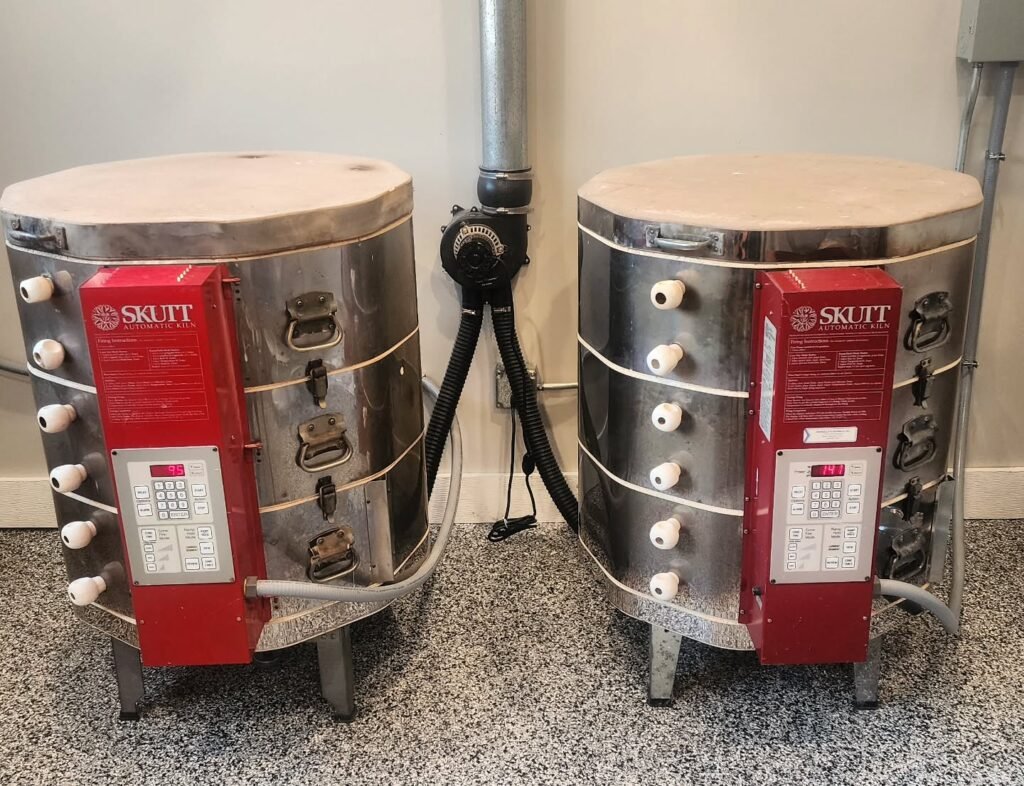
They are not the same thing.
A kiln vent is designed specifically to capture and remove emissions associated with firing. A room exhaust fan primarily exchanges air in the studio and removes heat and airborne contaminants after they enter the room.
That distinction matters.
You can have a powerful exhaust fan and still have a poorly designed kiln ventilation system.
You can also have a dedicated kiln vent and still need general room ventilation and fresh-air replacement.
For most potters planning an electric kiln in a home or small studio, the better question is not simply, “Which fan should I buy?”
It is:
What needs to be removed, where does it need to be captured, and where is the exhausted air going?
Skutt describes three basic purposes of kiln venting: removing heat from the room, removing fumes created during firing, and creating a kiln atmosphere that can benefit the ware.
Understanding those different jobs makes the kiln vent vs exhaust fan decision much easier.
Kiln Vent vs Exhaust Fan: The Basic Difference
The simplest distinction is source control.
A dedicated kiln vent is designed around the kiln.
An exhaust fan is designed around the room.
A downdraft kiln vent can draw air from the kiln chamber and direct fumes outside before they accumulate in the studio.
A room exhaust fan pulls air out of the room itself.
Both can move air.
They just do not necessarily move it from the same place.
Skutt’s EnviroVent 2, for example, uses a downdraft design with a collection cup beneath the kiln and a fan that draws air through openings in the kiln floor before exhausting it outdoors.
That makes it fundamentally different from installing a fan in a wall or window and hoping it captures everything produced by the kiln.
Why Does a Pottery Kiln Need Ventilation?
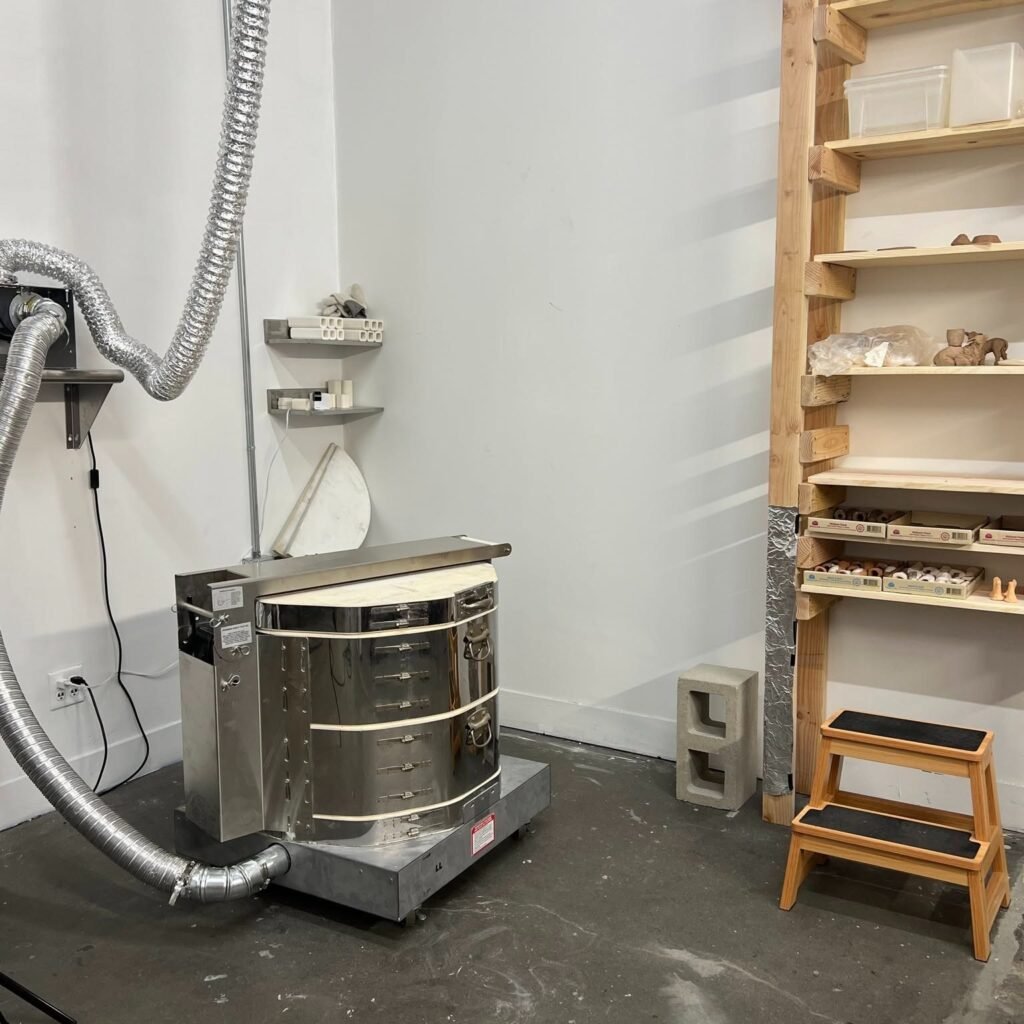
Firing is a chemical and thermal process.
Clay, glazes, kiln wash, organic material and other components can release gases, vapors or odors as they heat.
The studio therefore needs a way to control those emissions.
The goal is not simply to make the room smell better.
It is to prevent firing emissions from accumulating in the occupied workspace.
Skutt’s kiln safety guidance states that ventilation is important for maintaining a healthy work environment and appropriate room temperature.
That is why ventilation should be considered part of kiln installation rather than an accessory you think about after the kiln is already operating.
Do Electric Kilns Need Ventilation?
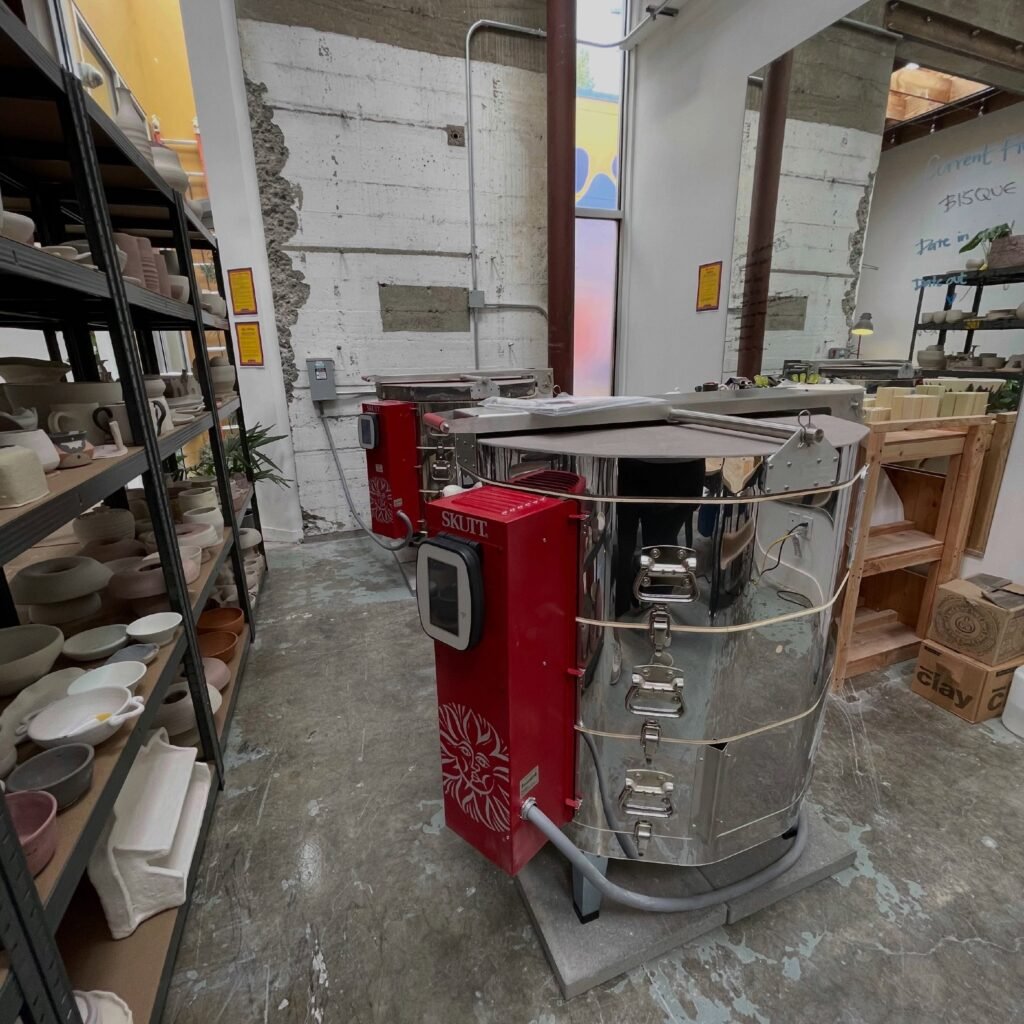
An electric kiln does not produce combustion exhaust in the same way as a gas-fired kiln.
That does not mean the firing process produces nothing that needs to be managed.
Materials inside the kiln undergo chemical changes as they heat.
Glazes can release vapors.
Organic material can burn out.
Certain clays and ceramic materials can produce noticeable odors or emissions.
This is why electric kiln studios still need appropriate ventilation.
Skutt specifically recommends a downdraft ventilation system such as the EnviroVent 2 for its electric kilns and describes the system as a way to remove fumes and odors from the kiln before they enter the room.
Kiln Vent vs Exhaust Fan for a Home Studio
The kiln vent vs exhaust fan decision becomes particularly important in a home studio.
A home studio is usually smaller than a commercial production space.
The kiln may be operating in:
- A garage
- Basement
- Utility room
- Dedicated studio
- Converted workshop
- Outbuilding
In a small room, emissions and heat can accumulate more quickly.
A room exhaust fan can help exchange air.
But a dedicated kiln vent addresses the source more directly.
That does not make a room exhaust fan useless.
It means the two systems perform different jobs.
A well-designed home studio may use dedicated kiln ventilation together with general room ventilation.
What Is a Downdraft Kiln Vent?
A downdraft vent pulls air downward through the kiln rather than simply collecting air above it.
In Skutt’s EnviroVent 2 design, air is drawn through openings in the kiln floor into a collection cup beneath the kiln. The air is then moved through ducting and exhausted outdoors.
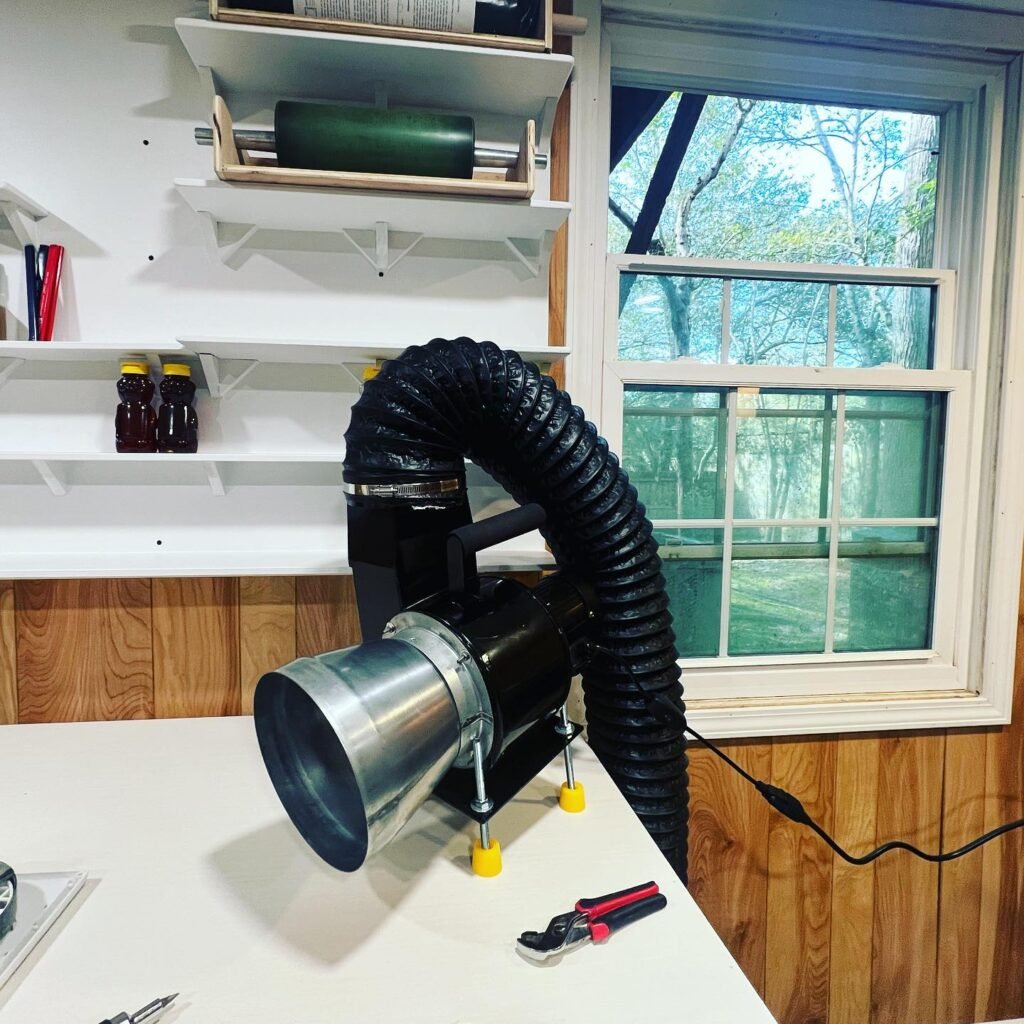
The design creates controlled airflow through the chamber.
That can help capture emissions before they enter the room.
The system also introduces fresh oxygen into the kiln chamber.
Skutt says this airflow can improve the kiln atmosphere and contribute to firing consistency.
Orton also describes its Vent Master as a downdraft kiln ventilation system designed to remove fumes from the workspace and support oxygen flow and temperature uniformity.
What Does an Exhaust Fan Do?
An exhaust fan removes air from a room.
Depending on its design and installation, it can help remove:
- Heat
- Odors
- Airborne contaminants
- Humidity
- General room air
This can be valuable in a kiln room.
Skutt specifically notes that overhead ventilation can be effective at removing heat from the room, but the required capacity should be determined based on the room, insulation and heat produced by the kiln.
The limitation is source capture.
An exhaust fan has to collect emissions after they enter the room.
A dedicated kiln vent is designed to capture them closer to the kiln.
That distinction is the heart of the kiln vent vs exhaust fan comparison.
Kiln Vent vs Exhaust Fan: Which Captures Fumes Better?
For source capture, a properly installed dedicated kiln vent has an important advantage.
The vent is positioned specifically to draw air from the kiln or immediately around the firing chamber.
That reduces the opportunity for emissions to spread throughout the studio first.
Skutt describes the EnviroVent 2 as creating negative pressure that draws fumes from the kiln before they enter the room.
An exhaust fan located across the room cannot provide the same source capture simply because it moves a larger volume of room air.
Airflow volume and source capture are different things.
A very powerful room fan is not automatically a substitute for a properly designed kiln vent.
Can I Use an Exhaust Fan Instead of a Kiln Vent?
Sometimes a properly designed room ventilation system may be appropriate for a particular installation.
But you should not assume that any wall, ceiling or window exhaust fan is an adequate substitute for a dedicated kiln vent.
The answer depends on:
- Kiln size
- Room size
- Firing materials
- Ventilation design
- Exhaust location
- Fresh-air supply
- Local building requirements
- Manufacturer requirements
Skutt explicitly distinguishes downdraft kiln venting from overhead ventilation and notes that overhead systems are primarily intended to remove heat and room air rather than capture fumes directly at the kiln.
For a new studio, have the entire ventilation plan evaluated rather than choosing a fan based only on its advertised airflow rating.
Kiln Vent vs Exhaust Fan for Heat
This is where an exhaust fan can be extremely useful.
A kiln produces a significant amount of heat.
That heat eventually enters the surrounding room.
A ceiling or wall exhaust system can remove heated room air.
A dedicated kiln vent is not necessarily designed to replace an HVAC system.
Skutt notes that kiln rooms should be evaluated by an HVAC professional to ensure room temperatures remain within appropriate limits.
This means your studio may need two ventilation functions:
Kiln ventilation: control emissions and kiln airflow.
Room ventilation: control the temperature and general air quality of the space.
That is one reason the kiln vent vs exhaust fan debate does not always have a single-device answer.
Does a Kiln Vent Cool the Room?
Not in the same way as an HVAC system.
A kiln vent moves air through the kiln and exhausts it outside.
That can remove some heat associated with the firing process, but it should not be treated as the studio’s complete cooling system.
Skutt’s installation guidance recommends planning HVAC requirements separately from kiln venting.
If your kiln room regularly becomes excessively hot, solve the room-temperature problem directly.
Do not assume that buying a stronger kiln vent is the same as installing adequate room ventilation.
Kiln Vent vs Exhaust Fan and Fresh Air
There is another side to exhaust ventilation that is easy to forget.
If you remove air from a room, replacement air has to come from somewhere.
This is called makeup air or fresh-air replacement.
Skutt’s current EnviroVent 2 manual states that a fresh-air source is essential because the system moves approximately 140 cubic feet of air per minute. The manual recommends allowing a window or door to remain slightly open if the room ventilation cannot otherwise provide the required replacement air.
This is a critical part of the kiln vent vs exhaust fan discussion.
A fan cannot continuously exhaust air from a sealed room without affecting the pressure balance.
You need a planned path for replacement air.
Where Should a Kiln Vent Exhaust?
Exhaust air should be discharged outdoors through an appropriate route.
The objective is to move firing emissions away from occupied areas.
Do not simply terminate the duct inside an attic, ceiling cavity, enclosed garage or other unoccupied-looking space.
The exhaust needs a proper destination.
You also need to consider where fresh-air intakes are located.
Skutt’s EnviroVent 2 manual specifically warns against exhausting fumes near a fresh-air intake.
That means exhaust and intake locations should be considered together.
Kiln Vent Ducting Matters
The fan is only one part of a ventilation system.
The ducting matters too.
Long runs, bends and undersized ductwork can affect airflow.
Skutt’s installation guidance provides duct-size recommendations for EnviroVent 2 installations and specifies a 3-inch duct connection for its standard setup.
Do not assume that buying a fan with a particular CFM rating guarantees that same performance after the air passes through a long or poorly configured duct run.
The complete system matters.
Kiln Vent vs Exhaust Fan: What About a Ceiling Hood?
A ceiling hood can be useful.
It can capture rising heat and fumes above the kiln.
It may also help with overall room ventilation.
But it is still different from source capture at the kiln.
Skutt acknowledges that overhead ventilation can remove heat effectively, while also explaining that it does not capture fumes in the same way a downdraft system does.
The practical question is therefore:
Do you need room ventilation, source capture, or both?
In many studio environments, the answer is both.
Can a Kiln Vent Improve Firing?
A properly installed downdraft vent can do more than remove odors.
Controlled airflow can influence the kiln atmosphere.
Skutt states that the EnviroVent 2 introduces fresh oxygen into the kiln chamber and can help improve firing consistency.
Orton similarly states that its Vent Master supports oxygen flow and temperature uniformity.
That does not mean a vent will automatically fix every firing problem.
Uneven firing can result from many factors, including:
- Element condition
- Shelf spacing
- Load density
- Firing speed
- Controller performance
- Cone placement
- Kiln size
- Thermocouple condition
Ventilation is one variable in the system.
It is not a substitute for proper kiln maintenance and loading.
Kiln Vent vs Exhaust Fan for Glaze Firing
Glaze firing is one of the situations where ventilation deserves particular attention.
Different glaze materials behave differently during firing.
Some materials can produce noticeable odors or emissions.
Metallic and sulfur-containing materials can be particularly noticeable.
Skutt specifically highlights metallics and high-sulfur clays as materials that can produce strong odors and identifies fume removal as a benefit of the EnviroVent 2.
If your studio regularly fires materials that produce noticeable fumes, source capture becomes especially useful.
What About Firing Clay?
Clay also undergoes chemical changes during firing.
Moisture leaves the ware.
Organic materials burn out.
Chemically bound components change as temperature rises.
That is another reason kiln ventilation should be planned from the beginning.
A kiln room should not depend entirely on opening a window whenever the kiln runs.
Opening a window can provide general airflow.
It does not necessarily capture emissions directly at their source.
Kiln Vent vs Exhaust Fan for a Garage Studio
Garages are common kiln locations because they provide space and separation from living areas.
But garages can still have ventilation problems.
They may have:
- Limited fresh-air exchange
- Poor insulation
- Combustible storage
- Vehicles
- Household chemicals
- Limited HVAC
- Shared walls with living spaces
A kiln vent can address source emissions.
A separate exhaust or HVAC strategy may still be needed for room temperature and general air exchange.
Skutt recommends planning kiln clearances, electrical requirements and ventilation requirements together when designing the kiln room.
Kiln Vent vs Exhaust Fan for a Basement Studio
Basements present a different challenge.
There may be limited windows.
The exhaust path may be longer.
Fresh-air replacement may be more complicated.
The kiln may also be located near occupied rooms.
In this situation, ventilation should be planned before installation.
Do not buy the kiln first and then discover that there is no sensible way to route the exhaust outdoors.
The duct route can be as important as the fan.
Kiln Vent vs Exhaust Fan for a Dedicated Studio
A purpose-built studio gives you more flexibility.
You can plan:
- Kiln location
- Electrical service
- Exhaust route
- Fresh-air intake
- HVAC
- Storage
- Working space
Skutt’s installation guidance specifically recommends planning the kiln room layout before installation and considering future expansion as part of the design.
If you know you may eventually add a second kiln, design the ventilation and electrical infrastructure with that possibility in mind.
Can One Kiln Vent Handle Two Kilns?
Some systems can.
For example, Skutt states that the EnviroVent 2 can be configured to vent two large kilns up to 12 cubic feet each using an optional dual intake or exhaust configuration.
That does not mean every two-kiln setup should share one vent.
The exact kiln sizes, ducting, installation and ventilation requirements matter.
If you are planning multiple kilns, verify the manufacturer’s configuration rather than improvising a shared duct system.
What About a Very Large Kiln?
Larger kilns can require different ventilation planning.
Skutt specifically notes that its dual exhaust configuration is required for certain larger kiln applications above 12 cubic feet.
This is another reason not to choose a vent based purely on the fan motor.
Match the ventilation system to the kiln.
The chamber volume, ducting, number of kilns and installation route all matter.
Do You Need a Kiln Vent for a Small Kiln?
Small does not automatically mean emission-free.
A compact kiln can still release odors and firing emissions.
The question is whether the studio’s ventilation system adequately manages them.
For a small kiln in a dedicated, properly ventilated workspace, the overall ventilation strategy may be simpler.
But if the kiln is operating in a small occupied room, source capture can become more valuable.
The kiln vent vs exhaust fan decision should therefore be based on the complete installation rather than kiln size alone.
What About Opening a Window?
Opening a window is useful for providing fresh air.
It can also improve general room ventilation.
But it should not automatically be treated as a kiln exhaust system.
The window does not capture emissions at the kiln.
Wind direction can change.
Room airflow can be unpredictable.
And in a tightly sealed room, the window may not provide enough exchange by itself.
Use windows as part of a planned ventilation strategy rather than assuming an open window solves everything.
What About a Box Fan?
A box fan can move a lot of air.
That does not make it a kiln ventilation system.
Placing a fan near the kiln may simply move contaminated air from one part of the room to another.
It may also disturb the intended airflow around the kiln.
If you need a ventilation system, use equipment designed for the application.
A fan’s advertised airflow number is not enough information to determine whether it is appropriate.
Kiln Vent vs Exhaust Fan: Installation Cost
The cost difference depends heavily on the studio.
A simple room exhaust fan may be inexpensive.
A dedicated kiln vent involves more components.
You may need:
- Vent motor
- Collection system
- Ducting
- Wall penetration
- Outdoor termination
- Electrical connection
- Fresh-air provision
- Professional installation
A room exhaust system may also require ductwork, electrical work and HVAC evaluation.
So comparing only the price of the fan itself is misleading.
Compare the complete installed system.
Kiln Vent vs Exhaust Fan: What Should You Buy?
For a dedicated electric pottery kiln, think in terms of functions.
If your priority is capturing kiln emissions at the source, a dedicated downdraft kiln vent is designed for that purpose.
If your priority is removing heat from the room, an appropriately sized room exhaust system may be important.
If your studio has both problems, you may need both approaches.
Skutt explicitly describes these as different ventilation functions and recommends evaluating room HVAC separately from kiln venting.
That is a more useful buying framework than simply asking which fan moves the most air.
What to Look for in a Kiln Vent
If you decide a dedicated system makes sense, look for:
Manufacturer compatibility
Make sure the vent is compatible with your kiln.
Proper source capture
The system should be designed to capture emissions from the kiln.
Appropriate ducting
The duct size and length should match the system requirements.
Outdoor exhaust
The system needs an appropriate exhaust destination.
Fresh-air replacement
The room needs enough makeup air.
Control
Some systems can be integrated with kiln controllers.
Serviceability
Replacement parts and technical support matter.
Installation documentation
A good system should provide clear installation instructions.
Skutt’s EnviroLink, for example, can control an EnviroVent 2 through compatible Skutt kiln controllers, allowing the vent to operate according to programmed firing settings.
Is Automatic Vent Control Worth It?
For many potters, yes.
One of the easiest mistakes is simply forgetting to turn the vent on.
A controller-linked system reduces that problem.
Skutt’s EnviroLink is designed to control the EnviroVent 2 from compatible kiln controllers, with different operating options depending on the programmed firing mode.
That is a convenience feature, but it can also make consistent operation easier.
Kiln Vent vs Exhaust Fan: Common Mistakes
Mistake 1: Assuming any fan is a kiln vent
It is not.
Mistake 2: Choosing the biggest fan
Airflow volume alone does not determine source capture.
Mistake 3: Ignoring makeup air
Exhausting air requires replacement air.
Mistake 4: Exhausting into an attic
The exhaust needs an appropriate outdoor destination.
Mistake 5: Putting the exhaust near a fresh-air intake
That can allow exhausted air to be drawn back into the building.
Mistake 6: Treating room cooling as kiln ventilation
They are different jobs.
Mistake 7: Forgetting duct length
Long duct runs and bends affect system performance.
Mistake 8: Installing before planning the kiln location
The kiln, electrical system and ventilation route should be planned together.
Mistake 9: Assuming a window solves everything
Fresh air is useful, but source capture is a separate consideration.
Mistake 10: Ignoring local requirements
Building, electrical and mechanical requirements vary by location.
A Practical Ventilation Planning Checklist
Before installing your kiln, answer these questions:
Where is the kiln going?
Choose the location before planning the exhaust.
What materials will you fire?
Your clay and glaze materials influence the emissions you need to manage.
How large is the room?
Room volume affects temperature and ventilation requirements.
Where will exhaust air go?
Plan a proper outdoor route.
Where will replacement air come from?
Exhaust systems need makeup air.
How long is the duct run?
Account for bends and length.
Will the kiln room need additional cooling?
A kiln vent is not automatically an HVAC system.
Will you add another kiln later?
Plan for future capacity if appropriate.
Does the manufacturer specify a particular vent?
Follow the kiln manufacturer’s recommendations.
Do local requirements apply?
Check applicable building, electrical and mechanical requirements.
Frequently Asked Questions
Is a kiln vent the same as an exhaust fan?
No. A kiln vent is designed around the kiln and can capture emissions at or near their source. An exhaust fan generally removes air from the room.
Can I use an exhaust fan instead of a kiln vent?
It depends on the complete ventilation design. A room exhaust system may help remove heat and airborne contaminants, but it should not automatically be considered equivalent to source-capture kiln ventilation.
Do electric kilns need ventilation?
Electric kilns do not have combustion exhaust like gas kilns, but firing can still produce fumes, vapors and odors. Appropriate ventilation should therefore be planned for electric kiln installations.
What is a downdraft kiln vent?
A downdraft vent draws air through or beneath the kiln and exhausts it outdoors. Skutt’s EnviroVent 2 is an example of this design.
Does a kiln vent remove heat?
It can remove some heat associated with the kiln, but it should not automatically be treated as the studio’s complete cooling system. Room HVAC may still be required.
Does a kiln vent need fresh air?
Yes. Exhausting air from the room requires replacement air. Skutt’s EnviroVent 2 manual specifically calls for a source of fresh air to replace the air being exhausted.
Can I just open a window?
An open window can provide makeup air and improve general ventilation, but it does not necessarily capture emissions directly from the kiln.
Can one vent handle two kilns?
Some systems can be configured for multiple kilns. Skutt’s EnviroVent 2 has a dual-kiln configuration for certain kiln sizes. The exact installation must match the manufacturer’s specifications.
Does a kiln vent improve firing?
A properly installed downdraft vent can influence kiln airflow and atmosphere. Skutt and Orton both describe improved airflow and potential firing-uniformity benefits from their downdraft systems.
Should the kiln vent exhaust near a window?
No. Exhaust should not be positioned where discharged air can easily return through a fresh-air intake or window. Skutt’s manual specifically warns against exhausting fumes near a fresh-air intake.
Final Verdict: Kiln Vent vs Exhaust Fan
The kiln vent vs exhaust fan debate becomes much easier when you stop treating them as competing versions of the same product.
They solve different problems.
A dedicated kiln vent is about source capture and controlled kiln airflow.
A room exhaust fan is about room air exchange and heat removal.
A good studio may need one.
It may need the other.
It may need both.
For a home pottery studio, the most important thing is to plan the entire ventilation system before the kiln arrives.
Choose the kiln location.
Plan the exhaust route.
Plan the fresh-air supply.
Consider room temperature.
Check the kiln manufacturer’s requirements.
Then determine whether you need dedicated kiln ventilation, room exhaust, or a combination.
Skutt’s current installation guidance specifically recommends considering kiln clearances, electrical requirements, HVAC requirements and venting requirements together when planning a kiln room.
Orton likewise offers a dedicated Vent Master system designed around electric kiln ventilation and describes source removal, oxygen flow and temperature uniformity as key functions.
If you are buying a kiln from The Kiln Depot, do not treat ventilation as an afterthought. The kiln, furniture, electrical installation, ventilation and studio layout all form one system.
A kiln can be an excellent piece of equipment.
But the installation around it determines how well that equipment works in the real studio.
Buy the kiln first only if you already know how you are going to ventilate it.
