A kiln thermocouple is one of the most important components inside an electronically controlled pottery kiln.
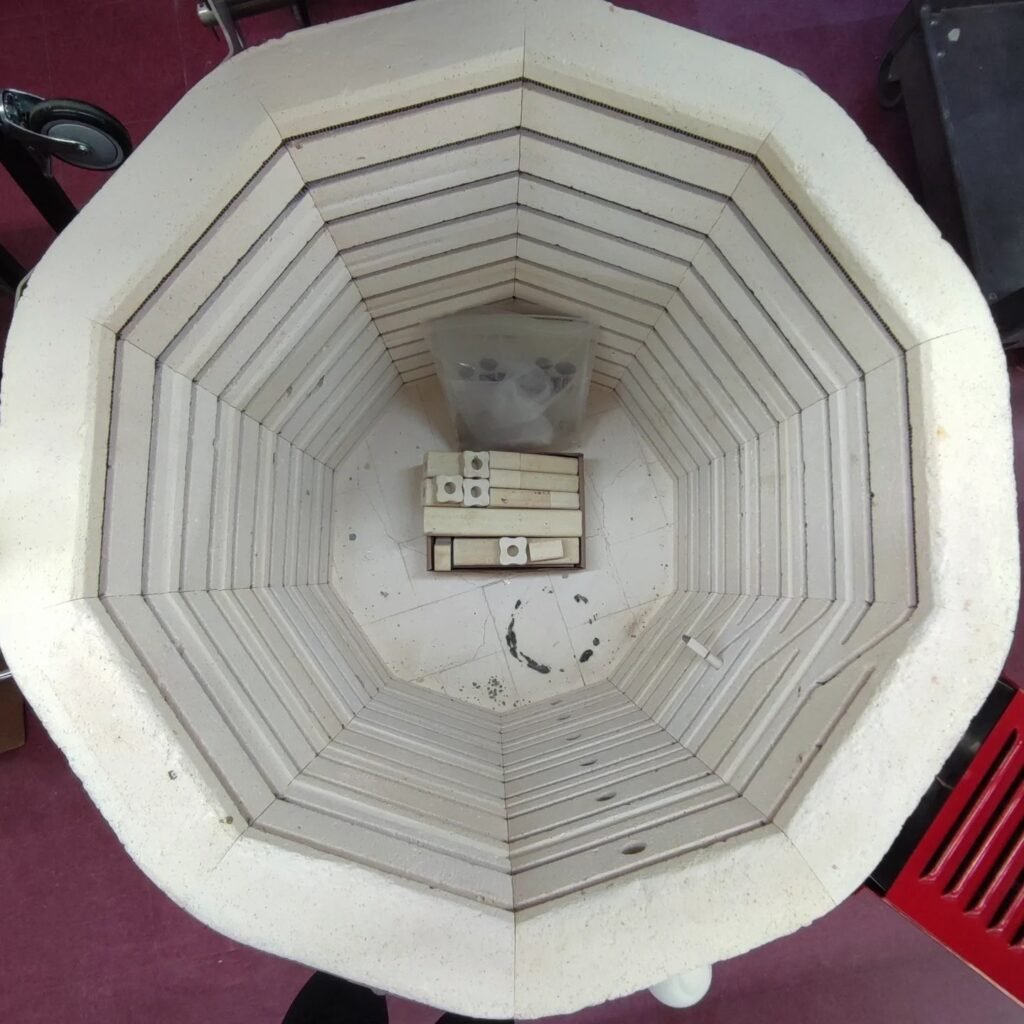
It is the temperature sensor.
The controller relies on the thermocouple to know what is happening inside the firing chamber. If the sensor is reading accurately, the controller can regulate the heating elements according to the programmed firing schedule.
If the sensor becomes inaccurate, damaged or incorrectly installed, the controller may be working perfectly while receiving bad information.
That distinction matters.
A slow kiln does not automatically mean bad elements.
A strange temperature reading does not automatically mean a bad controller.
And a kiln that continues heating past the expected temperature does not necessarily have a relay problem.
The kiln thermocouple belongs on the diagnostic list whenever the temperature information coming from the kiln does not make sense.
Skutt and L&L both provide model-specific thermocouple replacement procedures and emphasize using the correct thermocouple for the kiln and controller.
What Does a Kiln Thermocouple Do?
A kiln thermocouple measures temperature inside the firing chamber.
It consists of two dissimilar metals that generate a small electrical signal as their temperature changes.
The controller interprets that signal and displays a temperature.
It then uses the temperature information to determine how much heating is required.
The basic sequence is:
Thermocouple → temperature signal → controller → relay → heating elements
That makes the thermocouple a critical link in the control system.
If the thermocouple tells the controller the kiln is cooler than it actually is, the controller may continue heating.
If it reports a temperature that is higher than the actual chamber temperature, the controller may reduce heating too early.
Either situation can affect the firing result.
Why Is a Kiln Thermocouple So Important?
Ceramic firing depends on controlled heatwork.
The kiln needs accurate information about what is happening inside the chamber.
A controller cannot make an intelligent heating decision if its temperature sensor is inaccurate.
That is why thermocouple condition deserves attention alongside elements, relays and controllers.
The component itself is relatively small.
Its influence is not.
A faulty sensor can potentially affect an entire kiln load.
This is particularly important when firing valuable work, expensive glazes or pieces that have taken days or weeks to produce.
Signs Your Kiln Thermocouple May Be Failing
There is no single symptom that proves a thermocouple is defective.
However, several warning signs deserve investigation.
Watch for:
- Unusual temperature readings
- Temperature readings that change unexpectedly
- Firing behavior that differs from previous firings
- The kiln reaching temperature unusually quickly
- The kiln overshooting the programmed temperature
- Controller error messages
- A visibly corroded thermocouple tip
- A damaged or shortened thermocouple
- A thermocouple that has become brittle
- Incorrect temperature readings compared with witness cones
A firing problem can have several causes.
Treat these symptoms as reasons to investigate, not automatic proof that the sensor needs replacement.
A Kiln Suddenly Fires Differently
Suppose your kiln has always behaved consistently.
A Cone 6 firing normally follows a familiar temperature curve.
Then suddenly, the kiln behaves differently.
Perhaps it reaches the programmed temperature much faster.
Perhaps it appears to hold longer than expected.
Perhaps your witness cones show a result that does not match previous firings.
That change deserves investigation.
The kiln thermocouple is one possible cause.
But also consider:
- Heating elements
- Relays
- Controller settings
- Electrical supply
- Load size
- Firing schedule
- Ambient conditions
- Thermocouple placement
Do not replace a sensor simply because one firing looked unusual.
Look for a repeatable pattern.
Can a Bad Kiln Thermocouple Cause Overfiring?
Yes.
This is one of the reasons thermocouple condition matters.
If the sensor underreports the actual kiln temperature, the controller can believe the kiln is cooler than it really is.
The controller may therefore continue applying heat.
L&L warns that a thermocouple whose measuring tip is incorrectly positioned or buried in insulation can read lower than the actual kiln temperature, potentially contributing to overfiring.
Skutt also warns that incorrect thermocouple configuration, particularly when converting between thermocouple types, can result in severe overfiring.
That is not a problem to experiment with.
If you suspect inaccurate temperature measurement, stop normal firing and diagnose the system before risking another load.
Can a Bad Thermocouple Cause Underfiring?
Yes.
If the sensor reports a higher temperature than the actual kiln temperature, the controller can reduce heating too early.
The kiln may then appear to reach its target temperature while the pottery receives insufficient heatwork.
This is one reason witness cones remain useful.
The controller tells you what its sensor is reporting.
Witness cones give you another physical indication of what happened during the firing.
If the controller and cones repeatedly disagree, investigate rather than assuming the programmed temperature is the whole story.
Kiln Thermocouple vs Controller
These components work together but do completely different jobs.
The kiln thermocouple measures temperature.
The controller interprets that measurement and manages the firing program.
That means a controller can appear to be malfunctioning when the real problem is the sensor.
For example, the display might show a temperature that seems unreasonable.
The controller may actually be accurately displaying the signal it is receiving.
If the thermocouple is damaged or incorrectly wired, the controller cannot magically correct the information.
This is why replacing a controller should not be your first response to every temperature problem.
Kiln Thermocouple vs Heating Elements
Elements generate heat.
The thermocouple measures it.
A worn element can cause slow firing.
A faulty thermocouple can cause inaccurate temperature control.
The symptoms can overlap.
For example, both problems can produce unusual firing times.
That is why troubleshooting should consider the whole system.
If the kiln is slow but the temperature readings behave normally, elements or electrical issues deserve attention.
If the displayed temperature itself behaves strangely, investigate the thermocouple and its wiring.
The distinction is not always perfect, but it helps narrow the possibilities.
What Is a Type K Thermocouple?
Type K is one of the common thermocouple types used in electric kilns.
Skutt states that its standard ceramic kiln thermocouples are generally Type K and describes them as accurate and relatively inexpensive.
L&L similarly identifies Type K as a standard thermocouple used in many of its kilns.
Type K thermocouples are widely used because they provide a practical combination of temperature range, cost and availability.
Their main limitation is that they gradually degrade when repeatedly exposed to high temperatures.
That means they are consumable components.
Eventually, they need replacement.
What Is a Type S Thermocouple?
Type S is a higher-cost thermocouple using platinum and rhodium.
It is valued for its durability at high temperatures and harsh firing conditions.
Skutt describes Type S thermocouples as an upgrade option for demanding applications, particularly where high temperatures or aggressive firing conditions accelerate Type K wear.
L&L similarly describes Type S as a premium option and notes its suitability for high-fire applications.
The important word is upgrade.
You cannot simply remove a Type K sensor and install a Type S sensor without changing the associated configuration.
The controller must be configured correctly.
The thermocouple wiring must also be appropriate.
Type K vs Type S Thermocouple
| Feature | Type K | Type S |
|---|---|---|
| Typical cost | Lower | Higher |
| Common kiln use | Very common | Specialized/high-fire |
| High-temperature durability | Good but wears | Excellent |
| Material | Nickel-based alloys | Platinum/rhodium |
| Replacement frequency | Eventually required | Much longer potential life |
| Wiring | Type K wiring | Type S wiring |
| Controller configuration | Type K | Must support Type S |
| Best use | General ceramic firing | Demanding high-fire applications |
Type S is not automatically the better choice for every potter.
For many studios, a standard Type K provides everything needed.
If you regularly fire at high temperatures or operate in conditions that accelerate sensor degradation, a Type S upgrade may be worth considering.
Should You Upgrade From Type K to Type S?
It depends on your firing habits.
Skutt specifically points to high-temperature and demanding applications as situations where Type S can make sense.
A potter firing occasionally at moderate temperatures may gain little from the upgrade.
A studio firing frequently at high temperatures may value the longer potential service life.
But there is another issue.
Type S components are more expensive and can be physically more fragile.
Skutt warns that the platinum wire and protective assembly can be damaged mechanically, including by contact with kiln shelves.
So the decision is not simply:
Type S = better.
It is:
Does the durability justify the additional cost and handling requirements for your firing environment?
How Often Should a Kiln Thermocouple Be Replaced?
There is no universal firing count.
Thermocouple lifespan depends on:
- Type
- Firing temperature
- Firing frequency
- Atmosphere
- Mechanical damage
- Installation
- Contamination
- Material degradation
Type K sensors gradually degrade with use.
L&L recommends inspecting Type K thermocouples and replacing them when their condition or accuracy becomes unacceptable.
The better approach is condition-based replacement rather than blindly replacing every sensor after an arbitrary number of firings.
What Does a Worn Thermocouple Look Like?
Physical inspection can provide useful clues.
Depending on the design, look for:
- Severe corrosion
- Erosion
- Deformation
- Brittle material
- A damaged tip
- Cracks
- Excessive thinning
- Contamination
- A shortened exposed section
L&L specifically recommends visual inspection of Type K thermocouple tips and identifies severe corrosion as a reason for concern.
A thermocouple does not have to break completely to become unreliable.
Physical deterioration can affect its accuracy before total failure.
Why Thermocouple Placement Matters
The sensor has to measure the kiln chamber, not the insulation.
If the measuring tip is buried too deeply in the brick, it may not accurately represent the chamber temperature.
L&L states that the thermocouple tip must be exposed inside the kiln and warns that a sensor buried in insulation can read lower than the actual kiln temperature.
Placement also matters because the thermocouple should not be positioned where shelves or pottery can easily strike it.
A sensor that is technically functional but badly positioned can still create problems.
How Far Should a Kiln Thermocouple Extend?
The exact placement depends on the kiln and thermocouple design.
Do not use a generic measurement from another kiln as your installation specification.
L&L’s current guidance states that thermocouples in automatic kilns should extend at least 1 inch into the kiln from the interior surface, while its replacement guidance provides model-specific positioning information.
Skutt’s documentation likewise provides model-specific installation instructions.
Follow the manual for your exact kiln.
Can Kiln Shelves Hit the Thermocouple?
They can if the loading arrangement is poor.
This is one reason shelf spacing and kiln furniture matter.
A shelf should not be positioned so close to the thermocouple that it can strike or crowd the sensor.
Pottery should also have appropriate clearance.
If you regularly fire large work, identify the thermocouple location before building the load.
The sensor is part of the firing system.
It should not be treated as an obstacle you can work around at the last second.
Thermocouple Polarity Matters
Thermocouple wires have polarity.
The positive and negative connections need to be correctly matched.
L&L specifically warns that reversing polarity can cause incorrect readings or error conditions.
This is an easy mistake to make during replacement because the wires can look deceptively simple.
Do not rely on memory.
Use the manufacturer’s wiring diagram.
Take photographs before disconnecting an old sensor if the manufacturer permits the procedure and you are performing an authorized repair.
Then verify the positive and negative connections before powering the kiln.
What Happens if Thermocouple Polarity Is Reversed?
The controller may receive an incorrect signal.
L&L notes that reversed Type K polarity can cause false readings, while reversed Type S wiring can produce negative temperature readings or error conditions.
The exact behavior depends on the controller and thermocouple type.
The important point is that polarity is not optional.
Match the wiring exactly.
Can You Replace a Kiln Thermocouple Yourself?
Some experienced kiln owners can replace a thermocouple using manufacturer instructions.
Both Skutt and L&L publish replacement procedures.
However, the kiln must be disconnected from electrical power before opening the control system.
This is not a cosmetic repair.
The control panel can contain hazardous electrical circuits even when the kiln is not firing.
If you are not comfortable working around electrical equipment, use qualified service.
Do not improvise.
Basic Kiln Thermocouple Replacement Process
The exact procedure varies by manufacturer and model.
Generally, the process involves:
- Disconnecting the kiln from power.
- Opening the appropriate control or element panel.
- Identifying the thermocouple wiring.
- Disconnecting the old sensor.
- Removing the old thermocouple.
- Installing the correct replacement.
- Connecting the wires with correct polarity.
- Positioning the sensor correctly.
- Closing the control system.
- Testing the kiln according to the manufacturer’s instructions.
Skutt’s current replacement documentation follows this general sequence for its applicable KilnMaster thermocouples.
L&L provides a similar model-specific process.
The important part is not memorizing these ten steps.
It is following the exact instructions for your kiln.
Never Buy a Thermocouple by Appearance
This is one of the biggest purchasing mistakes.
Thermocouples can look similar while having different:
- Types
- Lengths
- Diameters
- Protection tubes
- Connectors
- Wiring
- Controller compatibility
Skutt explicitly provides identification guidance because different kiln models use different thermocouple assemblies.
L&L likewise lists different Type K and Type S configurations by kiln model and installation.
Use the kiln’s model and serial information when ordering.
Why the Kiln Model Matters
A replacement sensor needs to match the kiln’s control system.
The same manufacturer can use different thermocouples across different product families.
Even within a product family, there can be changes over time.
Skutt’s support documentation identifies different thermocouple assemblies and replacement procedures across its kiln models.
That is why “I need a Skutt thermocouple” is incomplete information.
You need to identify the kiln.
The same applies to L&L, Olympic, Paragon and other manufacturers.
Kiln Thermocouple Cost
The cost varies considerably according to type and manufacturer.
As one current L&L example, its standard Type K 8-gauge thermocouple is listed at $55 per unit.
Type S thermocouples cost substantially more because they use platinum and rhodium.
Skutt explicitly identifies the higher price of Type S as one of its disadvantages.
Do not compare thermocouples by price alone.
The inexpensive sensor that does not fit your kiln is not a bargain.
Should You Replace the Thermocouple When Replacing Elements?
This can be a sensible maintenance decision, particularly if the sensor is old.
L&L explicitly recommends replacing Type K thermocouples when replacing elements because the thermocouple also degrades during high-temperature use.
However, you should still consider condition, age, firing temperature and manufacturer guidance.
If a relatively new thermocouple is in excellent condition, replacing it simply because the elements are being changed may not always be necessary.
For an older kiln already undergoing significant electrical maintenance, replacing multiple aging wear components at once can sometimes reduce future downtime.
Kiln Thermocouple and Witness Cones
Witness cones remain valuable even when your kiln has a digital controller.
Why?
Because the controller measures temperature.
The cone responds to heatwork.
Those are related but not identical concepts.
If your programmed firing repeatedly produces unexpected cone results, the thermocouple is one possible thing to investigate.
But also examine:
- Firing rate
- Hold times
- Element condition
- Kiln loading
- Shelf spacing
- Glaze behavior
- Controller calibration
Use cones as another source of evidence rather than treating them as a replacement for the controller.
Kiln Thermocouple and Controller Errors
A failing sensor can trigger controller errors.
The exact error depends on the controller.
A thermocouple may also fail electrically or become disconnected.
When an error appears, do not immediately replace the controller.
Check the manufacturer’s troubleshooting documentation.
Inspect the sensor.
Inspect its wiring.
Check the connections.
Then determine whether the controller itself is actually defective.
This diagnostic approach can save considerable money.
What Is a Thermocouple Protection Tube?
Some kiln thermocouples are housed inside protective tubes.
The tube helps protect the sensor from mechanical damage and the kiln environment.
However, the protection tube itself can accumulate material or debris.
L&L recommends cleaning material from older protection tubes when replacing thermocouples because metallic oxides can fall onto the new sensor and interfere with temperature readings.
If your kiln uses a protection tube, inspect it during sensor replacement.
Can a Kiln Thermocouple Be Too Short?
Yes.
The sensor needs to be positioned correctly inside the firing chamber.
A replacement that is physically shorter than the specified component may not place the measuring tip in the correct location.
That can affect readings.
Never assume that a thermocouple with the same electrical type but a different physical length is interchangeable.
Match the manufacturer’s specified component.
Kiln Thermocouple Maintenance
Thermocouple maintenance is mostly inspection.
Before or during periodic kiln maintenance, check:
- Tip condition
- Corrosion
- Mechanical damage
- Position
- Wiring
- Polarity
- Connection hardware
- Protection tube
- Controller compatibility
Avoid hitting the sensor with shelves, posts or pottery.
During loading, know where it is.
During maintenance, inspect it.
During troubleshooting, consider it.
That simple routine can prevent many avoidable firing problems.
Buying a Used Kiln: Check the Thermocouple
A used kiln can be an excellent value, but the condition of the temperature-sensing system matters.
Ask:
What type of thermocouple does it use?
When was it last replaced?
Does it show corrosion?
Does the controller display temperature normally?
Does the kiln fire consistently?
Are the wires and connections intact?
Is the replacement part still available?
If the sensor is old, include replacement cost in your evaluation.
A $40–$100 component is not necessarily a reason to reject a used kiln.
It is simply part of the real ownership cost.
Buying a Refurbished Kiln: What to Ask
If you are buying refurbished equipment, ask specifically about the thermocouple.
Do not accept a vague statement such as “the kiln was tested.”
Ask:
- Was the thermocouple inspected?
- Was it replaced?
- What type is installed?
- Was polarity verified?
- Was the controller tested?
- Was the kiln test-fired?
- Were witness cones used?
- Was the sensor positioned correctly?
The answers help establish what refurbishment actually means.
A kiln with a documented new thermocouple and test firing is a different proposition from one that was simply cleaned and repainted.
Type S Upgrade: What Can Go Wrong?
Upgrading from Type K to Type S is not simply a matter of inserting a more expensive sensor.
The wiring must match.
The controller must be configured for the correct thermocouple type.
Skutt explicitly warns that failing to change the required wiring and controller configuration during a Type K to Type S conversion can cause severe overfiring.
L&L provides similar warnings about controller configuration and Type S compatibility.
This is a situation where professional installation can be worth the money if you are not completely familiar with the system.
Common Kiln Thermocouple Mistakes
1. Ordering the wrong type
Type K and Type S are not interchangeable.
2. Ordering by appearance
Physical similarity does not guarantee compatibility.
3. Reversing polarity
Incorrect wiring can produce false readings or errors.
4. Installing the sensor too far into the insulation
The tip needs to measure the kiln chamber.
5. Installing it too far into the chamber
The sensor can become vulnerable to mechanical damage.
6. Letting shelves hit the sensor
This can damage even a correctly installed thermocouple.
7. Ignoring corrosion
A deteriorating sensor can become unreliable before completely failing.
8. Replacing the controller first
The sensor may be the actual problem.
9. Upgrading to Type S without changing configuration
The controller and wiring must support the new thermocouple.
10. Ignoring witness cones
They can provide valuable evidence about what actually happened during firing.
Kiln Thermocouple Troubleshooting Checklist
If the kiln temperature seems wrong, work through the system.
Check the displayed temperature.
Does it behave normally?
Check the thermocouple visually.
Is it corroded or damaged?
Check the position.
Is the tip correctly exposed?
Check the wiring.
Are the connections secure?
Check polarity.
Are positive and negative correctly connected?
Check the controller configuration.
Does it match the thermocouple type?
Check the firing log.
Has the kiln’s behavior changed?
Check witness cones.
Do the cones agree with previous firings?
Check other kiln components.
Elements, relays and electrical supply can produce similar symptoms.
This approach gives you evidence instead of guesses.
Frequently Asked Questions
What does a kiln thermocouple do?
A kiln thermocouple measures the temperature inside the firing chamber and sends that information to the kiln controller.
How do I know if my kiln thermocouple is bad?
Possible signs include inaccurate temperature readings, unusual firing behavior, corrosion, physical damage, controller errors or repeated disagreement between programmed firing behavior and witness cones.
How often should a kiln thermocouple be replaced?
There is no universal interval. Type K thermocouples gradually degrade with high-temperature use, so replacement should be based on condition, accuracy and manufacturer guidance.
What is a Type K thermocouple?
Type K is a common thermocouple type used in ceramic kilns. It is relatively inexpensive and accurate but gradually degrades with repeated high-temperature exposure.
What is a Type S thermocouple?
Type S uses platinum and rhodium and is designed for demanding high-temperature applications. It is considerably more expensive than Type K but can provide much longer service under suitable conditions.
Can a bad kiln thermocouple cause overfiring?
Yes. If the sensor underreports the actual kiln temperature, the controller may continue heating longer than it should.
Can a kiln thermocouple cause underfiring?
Yes. An inaccurate reading can cause the controller to reduce heating before the pottery has received the intended heatwork.
Can I replace a kiln thermocouple myself?
Some manufacturers provide replacement instructions for experienced users. However, electrical safety procedures must be followed, and anyone uncomfortable working inside kiln control equipment should use qualified service.
Does thermocouple polarity matter?
Yes. The positive and negative connections must be correctly matched. Incorrect polarity can produce false readings or controller errors.
How much does a kiln thermocouple cost?
It depends on the type and manufacturer. As one current example, L&L lists a standard Type K 8-gauge thermocouple at $55.
Is Type S better than Type K?
Not automatically. Type S offers greater durability for demanding high-temperature applications but costs considerably more and requires compatible wiring and controller configuration.
Should I replace the thermocouple when replacing elements?
It can make sense if the thermocouple is old or heavily used. L&L specifically recommends replacing Type K thermocouples when replacing elements because they also degrade with high-temperature use.
Final Thoughts
The kiln thermocouple is easy to overlook because it is much smaller than the elements, shelves or kiln body.
But it is effectively the kiln’s temperature sensor.
The controller cannot make good decisions without reliable temperature information.
That is why unusual firing behavior deserves more than a quick guess.
If your kiln is suddenly firing differently, investigate the thermocouple alongside the elements, relays, controller and electrical supply.
Look at its physical condition.
Check its position.
Check its wiring.
Verify polarity.
Confirm that the controller is configured for the correct thermocouple type.
And use witness cones as another source of evidence.
For general ceramic firing, Type K remains a common and economical option. For demanding high-temperature applications, Type S can offer substantially greater durability, but the upgrade requires the correct wiring and controller configuration.
When buying a replacement, do not search for a generic “kiln thermocouple.”
Identify the kiln model, serial number, thermocouple type, physical configuration and controller first.
That small amount of research can prevent you from installing the wrong sensor and potentially turning a simple maintenance job into a much more expensive firing problem.
For a used or refurbished kiln, the same rule applies.
The condition of the thermocouple is part of the kiln’s value.
A kiln with worn elements, old relays, deteriorated wiring and an aging thermocouple may still be worth buying, but those parts belong in the ownership-cost calculation.
A kiln is a system.
The thermocouple is one of the components that tells that system what temperature it is actually experiencing.
Treat it accordingly.
