When a kiln breaker trips, do not simply reset it and start the firing again.
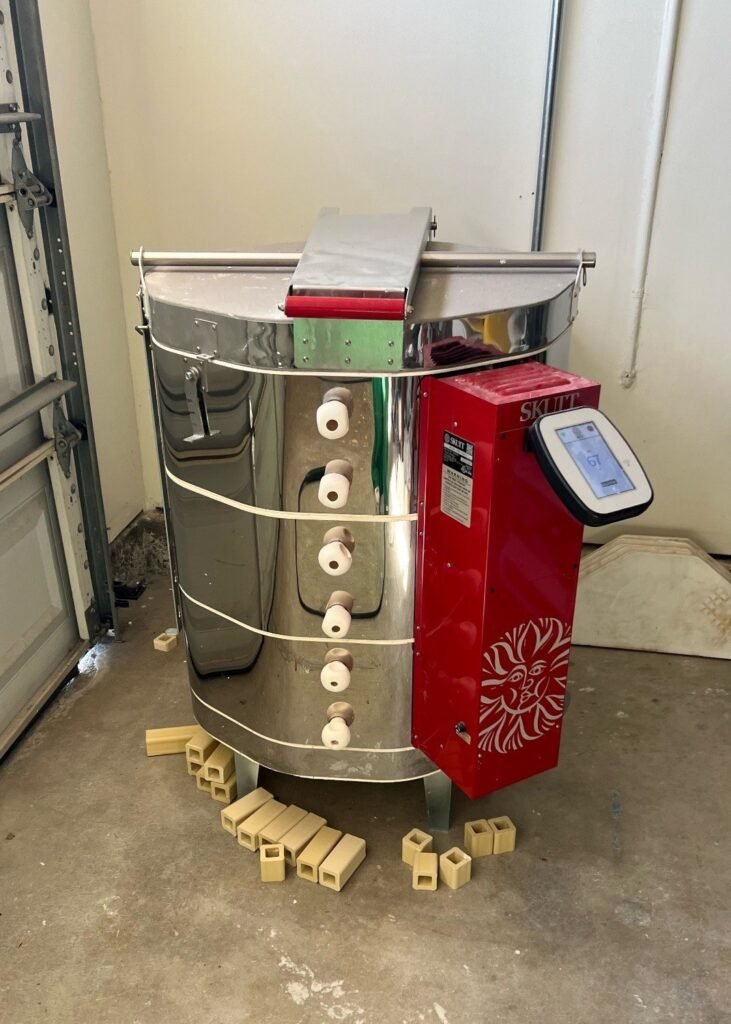
A circuit breaker is interrupting electrical power because it has detected a condition that requires attention. The cause might be a problem with the kiln, the electrical circuit, the breaker itself, or the relationship between the kiln’s electrical requirements and the building’s supply.
The timing of the trip is one of the most useful clues.
A kiln breaker that trips immediately is a different troubleshooting problem from one that runs for several hours before shutting off.
Likewise, a breaker that becomes unusually hot deserves a different response from one that trips without becoming noticeably warm.
The most important rule is simple:
Do not install a larger breaker just to stop the breaker from tripping.
The breaker, wiring, receptacle, disconnect, and kiln must be correctly matched. Increasing breaker capacity without verifying the rest of the electrical system can create a serious fire hazard.
Skutt’s current troubleshooting guidance specifically addresses circuit breaker trips during firing and recommends checking the kiln’s electrical installation, voltage, wiring, connections, and breaker condition rather than simply resetting the breaker repeatedly.
Why Does a Kiln Breaker Trip?

A circuit breaker trips when the electrical system detects excessive current or another condition that causes the breaker to interrupt the circuit.
With a pottery kiln, several things can produce a trip.
Common possibilities include:
- Incorrect breaker size
- Incorrect supply voltage
- Excessive current draw
- Worn or damaged electrical connections
- Damaged wiring
- A faulty heating element
- A short circuit
- A weak or defective breaker
- An electrical installation problem
- A kiln configuration that does not match the available supply
- Excessive heat at the breaker or connection
- A problem that develops only after the kiln heats up
The challenge is determining which one applies to your kiln.
That is why kiln breaker trips should be diagnosed based on when and how the breaker trips.
The First Question: When Does the Kiln Breaker Trip?
Start with the timing.
Ask yourself:
Does the breaker trip immediately after starting the kiln?
Does it trip after several minutes?
Does it trip several hours into the firing?
Does it trip only near the highest temperatures?
Does it trip randomly?
Does it trip every time?
That information can dramatically narrow the possible causes.
Immediate trip
An immediate trip can indicate a significant electrical fault, incorrect voltage configuration, wiring problem, short circuit, or another serious issue.
Trip after several minutes
A delayed trip may indicate an electrical component that becomes problematic as it heats, excessive current, or a connection that is heating under load.
Trip after several hours
A kiln that fires normally for a long time and then trips can have a different problem from one that trips the moment power is applied.
Thermal effects, current draw, connections, and breaker heating become more relevant.
Random trips
Intermittent trips can be especially difficult to diagnose.
The firing history, electrical supply, breaker condition, connections, and kiln components all need consideration.
The important point is that the timing itself is evidence.
Kiln Breaker Trips Immediately
If the kiln breaker trips immediately when you start the kiln, stop troubleshooting by repeatedly resetting it.
An immediate trip can indicate a significant fault.
Possible causes include:
- Shorted wiring
- Incorrect voltage
- Incorrect electrical connection
- Damaged power cord
- Damaged receptacle
- Faulty component
- Incorrect breaker installation
- Internal kiln wiring problem
Skutt’s troubleshooting flowchart specifically asks whether the breaker trips immediately and then directs the diagnosis toward voltage compatibility, wiring, connections, and breaker condition.
This is not the time to keep pressing Reset.
Turn the system off and investigate the electrical installation.
If you are not qualified to diagnose electrical circuits, involve a licensed electrician or qualified kiln technician.
Kiln Breaker Trips After Several Hours
A kiln that operates normally for hours before the breaker trips presents a different diagnostic pattern.
The kiln may be drawing the expected current initially, but something changes as the firing progresses.
Potential factors include:
- Breaker heating
- A poor electrical connection heating up
- Excessive current draw
- Voltage conditions
- A component changing behavior with temperature
- An element or electrical fault developing under load
- Breaker deterioration
Pay attention to the breaker itself.
Was it unusually hot?
Did you notice a burning smell?
Was there discoloration around the breaker, receptacle, plug, or wiring?
Did the trip occur at approximately the same stage of the firing every time?
Those observations can help a qualified technician identify the cause.
A Hot Kiln Breaker Is a Warning
A breaker can become warm during normal operation.
A breaker that becomes excessively hot is different.
Heat at an electrical connection can indicate resistance where there should not be excessive resistance.
A loose connection can create localized heating.
A poor connection at the breaker, panel, receptacle, disconnect, or kiln wiring can therefore become a safety concern.
Skutt’s troubleshooting material specifically distinguishes a warm breaker from a hot breaker and identifies poor electrical connections, incorrect wire sizing, and breaker problems as possible causes of excessive heat.
If the breaker is extremely hot, smells burnt, shows discoloration, or shows signs of damage, stop using the kiln and have the electrical system inspected.
Do not repeatedly reset a visibly overheated breaker.
Do Not Replace the Breaker With a Larger One
This is probably the most dangerous shortcut in kiln troubleshooting.
Suppose your kiln is connected to a circuit protected by a 40 amp breaker and the breaker keeps tripping.
Installing a 50 amp breaker might appear to solve the problem.
But if the wiring was sized for 40 amps, the larger breaker could allow the wiring to carry more current than it is designed to handle.
The breaker is there to protect the circuit.
It is not an obstacle that should simply be bypassed.
The correct solution is to determine why the existing system is tripping and correct the underlying electrical problem.
The Kiln Depot’s kiln breaker size guide covers the relationship between kiln electrical requirements, breaker sizing, and circuit installation.
Check the Kiln Data Plate
Before diagnosing anything, find the kiln’s rating plate.
It normally provides important electrical information such as:
- Voltage
- Amperage
- Phase
- Model
- Serial information
Record those values.
Then compare them with the electrical installation.
Do not assume that because the kiln physically plugs into a receptacle, the electrical supply is automatically correct.
A plug can fit while the electrical configuration is wrong.
The kiln’s designed voltage and the building’s supply voltage need to be compatible.
Voltage Matters
Incorrect voltage can cause major kiln problems.
A kiln designed for one voltage configuration should not simply be connected to another because the receptacle looks similar.
Skutt’s current diagnostic guidance explains that low voltage can cause a kiln to struggle to reach temperature, while excessive voltage can increase current draw.
Their troubleshooting flowchart also identifies voltage mismatch as a possible cause of a breaker trip.
This is particularly important when buying used equipment.
A kiln that worked perfectly in its previous location may not be correctly configured for the electrical supply in its new location.
Can Low Voltage Make a Kiln Breaker Trip?
Low voltage does not automatically mean the breaker will trip.
In fact, low voltage can cause a kiln to struggle to reach temperature because the heating elements receive less power.
However, electrical problems involving voltage, wiring, connections, or supply conditions can contribute to abnormal current behavior and firing problems.
This is why voltage should be measured rather than guessed.
If the kiln is behaving strangely, have the supply evaluated under appropriate conditions.
Live electrical measurements should be performed by qualified personnel.
Can High Voltage Make a Kiln Breaker Trip?
Potentially.
Higher voltage applied to a resistive heating load can increase current and power.
If the kiln is not designed for that voltage, the result can be excessive current and overheating.
Skutt specifically warns about voltage mismatch in its troubleshooting documentation.
This is particularly important with older or used kilns because the kiln’s electrical configuration may not match the supply available at the new installation site.
Verify the voltage from the kiln’s rating plate and manufacturer documentation before connecting the equipment.
Kiln Breaker Trips Because of a Wiring Problem
Electrical wiring problems can cause breaker trips.
Potential problems include:
- Loose terminals
- Damaged insulation
- Burned connectors
- Incorrect wire size
- Poor receptacle connections
- Damaged plugs
- Loose breaker connections
- Damaged kiln wiring
- Arcing
- Improper installation
A wiring problem can also create heat.
That means a breaker that becomes unusually hot should not be treated as merely annoying.
The wiring and connections need to be evaluated.
Skutt’s troubleshooting flowchart specifically instructs users to inspect wiring connections for signs of arcing or burning when troubleshooting certain breaker-trip conditions.
Look for Signs of Arcing
Arcing can leave visible evidence.
Look for:
- Blackened areas
- Melted insulation
- Burn marks
- Discoloration
- Pitted terminals
- Melted receptacles
- Unusual electrical odors
- Visible sparks
Do not touch damaged electrical components to investigate them.
Turn the system off and have the installation evaluated.
A kiln operates at substantial electrical power.
A small-looking electrical connection can become a serious failure point under continuous load.
Can a Bad Heating Element Cause a Breaker to Trip?
It can, depending on the failure and kiln design.
Heating elements are resistive loads, and their electrical condition affects the current drawn by the kiln.
A severely damaged element or an electrical fault involving an element can contribute to abnormal circuit behavior.
However, do not automatically blame the elements every time a breaker trips.
A breaker problem, wiring problem, voltage issue, relay problem, or electrical installation problem may produce similar symptoms.
If element condition is suspected, a properly performed kiln element resistance test can provide useful diagnostic information.
That test should be performed with the kiln disconnected from power and according to the manufacturer’s procedure.
Can a Bad Relay Cause a Breaker to Trip?
A relay controls power to a kiln’s heating elements.
A relay failure can cause heating problems, but it is not automatically the cause of every breaker trip.
If a relay becomes damaged or fails in a way that creates an electrical fault, it may contribute to abnormal behavior.
However, diagnosing the relay requires looking at the kiln’s specific control system.
Do not replace the relay simply because the breaker tripped once.
If the kiln is failing to energize one section, the kiln relay troubleshooting guide can help explain the symptoms and diagnostic process.
Can a Kiln Controller Cause a Breaker Trip?
The controller itself is usually not the first thing to blame.
The controller manages the firing program and controls when power is sent to the heating system.
A controller problem can create unusual firing behavior, but the breaker is protecting the electrical circuit.
If the breaker trips, investigate the electrical supply and load rather than immediately replacing the controller.
This is particularly important because controllers are relatively expensive components.
Replacing one without diagnosing the actual problem can turn a simple electrical repair into an unnecessary parts bill.
For background on how controllers fit into the kiln’s electrical system, see the Kiln Depot’s pottery kiln controller guide.
What If the Breaker Trips Only at High Temperature?
This pattern is worth investigating.
At higher temperatures, the kiln may have been operating under significant electrical load for a long period.
Potential factors include:
- Breaker heating
- Wiring heating
- Connection resistance
- Element condition
- Voltage
- Current draw
- Electrical installation problems
Do not assume the kiln is simply “working too hard.”
An electric kiln is designed to operate at its rated load.
If the properly installed kiln repeatedly trips its correctly sized breaker during normal firing, something needs investigation.
What If the Breaker Trips Only on a Full Load?
The load of pottery itself does not directly create electrical current in the same way that the heating elements do.
However, a heavily loaded kiln can change the firing behavior.
It may take longer to reach temperature.
It may operate at high power for longer.
The longer firing period can expose problems with electrical connections, breaker heating, elements, or other components that do not appear during a lightly loaded test.
If the breaker trips only with heavy loads, compare the firing duration and electrical behavior with lighter firings.
Also verify that the kiln is not being overloaded beyond the manufacturer’s recommendations.
Kiln Breaker Trips After Moving the Kiln
If the kiln worked correctly in one location and began tripping the breaker after installation somewhere else, investigate the electrical installation first.
The kiln may be perfectly fine.
The new location could have:
- Different voltage
- Different phase configuration
- Incorrect breaker
- Undersized wiring
- Incorrect receptacle
- Poor connection
- Inadequate electrical service
This is one of the reasons kiln installation should be treated as an electrical project rather than simply moving an appliance.
The Kiln Depot’s pottery kiln setup guide covers the broader installation process.
Used Kilns Need Extra Electrical Attention
A used kiln introduces another variable: history.
You may not know:
- How many firings it has completed
- Whether elements were replaced
- Whether the controller was replaced
- Whether the kiln was rewired
- Whether the breaker was correctly sized
- Whether the kiln was previously connected to a different voltage
- Whether the electrical installation was modified
- Whether previous repairs were performed correctly
This is why a used kiln should be inspected before purchase.
If a seller tells you:
“It works perfectly.”
That is useful information, but it is not an electrical inspection.
Check the model.
Check the rating plate.
Check the electrical requirements.
Check the elements.
Check the controller.
Check the wiring.
Check the firing performance.
The Kiln Depot’s used pottery kiln guide covers the broader inspection process.
Kiln Breaker Trips Because of a Weak Breaker
Breakers can fail.
A breaker that has been repeatedly exposed to high temperatures, overloads, or electrical faults may eventually need replacement.
But do not diagnose a breaker as “weak” simply because it trips.
The breaker may be doing exactly what it is supposed to do.
The correct sequence is to determine whether the kiln is drawing excessive current or whether there is another electrical fault.
If the kiln’s electrical system checks out and the breaker is suspected, a qualified electrician can test or replace it.
Can You Reset a Kiln Breaker?
If the breaker trips once and there is no evidence of an electrical fault, the manufacturer’s troubleshooting procedure may allow a reset after the cause has been considered.
But repeatedly resetting a breaker that immediately trips is not troubleshooting.
It is repeatedly re-energizing a circuit that is telling you something is wrong.
If the breaker trips again:
Stop.
Determine the cause before continuing.
If you smell burning, see smoke, see sparks, or find a hot or damaged breaker, receptacle, plug, or wire, leave the circuit de-energized and get qualified electrical help.
What to Do When a Kiln Breaker Trips
Use this basic sequence.
1. Stop the firing
Do not immediately restart the kiln.
2. Note when the trip occurred
Write down the approximate temperature and firing stage if known.
3. Check for obvious warning signs
Look for:
- Burning smell
- Smoke
- Sparks
- Melted insulation
- Discoloration
- Excessive heat
Do not touch damaged electrical components.
4. Check the kiln rating information
Confirm the voltage, amperage, phase, and model.
5. Compare the electrical installation
The breaker, wiring, receptacle, and supply must be appropriate for the kiln.
6. Consider whether the breaker trips immediately or after running
The timing is diagnostic information.
7. Do not install a larger breaker
Not without a complete electrical evaluation and correct circuit design.
8. Get qualified help when necessary
Electrical diagnosis is not the place for guesswork.
What Not to Do When a Kiln Breaker Trips
Avoid these shortcuts.
Do not repeatedly reset the breaker
Especially if it trips immediately.
Do not hold the breaker on
A breaker is a safety device.
Do not replace it with a larger breaker
Not to solve an unknown problem.
Do not use an extension cord
A high-power kiln requires an appropriately designed electrical installation.
Do not bypass the breaker
Never.
Do not ignore a burning smell
Electrical odors are warning signs.
Do not continue firing with visible arcing
Stop using the equipment.
Do not open energized electrical compartments
Disconnect power and follow manufacturer procedures.
Do not assume the kiln is at fault
The building’s electrical system may be the problem.
Do not assume the building’s electrical system is at fault
The kiln may have an internal problem.
Diagnose the complete system.
How Breaker Trips Differ From Kiln Error Codes
A kiln controller can display an error code while the breaker remains on.
A breaker trip physically removes electrical power from the kiln.
They are different symptoms.
For example, Skutt’s current troubleshooting resources list specific error codes for conditions such as inadequate temperature rise.
If the controller reports an error without the breaker tripping, follow the manufacturer’s error-code procedure.
If the breaker itself trips, investigate the electrical circuit as well.
The two symptoms can occur together, but they should not automatically be treated as the same problem.
Kiln Breaker Trips vs Kiln Underfiring
These can be related, but they are not identical.
A kiln can underfire without tripping a breaker.
A kiln can trip a breaker without underfiring.
However, both symptoms can originate from electrical problems.
For example, a kiln with aging elements may struggle to reach temperature.
An electrical fault could cause the breaker to trip.
A poor electrical supply can also produce abnormal firing behavior.
Use witness cones and firing records alongside electrical diagnostics when investigating inconsistent firings.
The Kiln Depot’s kiln temperature uniformity guide explains how physical firing results can reveal differences that a controller display alone may not show.
What a Kiln Technician May Check
Depending on the symptoms, a qualified technician or electrician may evaluate:
- Supply voltage
- Voltage under load
- Circuit amperage
- Breaker condition
- Wire gauge
- Connections
- Receptacle
- Disconnect
- Power cord
- Element resistance
- Relay operation
- Controller
- Thermocouple
- Internal kiln wiring
Not every kiln needs every test.
The symptom determines the diagnostic path.
Skutt’s current diagnostic resources separate tests that can be performed with the kiln disconnected from power from tests involving potentially live electrical components. The manufacturer states that live electrical testing should be performed by a licensed electrical contractor. citeturn1search2
Why Voltage Under Load Matters
A voltage measurement at an idle circuit can look normal while voltage changes significantly when the kiln is operating.
This can reveal problems with the electrical installation.
Skutt’s diagnostic guidance specifically notes that significant differences between supply voltage and voltage under load can indicate undersized wiring and potentially represent a fire hazard.
That is why simply checking the voltage with the kiln turned off may not tell the entire story.
Load testing is electrical work and should be performed by qualified personnel.
Can the Kiln Be Too Large for the Circuit?
Yes.
The kiln’s electrical requirements must match the available electrical service.
A larger kiln generally requires more electrical power than a smaller kiln, although the exact requirements depend on the model.
If you purchase a kiln without checking its electrical requirements first, you can end up with equipment that cannot be safely connected to your existing circuit.
This is one of the most important checks to make before buying used equipment.
Find the kiln’s rating plate.
Find the manufacturer’s electrical specifications.
Then have the intended installation evaluated.
Why the Breaker Rating Alone Is Not Enough
Suppose a kiln requires a particular current rating.
You cannot evaluate the installation simply by looking at the number printed on the breaker.
The complete circuit matters.
That includes:
- Breaker
- Wiring
- Receptacle
- Disconnect
- Plug
- Kiln cord
- Kiln electrical components
- Supply voltage
- Installation method
Every component needs to be appropriate for the intended load.
A correct breaker connected to incorrect wiring is still an unsafe installation.
A Practical Kiln Breaker Troubleshooting Checklist
If your kiln breaker trips, record the following before calling for service:
Kiln model: ______
Voltage on data plate: ______
Amperage on data plate: ______
Phase: ______
Breaker rating: ______
When did it trip? ______
Approximate kiln temperature: ______
Was the breaker hot? ______
Any burning smell? ______
Any visible discoloration? ______
Any sparks or arcing? ______
Has this happened before? ______
Was the kiln recently moved? ______
Were elements recently replaced? ______
Was electrical work recently performed? ______
Was the kiln heavily loaded? ______
Did the firing program change? ______
This information can make troubleshooting much faster.
When You Should Call an Electrician
Call a qualified electrician when the problem involves the building’s electrical system.
That includes situations involving:
- Breaker installation
- Panel connections
- Circuit wiring
- Receptacle installation
- Voltage measurement
- Wire sizing
- Hot breakers
- Burned connections
- Arcing
- Electrical modifications
- Hardwired kiln connections
A kiln technician may be appropriate for problems inside the kiln itself.
In some cases, you may need both.
Do not assume that a kiln technician and an electrician perform the same role.
The kiln technician understands the kiln.
The electrician understands the building’s electrical installation.
For electrical safety, use appropriately qualified professionals.
When You Should Stop Using the Kiln Completely
Stop using the kiln until the problem is evaluated if:
- The breaker repeatedly trips
- The breaker becomes extremely hot
- You smell burning insulation
- You see smoke
- You see sparks
- The receptacle is discolored
- The plug is melted or damaged
- Wiring is visibly damaged
- There is evidence of arcing
- The kiln has suffered an electrical fault
- The breaker trips immediately every time
A pottery kiln is a high-power electrical appliance.
Treat electrical warning signs seriously.
Preventing Future Kiln Breaker Trips
The best way to prevent nuisance trips is to start with a correct installation.
Before installing the kiln:
- Identify the exact kiln model.
- Confirm voltage.
- Confirm amperage.
- Confirm phase.
- Verify breaker requirements.
- Verify conductor requirements.
- Verify receptacle or disconnect requirements.
- Have the circuit installed or inspected by a qualified electrician.
- Follow the kiln manufacturer’s installation instructions.
- Keep the kiln’s electrical documentation.
After installation:
- Inspect the kiln periodically.
- Monitor firing times.
- Keep firing records.
- Investigate changes in performance.
- Do not overload the circuit.
- Do not use inappropriate extension equipment.
- Replace damaged electrical components promptly.
Good maintenance is easier than diagnosing a major electrical failure after it occurs.
What If the Breaker Only Trips Occasionally?
Intermittent problems can be frustrating because the kiln may appear normal for several firings.
That does not make the problem harmless.
Record exactly when the trip occurs.
Look for patterns.
Does it happen:
- At the same temperature?
- After the same number of hours?
- Only during certain programs?
- Only with a full load?
- Only in hot weather?
- Only after the kiln has been firing repeatedly?
- Only after the kiln was moved?
- Only after an element replacement?
Patterns can turn an intermittent fault into a diagnosable fault.
If there is no obvious pattern, have the electrical system and kiln inspected rather than waiting for the breaker to fail completely.
Final Thoughts
When a kiln breaker trips, the correct response is not to find the biggest breaker that will stay on.
The breaker is part of the kiln’s safety system.
A trip is information.
The important question is why it happened.
Start with the timing.
Check the kiln’s rating plate.
Verify the electrical installation.
Consider voltage, current, wiring, connections, elements, relays, and the breaker itself.
If the kiln was recently moved, pay particular attention to the new electrical installation.
If the breaker is hot, damaged, discolored, or associated with burning smells or arcing, stop using the kiln and get qualified electrical help.
Do not bypass the breaker.
Do not repeatedly reset it.
Do not install a larger breaker as a shortcut.
And do not diagnose the problem from the breaker rating alone.
For kiln owners, electrical troubleshooting should always follow the manufacturer’s documentation and the requirements of the actual installation.
If you are buying a kiln, check its electrical requirements before you buy it, not after you bring it home.
And if an older kiln suddenly starts tripping its breaker after years of normal operation, treat that change as a maintenance signal.
The goal is not simply to get the kiln running again.
The goal is to identify and correct the reason the kiln breaker trips in the first place.
