Before you buy an electric pottery kiln, figure out the electrical supply first.
Not after the kiln arrives.
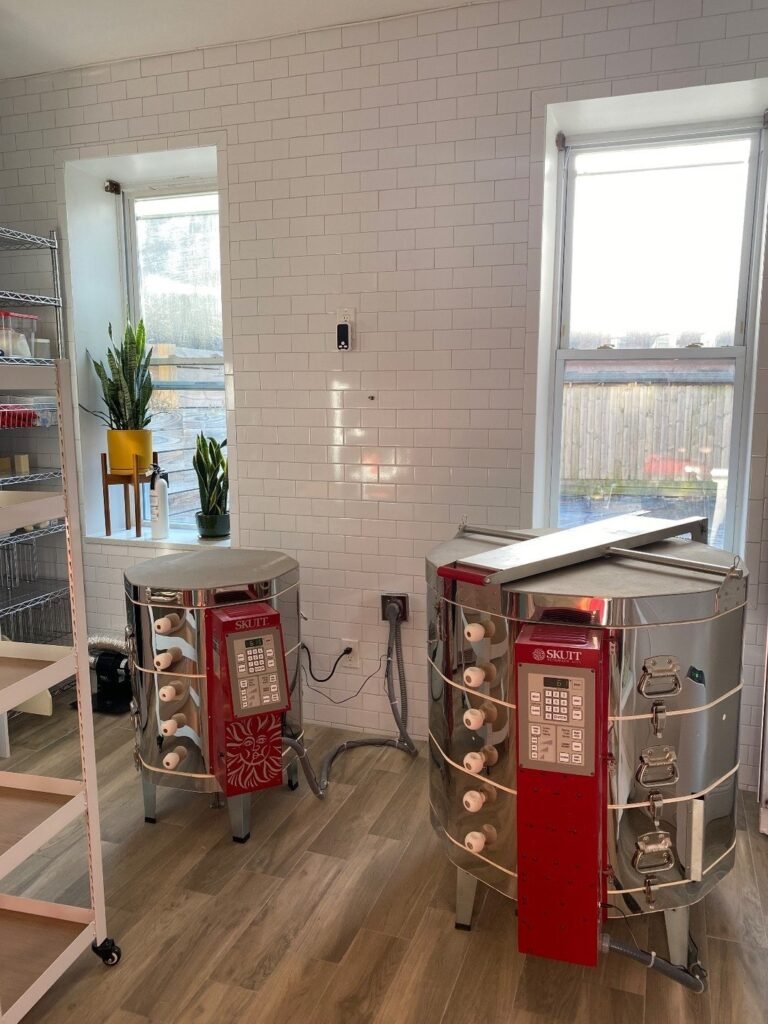
The most important pottery kiln electrical requirements are voltage, amperage, phase, circuit capacity, wiring, breaker protection and the correct receptacle or direct-wire connection. Those requirements vary by kiln model, so there is no single outlet, breaker or wire size that works for every pottery kiln.
This is one of the easiest parts of kiln buying to underestimate.
A kiln may fit perfectly in your garage or studio, have the right chamber size, and reach the firing temperature you need, yet still be unsuitable for your building’s electrical supply.
The solution is straightforward.
Identify the exact kiln model you are considering. Get its electrical specifications from the manufacturer. Then have a qualified electrician confirm that your building can supply what the kiln requires.
Skutt’s current electrical documentation, for example, lists model-specific voltage, amperage, wattage, phase and receptacle information rather than treating all kilns as electrically identical. Skutt electrical specifications
This guide explains how to understand those numbers before you buy.
What Are Pottery Kiln Electrical Requirements?
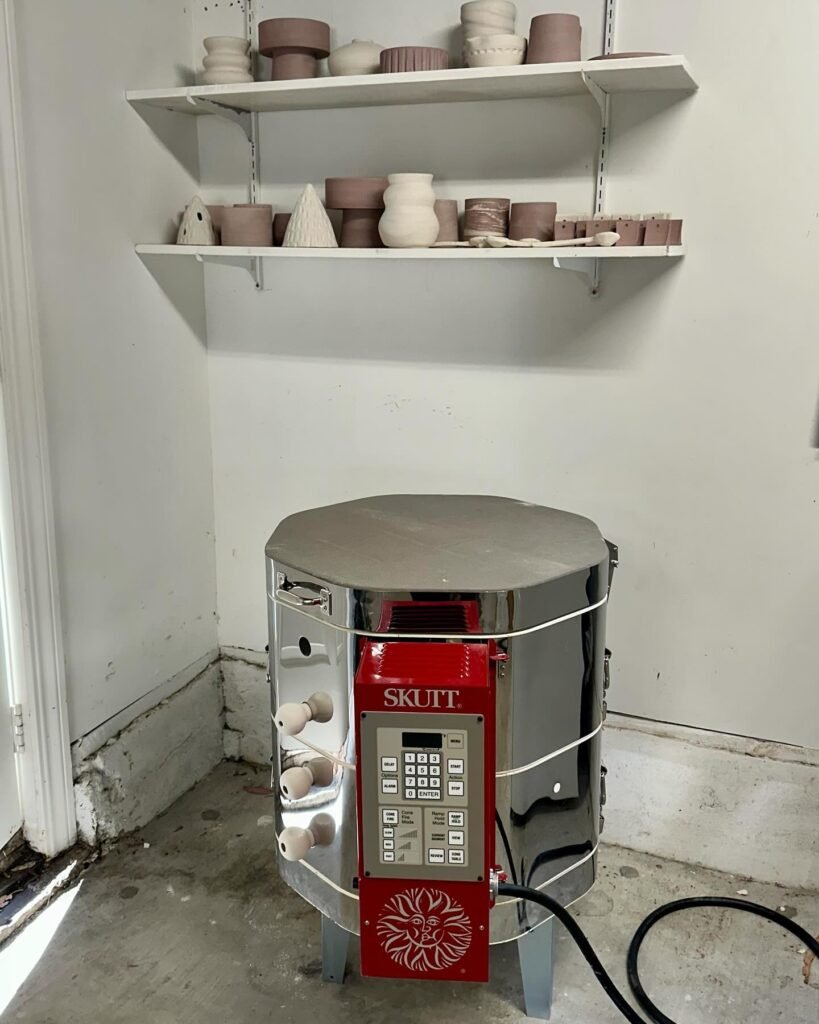
Pottery kiln electrical requirements are the electrical conditions a particular kiln needs to operate correctly and safely.
The main specifications are:
- Voltage
- Amperage
- Wattage
- Phase
- Circuit breaker
- Wire size
- Receptacle or connection type
- Circuit configuration
- Grounding
- Installation requirements
You will usually find these specifications on the kiln’s data plate, in the manufacturer’s manual, or on the manufacturer’s product documentation.
Do not choose a kiln based on only one number.
A kiln listed as “240V” does not tell you everything you need to know.
You also need to know how many amps it draws, whether it is single phase or three phase, what circuit protection is required, what receptacle is specified, and whether the unit is supplied with a plug or intended to be hardwired.
That is why the first step in understanding pottery kiln electrical requirements is identifying the complete electrical specification for the exact model.
The Four Numbers You Need to Understand

When you look at a kiln specification sheet, four numbers matter immediately.
Voltage
Voltage describes the electrical potential supplied to the kiln.
Common kiln configurations include 120V, 208V and 240V, depending on the model and application.
Amperage
Amperage describes the current the kiln draws while operating.
Larger and more powerful kilns generally require more current.
Wattage
Wattage describes electrical power.
A simple relationship is:
Watts = Volts × Amps
For example, a 240V kiln drawing 30 amps would have a nominal electrical load of about 7,200 watts.
Actual manufacturer specifications should always take precedence over a simple calculation.
Phase
Phase describes the electrical supply configuration.
A kiln may be designed for single-phase or three-phase power.
These four specifications need to match the kiln and the electrical installation.
Pottery Kiln Voltage Requirements

Voltage is one of the first things to check when buying a kiln.
A kiln designed for one voltage should not simply be connected to a different voltage because the plug happens to fit or because the difference looks small.
Skutt explains that most of its common ceramic kilns are available in 208V or 240V configurations, while particular models have different electrical arrangements. Its current specifications show, for example, different voltage and amperage configurations across its kiln range. Skutt electrical specifications
This matters because the heating elements are designed around the electrical configuration of the kiln.
If the voltage does not match the kiln’s intended configuration, firing performance and component loading can be affected.
Skutt’s installation guidance specifically recommends having an electrician verify the actual supply voltage rather than assuming what the building provides. Skutt kiln installation requirements
Do Pottery Kilns Use 120V?
Some small kilns do.
However, you should not assume that a kiln is suitable for a normal household receptacle simply because it is physically small.
Check the manufacturer’s specifications.
Small test, jewelry and glass kilns may have relatively low electrical requirements, while larger pottery kilns can require substantially more power.
Skutt’s current specifications, for example, include 115V and 120V models as well as 208V and 240V ceramic kilns. Skutt electrical specifications
The important point is not that “pottery kilns use 240V.”
The important point is that the correct voltage depends on the exact kiln.
208V vs 240V Pottery Kilns
The difference between 208V and 240V is particularly important for studios in commercial buildings, schools and other facilities where 208V power may be available.
Do not assume that a 208V supply is interchangeable with a 240V kiln.
Some kiln models are available in versions designed for either voltage.
Others have specific conversion procedures.
Some are not intended to be converted by the user.
Skutt’s documentation warns that connecting a kiln to the wrong voltage can create serious problems and states that a kiln with a voltage designation that does not match the available supply should not simply be connected. Skutt electrical requirements
This is one reason voltage should be confirmed before purchasing the kiln.
Why 208V Is Common in Studios
Commercial buildings and schools may have electrical systems that provide 208V.
Residential properties commonly have different electrical configurations.
The exact supply depends on the building.
If you are setting up a kiln in a school, university, commercial studio or industrial space, have an electrician identify the actual available voltage and phase.
Do not rely on a label such as “220V” from memory.
Skutt specifically notes that people sometimes describe their supply as 220V even though the actual system may be 208V or 240V. Skutt installation requirements
How Many Amps Does a Pottery Kiln Use?
The answer depends on the kiln.
There is a huge difference between a small kiln and a large production kiln.
Current Skutt specifications illustrate this clearly.
For example, the KM-818 is listed at 26.7 amps on a 240V configuration, while larger KM-1027 and KM-1227 configurations are listed at 48 amps on 240V single phase. Skutt electrical specifications
That is why you should never buy a kiln and then ask the electrician to “put in whatever breaker it needs.”
The electrician needs the exact manufacturer specifications.
The kiln’s amperage affects:
- Circuit design
- Breaker requirements
- Wire sizing
- Receptacle selection
- Panel capacity
- Installation cost
It also affects whether your existing building can support the kiln at all.
Kiln Amperage Is Not the Same as Breaker Size
This distinction causes a lot of confusion.
A kiln’s rated current and the circuit breaker protecting the circuit are related, but they are not necessarily identical numbers.
The breaker is selected according to the applicable electrical code, the equipment requirements and the manufacturer’s specifications.
Skutt explicitly notes that its wire gauge recommendations are based on the recommended circuit breaker or fuse size rather than simply the kiln’s amperage rating. Skutt electrical specifications
That means you should not look at a kiln that draws 48 amps and automatically decide that a 48-amp breaker is appropriate.
Follow the kiln manufacturer’s installation requirements and local electrical code.
For more detail, see our guide to Kiln Breaker Size: How to Get the Amperage Right.
Does a Pottery Kiln Need a Dedicated Circuit?
Many substantial electric kilns require their own properly sized circuit.
The exact installation depends on the kiln.
The reason is simple.
A kiln can draw significant electrical power for an extended period. Sharing a circuit with unrelated high-load equipment can create an installation that does not meet the kiln’s requirements.
The manufacturer should specify the required circuit arrangement.
Skutt’s kiln room wiring guidance tells buyers to provide the electrician with the kiln’s required wire gauge, receptacle style and circuit breaker information and emphasizes using a qualified electrician for installation. Skutt kiln room wiring
If you are planning a home studio, do not assume that an existing garage outlet is suitable.
Have the circuit evaluated.
What Size Breaker Does a Pottery Kiln Need?
There is no universal breaker size for pottery kilns.
The correct breaker depends on:
- Kiln model
- Voltage
- Amperage
- Phase
- Manufacturer requirements
- Circuit design
- Applicable electrical code
For example, Skutt’s current documentation lists different electrical requirements across its models, including kilns with substantially different amperage requirements. Skutt electrical specifications
This is why online advice that says “all pottery kilns need a 50-amp breaker” is unreliable.
Some kilns need less.
Some need more.
Some require direct wiring instead of a conventional receptacle.
Use the exact kiln documentation.
Never install a larger breaker simply because the existing breaker keeps tripping.
That can turn an electrical protection problem into a much more serious hazard.
What Size Wire Does a Pottery Kiln Need?
Wire size also varies by installation.
It depends on the kiln’s electrical requirements, circuit protection, conductor material, installation method, distance and applicable electrical code.
Skutt’s current electrical documentation provides model-specific wiring guidance while also explaining that local electrical codes take precedence and that longer circuit runs can require different considerations. Skutt electrical specifications
Do not choose wire based solely on the kiln’s amp rating.
The electrician needs the complete installation information.
Copper vs Aluminum
The conductor material matters.
Skutt currently states that aluminum wire is not recommended for its kiln circuits and provides its wiring recommendations around copper conductors. Skutt electrical specifications
Your electrician should determine the appropriate conductor type and installation method for your location and applicable code.
Does the Distance From the Electrical Panel Matter?
Yes.
The longer the circuit run, the more important voltage drop and conductor sizing become.
Skutt’s installation guidance recommends keeping kilns relatively close to the breaker panel where practical and notes that longer runs can require heavier wire. Skutt kiln installation requirements
This matters when planning a studio.
A kiln at the far end of a large building may require a different electrical installation from an identical kiln positioned close to the panel.
That is another reason to plan the kiln location before the electrical work is completed.
Pottery Kiln Receptacle Requirements
The receptacle is the outlet that accepts the kiln’s plug.
The correct receptacle depends on the kiln.
You may encounter NEMA configurations such as:
- NEMA 5-15
- NEMA 5-20
- NEMA 6-20
- NEMA 6-30
- NEMA 6-50
- NEMA 14-30
- NEMA 15-50
These are not interchangeable simply because they physically look similar.
The receptacle needs to match the kiln’s specified electrical configuration and the circuit.
Skutt’s current specifications list the appropriate receptacle for many of its models. Skutt electrical specifications
Do Not Change the Kiln Plug Just to Fit Your Outlet
This is a particularly bad shortcut.
If your kiln has a plug that does not match your existing receptacle, do not simply cut the plug off and install another one because it fits.
The plug is part of the kiln’s electrical configuration.
Skutt specifically advises against altering the original plug and notes that doing so can, in some circumstances, affect warranty coverage. Skutt kiln room wiring
Instead, determine why the configurations do not match.
You may have the wrong receptacle.
You may have the wrong circuit.
You may have a kiln configured for a different voltage or phase.
Or you may simply need a properly installed receptacle that matches the kiln.
Can You Use an Extension Cord With a Pottery Kiln?
For a substantial pottery kiln, do not assume an extension cord is acceptable.
Manufacturers may explicitly prohibit extension cords.
Skutt’s kiln safety guidance states that the power cord is sized for the particular kiln and says never to use an extension cord. It also warns that the power cord should not touch hot portions of the kiln. Skutt kiln safety
This is not an area for improvisation.
If the kiln cannot reach the existing receptacle, the correct solution is to have the electrical installation evaluated.
Do not solve a permanent installation problem with a temporary household extension cord.
Pottery Kiln Electrical Requirements and Phase
Phase is another specification that buyers sometimes overlook.
A kiln can be configured for:
- Single phase
- Three phase
The building’s available electrical supply must be compatible with the kiln.
Some kiln models are offered in multiple phase configurations.
Others are not.
Skutt’s current specifications show both single-phase and three-phase configurations for selected models. Skutt electrical specifications
Do not assume that having three-phase power means you can connect any kiln to it.
Likewise, do not assume a three-phase kiln can simply be connected to single-phase power.
The kiln manufacturer and electrician need to confirm the correct configuration.
Single Phase vs Three Phase Kilns
Single Phase
Single-phase power is common in residential environments and many smaller studio installations.
A single-phase kiln can be entirely appropriate for a home studio if the electrical supply is properly sized.
Three Phase
Three-phase power is more common in certain commercial, institutional and industrial environments.
Some larger kiln configurations can use three-phase power.
The advantage can include distributing the electrical load across phases, depending on the equipment and building supply.
But the exact kiln configuration matters.
Do not convert between phase configurations without manufacturer-approved instructions and qualified electrical work.
Direct Wire vs Plug-In Kilns
Not every kiln uses a conventional wall receptacle.
Some larger kilns are designed for direct wiring.
This means the kiln’s electrical connection is wired into an appropriate disconnect or other approved connection point rather than plugged into a standard receptacle.
Skutt’s current specifications identify certain larger models as “Direct Wire.” Skutt electrical specifications
Skutt’s kiln room wiring guidance also explains that larger or higher-power kilns may use a shut-off switch and direct connection rather than a conventional receptacle. Skutt kiln room wiring
This is one more reason to check the exact model before planning the electrical installation.
What Is a Kiln Disconnect?
A disconnect provides a means of disconnecting power to the kiln.
The exact installation depends on the equipment and electrical code.
For direct-wired installations, the disconnect can be an important part of the electrical system.
Your electrician should determine the correct arrangement.
Do not build the installation around a generic diagram from another kiln.
The manufacturer’s installation instructions should be the starting point.
Why the Kiln’s Nameplate Matters
The data plate on the kiln contains information that should match your electrical installation.
Depending on the manufacturer and model, you may find:
- Model number
- Voltage
- Amperage
- Phase
- Serial number
- Electrical rating
If you are buying a used kiln, photograph the nameplate before making an offer.
This is one of the fastest ways to establish exactly what electrical configuration you are dealing with.
Do not rely on the seller saying:
“It was plugged into a 240V outlet.”
That does not tell you enough.
You want the exact model and electrical configuration.
Buying a Used Kiln: Electrical Checks
Electrical compatibility becomes even more important when buying used equipment.
A used kiln may have:
- A replacement cord
- Modified wiring
- Replaced elements
- A different controller
- Older electrical components
- Previous repairs
- A modified plug
- A different voltage configuration from the one you expected
Inspect the kiln’s documentation and nameplate.
Ask what repairs have been made.
Ask whether the electrical system has been modified.
Ask whether the kiln was operated on the voltage for which it was designed.
Then have a qualified electrician inspect the installation requirements before connecting it.
Our used pottery kiln inspection guide covers the wider inspection process.
Refurbished Kilns Need the Same Electrical Attention
A refurbished kiln can save money, but refurbishment does not automatically mean the electrical system matches your studio.
Check:
- Model
- Voltage
- Phase
- Amperage
- Plug
- Wiring
- Controller
- Relays
- Elements
- Terminals
- Grounding
- Previous modifications
A refurbished kiln may have had electrical components replaced.
That can be perfectly acceptable.
But you need to know what was replaced and why.
Do not assume that a newer controller or new elements automatically mean the kiln can use a different electrical supply.
The complete kiln configuration still matters.
Pottery Kiln Electrical Requirements Before You Buy
The smartest time to investigate pottery kiln electrical requirements is before you purchase the kiln.
Use this sequence.
Step 1: Choose the kiln
Identify the exact manufacturer and model.
Step 2: Get the electrical specification
Record:
- Voltage
- Amperage
- Phase
- Wattage
- Breaker requirement
- Wire requirements
- Receptacle
- Direct-wire requirements
Step 3: Check your building
Have an electrician verify:
- Available voltage
- Available phase
- Panel capacity
- Existing circuit capacity
- Installation location
- Required circuit work
Step 4: Confirm the installation cost
Electrical work can become a meaningful part of the total kiln investment.
Include it in your budget before purchasing.
Step 5: Plan ventilation and location
Electrical planning should happen alongside the physical kiln installation.
Our Pottery Kiln Setup guide covers the wider studio setup.
Step 6: Purchase the kiln
Only after confirming that the building can support it.
This order prevents an expensive mistake.
What If Your Electrical Supply Is Not Strong Enough?
Do not simply buy the kiln and hope it works.
You have several possibilities.
You may be able to:
- Choose a smaller kiln
- Select a kiln designed for your existing voltage
- Upgrade the electrical service
- Install a new dedicated circuit
- Change the kiln location
- Choose a different model
- Work with an electrician to determine an appropriate configuration
The correct solution depends on the building.
Do not solve inadequate electrical capacity by using a smaller breaker, bypassing protection or improvising wiring.
If the building cannot safely support the kiln, change the plan.
Can a Pottery Kiln Run on 208V Instead of 240V?
Only if the specific kiln is designed or approved for that configuration.
Some manufacturers offer the same general kiln model in different voltage versions.
Others provide conversion procedures for certain models.
The manufacturer’s instructions determine what is acceptable.
Skutt’s documentation illustrates why this distinction matters: its specifications include separate 208V and 240V configurations for various models, with different electrical characteristics. Skutt electrical specifications
Never assume that plugging a 240V kiln into a 208V supply is an acceptable substitute.
The kiln may not operate as intended.
Likewise, applying higher voltage than the equipment is designed for can damage components and create a dangerous condition.
What Happens If a Kiln Has the Wrong Electrical Supply?
The consequences depend on the mismatch.
A kiln supplied with insufficient voltage may take longer to heat or fail to achieve expected performance.
A kiln exposed to an unsuitable higher voltage can have components overstressed.
Incorrect phase configuration can also cause problems.
The exact consequences depend on the equipment.
If you suspect that your kiln has been connected to the wrong electrical supply, stop using it and have the situation assessed by a qualified professional.
Do not keep firing it to “see what happens.”
Pottery Kiln Electrical Requirements and Low Voltage
Low voltage can also affect kiln performance.
Skutt specifically warns that low-voltage conditions can cause problems with firing and recommends having the electrical supply tested when necessary. Skutt kiln installation requirements
This is particularly relevant when:
- The circuit run is long
- The building has limited electrical capacity
- Multiple heavy loads operate simultaneously
- The supply itself is unstable
- The wiring is not appropriately sized
If a kiln suddenly takes much longer to fire than expected, do not automatically assume the elements are defective.
Electrical supply is one possible factor.
Pottery Kiln Electrical Requirements and Breaker Trips
A breaker that trips during firing deserves attention.
It could indicate an electrical installation issue, an equipment fault, an overloaded circuit, a problem with connections or another condition that requires diagnosis.
Do not solve the problem by installing a larger breaker without determining why the existing breaker is tripping.
Our Kiln Breaker Trips guide covers the issue in more detail.
The basic rule is simple:
A tripping breaker is a diagnostic signal, not an invitation to increase breaker size.
Do Pottery Kilns Need a Ground?
Electrical safety depends on proper grounding and bonding according to the equipment design and applicable electrical code.
Do not remove or defeat the grounding connection.
Skutt’s documentation identifies the safety ground as part of its kiln electrical configuration and its safety guidance emphasizes proper electrical installation. Skutt kiln electrical requirements
If the receptacle or wiring in your building does not appear to provide the correct grounding arrangement, stop and have it inspected.
Do not use adapters that eliminate the grounding path.
What About the Kiln Power Cord?
If the kiln comes with a factory-installed power cord, treat it as part of the equipment.
Inspect it for:
- Heat damage
- Cracks
- Fraying
- Melted insulation
- Loose connections
- Damage near the plug
- Contact with hot kiln surfaces
Skutt specifically warns that the power cord should not touch portions of the kiln that become hot. Skutt kiln safety
If a cord appears damaged, do not continue operating the kiln until it has been properly assessed.
A Pottery Kiln Electrical Requirements Checklist
Before buying or installing an electric kiln, verify all of the following:
Kiln
- Exact manufacturer
- Exact model
- Serial number if applicable
- Voltage
- Amperage
- Wattage
- Phase
- Maximum firing temperature
Electrical system
- Available voltage
- Available phase
- Panel capacity
- Circuit capacity
- Breaker requirements
- Wire requirements
- Grounding
- Receptacle or direct-wire configuration
Installation
- Qualified electrician
- Correct circuit
- Correct breaker
- Correct conductor
- Correct receptacle
- Correct grounding
- Suitable location
- Appropriate cord routing
- Local code compliance
Studio
- Adequate ventilation
- Appropriate clearances
- Suitable floor
- Suitable kiln stand
- Adequate room capacity
- Safe access around the kiln
Documentation
- Manufacturer manual
- Electrical specifications
- Installation instructions
- Warranty
- Service information
Common Pottery Kiln Electrical Mistakes
Mistake 1: Buying the kiln before checking the electrical supply
This is probably the most expensive mistake.
Check first.
Mistake 2: Assuming every kiln is 240V
Some are.
Some are not.
Mistake 3: Choosing a breaker based on internet advice
Use the manufacturer’s specifications and applicable electrical code.
Mistake 4: Changing the plug
Do not modify the kiln’s electrical configuration just to fit an existing outlet.
Mistake 5: Using an extension cord
Manufacturers such as Skutt explicitly prohibit this for their kilns. Skutt kiln safety
Mistake 6: Ignoring phase
A three-phase supply and single-phase kiln are not automatically interchangeable.
Mistake 7: Ignoring wire length
Longer runs can affect installation requirements.
Mistake 8: Installing the kiln yourself when the electrical work requires a professional
The kiln may be yours.
The building’s electrical system is still subject to electrical safety requirements and local code.
How Much Should You Budget for Electrical Installation?
There is no reliable universal price.
The cost depends on:
- Distance from panel to kiln
- Existing panel capacity
- Required breaker
- Wire size
- Conduit requirements
- Receptacle
- Building construction
- Electrical service capacity
- Local labor rates
- Permits and inspections
- Whether the kiln needs direct wiring
A kiln that costs $2,000 can therefore require a very different total investment from another $2,000 kiln if their electrical requirements are different.
This is one reason total installed cost matters more than the kiln’s sticker price.
Before buying, get an electrician’s assessment.
Pottery Kiln Electrical Requirements Should Be Part of the Buying Decision
Electrical requirements should influence which kiln you buy.
Suppose you have two otherwise suitable models.
Kiln A requires an electrical upgrade that would be expensive in your building.
Kiln B can operate with an electrical configuration already available.
Even if Kiln A has features you prefer, Kiln B may be the more practical purchase.
Likewise, if you know you will eventually want a larger kiln, it can make sense to discuss future electrical capacity with your electrician before installing the first circuit.
Skutt’s kiln room wiring guidance specifically discusses planning wiring with future kiln upgrades in mind. Skutt kiln room wiring
That is a useful approach for a growing studio.
Pottery Kiln Electrical Requirements FAQ
Does a pottery kiln need 240 volts?
Not always. Some kilns operate at 120V, while others are designed for 208V or 240V. The correct voltage depends on the exact kiln model.
How many amps does a pottery kiln use?
It varies significantly by kiln size and configuration. Small kilns can use relatively little current, while larger kilns can require several dozen amps or more. Always use the manufacturer’s specifications.
Does a pottery kiln need its own circuit?
Many substantial electric kilns require a dedicated circuit. Confirm the exact requirement with the kiln manufacturer and a qualified electrician.
What size breaker does a pottery kiln need?
There is no universal breaker size. The correct breaker depends on the kiln’s electrical specifications, circuit design and applicable electrical code.
Can I plug a kiln into a normal outlet?
Only if the particular kiln is designed for that outlet and electrical supply. Never assume a normal household outlet is suitable.
Can I use an extension cord with a kiln?
Do not assume that you can. Skutt specifically states that extension cords should not be used with its kilns. Skutt kiln safety
What is the difference between 208V and 240V for a kiln?
They are different electrical supplies. Some kiln models are available in both configurations, but a kiln should only be operated at the voltage for which it is designed or properly converted according to manufacturer instructions.
Can I use a three-phase supply for a single-phase kiln?
Do not assume so. Some installations may permit particular configurations, but the exact kiln and electrical system must be evaluated by the manufacturer and a qualified electrician.
Does wire length matter?
Yes. Longer circuit runs can affect voltage drop and conductor sizing. The installation should be designed according to the kiln specifications and applicable electrical code.
Should I check electrical requirements before buying a kiln?
Absolutely. This is one of the first things you should check. Confirm the building’s electrical supply before committing to a kiln.
Final Verdict
Understanding pottery kiln electrical requirements before you buy can save you from one of the most frustrating kiln-buying mistakes: purchasing the right kiln for your pottery but the wrong kiln for your building.
Start with the exact model.
Then identify its voltage, amperage, wattage, phase, breaker requirements, wiring requirements and connection type.
Next, have a qualified electrician evaluate your building’s electrical supply.
Do not guess the breaker.
Do not guess the wire size.
Do not change the plug simply because it does not match your existing outlet.
Do not use an extension cord as a permanent solution.
Do not assume 208V and 240V are interchangeable.
And do not assume that because a used kiln operated successfully in another studio, it will automatically be compatible with yours.
The electrical installation is part of the kiln purchase.
When you calculate the true cost of a new or used kiln, include the electrical work, ventilation, stand, kiln furniture and other installation requirements rather than looking only at the kiln’s purchase price.
Most importantly, use the manufacturer’s documentation for the exact kiln you intend to buy. Electrical specifications vary substantially between models, and local electrical codes can impose requirements beyond the manufacturer’s general guidance.
Get the electrical side right before the kiln arrives.
That makes the rest of your kiln setup much easier, safer and more predictable.
