Kiln element grooves are easy to ignore until a heating element starts moving, sagging, popping out of the wall, or showing signs of uneven heating.
Those grooves are not simply channels cut into the firebrick for convenience. They position the resistance wire, help maintain the intended element geometry, and keep the heating element where the kiln manufacturer designed it to operate.
When the groove is intact, you rarely think about it.
When it is damaged, the problem can become much more serious.
A broken groove can allow an element to sag or move. Crumbling firebrick can interfere with the element. Glaze, kiln wash, and debris can contaminate the groove. A badly damaged channel may require more than simply replacing the heating element.
This guide explains kiln element grooves, what they do, why they become damaged, how to inspect them, when they can be repaired, and when the brick or element channel needs to be replaced.
What Are Kiln Element Grooves?
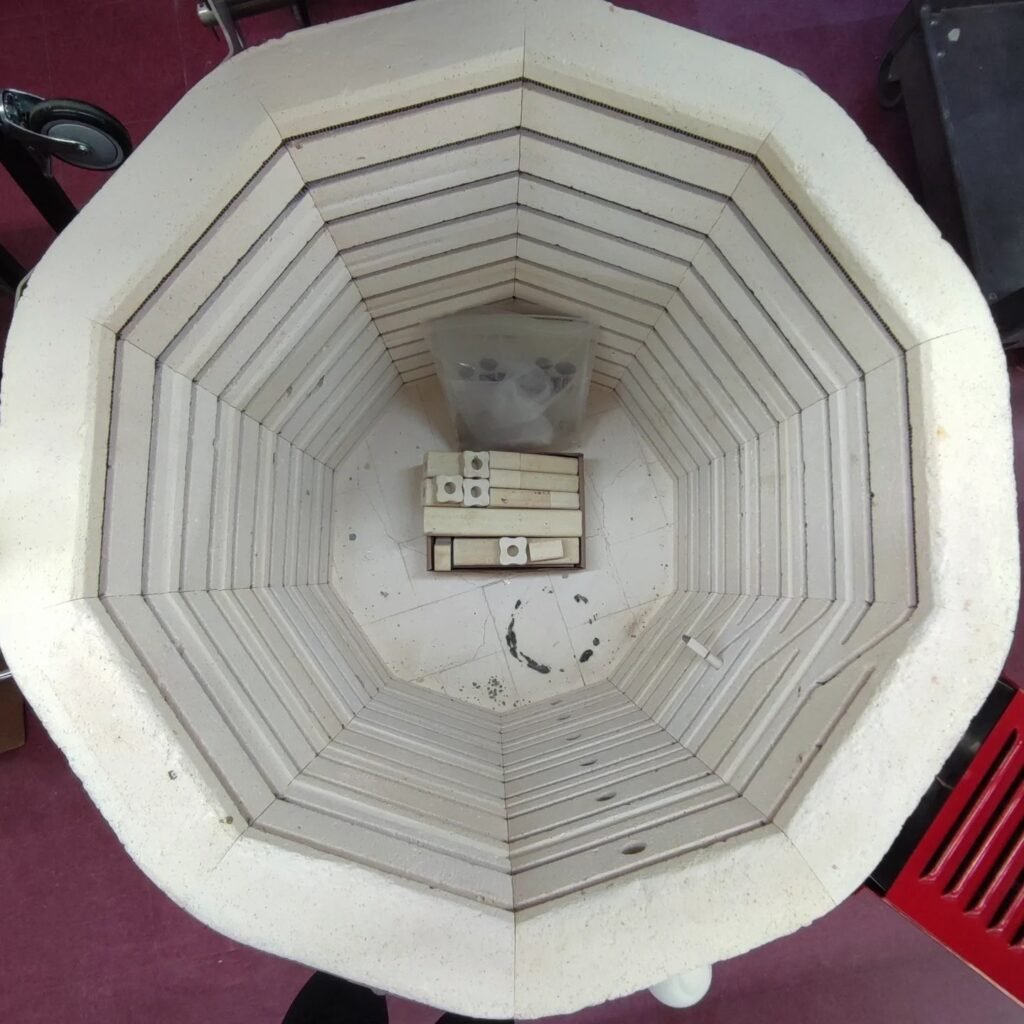
Kiln element grooves are recessed channels formed in the insulating firebrick or element holders inside an electric kiln.
The heating element sits inside or against these channels.
The exact construction varies between kiln manufacturers.
Some kilns have heating elements positioned directly in grooves machined into the insulating firebrick. Other designs use separate ceramic element channels or holders installed into the brick.
The purpose is essentially the same:
Keep the heating element in the correct position while the kiln fires.
That position matters because electric kiln elements are designed around specific electrical and physical characteristics.
The amount of resistance wire, its gauge, coil diameter, spacing, and distribution all affect how the kiln heats.
Skutt explains that element design involves factors including watt density, pitch, gauge, and available groove space. Its kiln designs use multiple groove positions to give the manufacturer more flexibility in element placement and to give users more options when arranging shelves.
So when you see a damaged groove, you are not looking at an insignificant cosmetic defect.
You are looking at part of the system that positions the kiln’s heating elements.
Why Kiln Element Grooves Matter
The heating element needs to maintain its intended shape during firing.
As resistance wire heats, it expands.
As it cools, it contracts.
It also becomes progressively more fragile after repeated high-temperature firings.
A properly formed groove helps support the element through these thermal cycles.
If the groove is badly damaged, the element may move away from its intended position.
That can affect:
- Element support
- Element spacing
- Heat distribution
- Element life
- Shelf placement
- Firing consistency
- The condition of the surrounding firebrick
L&L notes that the condition of the firebrick or element channels supporting an element is important. Its maintenance guidance recommends keeping the supporting areas clean and free from kiln wash, glaze, and crumbling firebrick.
L&L: Extending Ceramic Kiln Element Life
This is why kiln element grooves deserve inspection whenever you are replacing elements or evaluating an older kiln.
What Should Healthy Kiln Element Grooves Look Like?
A healthy groove should hold the element in its intended position without excessive movement.
The surrounding brick or channel should be reasonably intact.
There should not be large sections of crumbling material around the element.
The groove should also be free of unnecessary contamination.
Inspect for:
- Cracked brick
- Missing brick
- Loose element
- Sagging element
- Broken groove edges
- Glaze contamination
- Kiln wash buildup
- Excessive debris
- Burned or damaged element wire
- Missing element pins
- Damaged ceramic holders
- Evidence of an element rubbing against another component
Do not expect an old kiln to look perfect.
Some surface deterioration is normal after years of firing.
The important question is whether the groove still performs its job.
What Causes Damaged Kiln Element Grooves?
There are several common causes.
Thermal Cycling
Every firing heats the firebrick.
Every cooling cycle brings it back down.
Repeated expansion and contraction can gradually produce cracks and deterioration.
This is one reason older kilns may have visible cracks in their insulating brick.
Physical Impact
Kiln furniture is a major source of accidental damage.
A shelf can hit the kiln wall during loading.
A post can fall.
A tool can strike the brick.
A large piece of pottery can contact the wall.
Because insulating firebrick is relatively soft and lightweight, a careless impact can create a gouge or break a section of the groove.
Glaze Contamination
Glaze can end up where it does not belong.
A glaze drip that reaches an element groove can harden during firing and interfere with the element.
The glaze itself can also bond to the element.
Kiln Wash
Kiln wash belongs primarily on kiln shelves.
It should not be treated as a general-purpose coating for the firing chamber.
Material that gets into element grooves can interfere with element seating and contribute to contamination.
L&L specifically advises keeping the element-supporting brick or channels clean and free of kiln wash, glaze, and crumbling firebrick.
Element Replacement
Replacing an element involves removing it from the groove.
If an element is old and brittle, forcing it out can damage surrounding brick.
If tools are used aggressively, the groove can be chipped.
Skutt’s element replacement instructions call for removing the element pins, carefully removing the element from the groove, and vacuuming debris from the groove before installing the replacement.
Skutt: Element Replacement Instructions
Age
Old kilns can develop deteriorated element channels simply from years of service.
That does not mean every old kiln needs rebuilding.
It means the condition of the groove should be considered when evaluating the kiln.
Kiln Element Grooves and Heating Element Replacement
The two problems are closely related but not identical.
A worn heating element does not automatically mean the groove is damaged.
Likewise, a damaged groove does not automatically mean the heating element has failed.
Inspect both.
When replacing an element, check:
- The condition of the element wire
- The condition of the groove
- The condition of the surrounding brick
- Element pins or holders
- The element’s position
- The element pigtails and terminal connections
Skutt’s replacement procedure includes removing the old element, cleaning the groove, installing the replacement, and securing it with the appropriate element pins.
That sequence matters.
A new element installed into a dirty or damaged groove may not solve the underlying problem.
For more information on element wear and replacement, see the Kiln Depot guide to kiln elements and the signs they need replacing.
Why Is My Kiln Element Falling Out of the Groove?
If an element keeps moving out of its groove, do not assume the element itself is defective.
Possible causes include:
- Broken element pins
- Damaged element holders
- Crumbling firebrick
- A damaged groove
- Incorrect element installation
- An improperly stretched element
- Physical impact
- Severe deterioration around the groove
L&L notes that if an element droops because of a broken groove, the element itself may eventually be lost. It also notes that temporary pinning can sometimes help but is not necessarily an ideal permanent repair.
The correct fix depends on why the element is moving.
If the groove is intact but the retaining pin is missing, the repair may be simple.
If the groove has collapsed, replacing the pin will not restore the damaged brick.
Can You Repair Damaged Kiln Element Grooves?
Yes, in some situations.
The appropriate repair depends on how the kiln is constructed and how severe the damage is.
A small amount of damaged insulating firebrick may be repairable with an appropriate high-temperature brick repair material.
If the kiln uses a separate element channel or holder, that component may be replaceable without replacing the entire kiln section.
L&L provides a specific procedure for replacing damaged element channels. Its instructions describe removing the damaged channel and fitting a replacement channel into the existing groove.
L&L: Replacing Element Channels
That is an important distinction.
Sometimes the groove is part of the brick itself.
Sometimes there is a replaceable channel inside the brick.
You need to know which system your kiln uses before deciding how to repair it.
Element Channel vs. Firebrick Groove
The terminology can get confusing.
A firebrick groove is a channel formed directly in the insulating brick.
An element channel can refer to a separate component or holder that supports the element inside the brick.
Some manufacturers use specific channel or holder systems.
L&L, for example, has replaceable element channels and provides model-specific instructions for removing and installing them.
That means you should not order a generic “element channel” simply because your kiln has damaged grooves.
First identify the kiln manufacturer and model.
Then determine whether the damaged component is:
- The firebrick itself
- A removable element channel
- An element holder
- An element pin
- The heating element
- Or a combination of these
That distinction can save you from buying the wrong part.
How to Inspect Kiln Element Grooves
Inspection should be part of normal kiln maintenance.
Skutt’s maintenance guidance recommends regularly vacuuming the kiln floor and element grooves and carefully cleaning around the thermocouple and elements.
Always follow your kiln manufacturer’s safety instructions when cleaning.
Start with the kiln completely cool.
Then inspect the chamber from top to bottom.
Look at the Element
Is the coil sitting where it should?
Does it sag?
Is it stretched?
Are sections of the coil touching each other?
Look at the Groove
Is the groove intact?
Are the edges crumbling?
Is there missing brick?
Is something stuck inside it?
Look at the Pins
Are the element pins present?
Are they properly positioned?
Are they damaged?
Look for Contamination
Look for:
- Glaze
- Kiln wash
- Dust
- Brick fragments
- Other foreign material
A clean groove makes problems easier to identify.
How to Clean Kiln Element Grooves
Routine cleaning is usually about removing loose debris rather than aggressively reshaping the groove.
Skutt specifically recommends vacuuming the kiln floor and element grooves regularly.
A suitable vacuum and careful technique are important because you do not want to damage the element while cleaning.
Do not scrape an element aggressively.
Do not pry against fragile firebrick.
Do not pull on an old heating element unnecessarily.
If you are cleaning around the element during replacement, follow the manufacturer’s service instructions.
Skutt’s element replacement procedure specifically includes vacuuming debris from the groove after removing the old element.
Can Kiln Wash Damage Element Grooves?
Kiln wash can become a problem if it gets into areas where it does not belong.
Kiln wash is designed primarily to protect kiln shelves from glaze.
It is not intended as a general coating for heating elements or their supporting grooves.
L&L specifically says that the brick or element channels supporting the element should be clean and free of kiln wash, glaze, and crumbling firebrick.
This is another reason to keep kiln wash confined to the shelf surfaces where it belongs.
If you discover kiln wash inside an element groove, do not automatically scrape it out with force.
Consider the condition of the element and brick first.
What Happens If the Element Groove Is Broken?
The answer depends on the severity of the damage.
A small chip may have little effect.
A larger break can allow the element to move.
If the element moves, it may change the way radiant heat reaches the ware or potentially create contact with areas where the element should not be positioned.
A badly broken groove can also accelerate element deterioration.
L&L’s element guidance specifically connects the condition of the supporting brick and channels with element performance and life.
That is why replacing the element alone may not solve the problem.
You need to address the support.
Can You Patch a Broken Element Groove?
Sometimes.
For localized firebrick damage, a suitable high-temperature brick repair compound may restore the damaged area.
But there is an important limitation.
The repaired surface must still provide the correct support for the element.
A repair that looks good but changes the shape or depth of the groove may not be an appropriate repair.
Do not fill the groove completely with repair cement.
The element needs to remain positioned according to the kiln manufacturer’s design.
Paragon’s repair instructions emphasize removing excess repair cement from the element groove when repairing damaged brick.
Paragon: Kiln Repair and Maintenance
The objective is to repair the brick around the groove without accidentally creating a new obstruction.
When Should You Replace the Firebrick?
Firebrick replacement becomes more reasonable when the damage is extensive.
Consider replacement when:
- A large section of groove is missing
- The surrounding brick is crumbling
- The element cannot remain in position
- A major section of brick has broken away
- Multiple repair attempts have failed
- The brick can no longer support the element
- The damage extends through the section
- The manufacturer specifies replacement
Paragon’s service documentation describes replacing firebrick when repair is no longer sufficient.
That is a useful general principle.
Do not replace a whole brick because of a tiny chip.
Do not keep patching a brick that can no longer perform its job.
For a broader look at repairing damaged kiln firebrick, see Kiln Brick Repair: How to Fix Cracks, Chips and Firebrick Damage.
Replacing a Separate Element Channel
If your kiln uses removable element channels, the repair can be considerably more targeted.
L&L’s current instructions describe approaches for replacing damaged element channels without necessarily replacing the entire kiln section.
The damaged channel can be removed and a replacement fitted into the existing groove.
More extensive procedures may require removing the affected kiln section and accessing the channel from the side.
That requires more disassembly.
L&L warns that when working with the kiln section, the bricks need to remain aligned and that the section should be placed on a flat surface during the procedure.
This is a good example of why model-specific repair instructions matter.
A repair that is reasonable on one kiln may be completely inappropriate on another.
Do Not Forget the Heating Element
The groove is only half of the system.
If the groove has been damaged, inspect the element carefully.
Look for:
- Broken coils
- Thin sections
- Sagging
- Coil-to-coil contact
- Excessive oxidation
- Glaze contamination
- Distorted sections
- Damage at the pigtails
If the element has already been through many high-temperature firings, it may be brittle.
L&L specifically cautions that fired elements are brittle and can break during service work.
That means a groove repair should not turn into an unnecessary element replacement simply because the element was handled roughly.
Handle it carefully.
Kiln Element Grooves and Firing Uniformity
Element placement affects heat distribution.
Skutt explains that it is generally recommended to have an element radiating between each shelf because radiant heat needs a clear path into the spaces where ware is being fired.
Its balanced-element design uses multiple element grooves to provide more options for element placement and shelf arrangement.
This does not mean every kiln must be loaded according to the same shelf arrangement.
It does mean that the relationship between the elements, shelves, and firing chamber matters.
A damaged groove that changes element position can therefore become more than a mechanical problem.
It can affect the thermal environment inside the kiln.
That is especially relevant when troubleshooting changes in firing results.
Kiln Element Grooves on an Older Kiln
Older kilns deserve particular attention.
A kiln may have working elements but deteriorated element support.
That can be easy to miss during a basic inspection.
If you are considering a used kiln, open the lid and inspect the entire firing chamber.
Look at every element.
Then inspect the groove supporting it.
Do not inspect only the most accessible section.
You want to know whether the damage is isolated or widespread.
A single damaged groove may be a manageable repair.
Multiple deteriorated grooves can change the economics of the purchase.
The Kiln Depot’s used pottery kiln inspection guide covers firebrick, elements, controls, and other major components that should be evaluated before buying a used kiln.
That same logic applies here.
What Should You Check Before Buying a Used Kiln?
Add these questions to your inspection:
Are the elements properly seated?
Are the element grooves intact?
Are any sections crumbling?
Are there replacement channels or holders?
Has the kiln had previous element replacements?
Were the elements installed correctly?
Is there glaze or kiln wash inside the grooves?
Are element pins present?
Are there damaged bricks around the elements?
If the seller cannot answer these questions, inspect the kiln yourself or have someone experienced inspect it.
The purchase price is only part of the cost.
Replacement elements, firebrick, channels, electrical work, and labor can change the economics quickly.
Common Kiln Element Groove Mistakes
Mistake 1: Treating the Groove as Cosmetic
A damaged groove can affect element support.
Do not dismiss major deterioration as simple wear.
Mistake 2: Replacing the Element Without Inspecting the Groove
A new element will not fix a broken support structure.
Inspect both.
Mistake 3: Packing Repair Cement Into the Groove
Repair the damaged brick without obstructing the element’s intended position.
Mistake 4: Scraping Aggressively
Firebrick is fragile.
Aggressive tools can turn a small repair into a large one.
Mistake 5: Pulling on Old Elements
Heavily fired elements can be brittle.
Handle them carefully.
Mistake 6: Leaving Glaze in the Groove
Glaze contamination can interfere with the element and supporting material.
Mistake 7: Ignoring Element Pins
If the design uses pins, make sure they are correctly installed.
Skutt specifies using the appropriate element pins with its replacement elements.
Mistake 8: Using the Wrong Replacement Channel
Element channels are not universal.
Use the manufacturer, model, and appropriate dimensions when ordering.
L&L specifically asks for the kiln model information when ordering replacement channels.
How to Prevent Kiln Element Groove Damage
The best repair is the one you never need.
Start with loading.
Do not drag shelves against the kiln wall.
Lift kiln furniture rather than scraping it across the firebrick.
Keep tall pottery from contacting the elements.
Do not allow glaze to drip onto the elements or into their grooves.
Keep kiln wash on shelves.
Clean loose debris regularly.
Inspect the firing chamber periodically.
And when replacing an element, work slowly.
Skutt’s preventative maintenance guidance recommends regular vacuuming of the element grooves and kiln floor.
That simple habit makes it easier to see deterioration before it becomes a major repair.
Kiln Element Grooves Maintenance Checklist
Use this quick inspection whenever you are servicing an electric kiln.
☐ Kiln is completely cool
☐ Power is disconnected before repair work
☐ Elements are visually inspected
☐ Element grooves are free of loose debris
☐ No significant glaze contamination is present
☐ Kiln wash has not accumulated in the grooves
☐ Element pins or holders are intact
☐ No major sections of brick are missing
☐ Elements are sitting correctly
☐ No coils are touching each other unexpectedly
☐ Surrounding firebrick is stable
☐ Any repair material is compatible with the kiln
☐ Manufacturer instructions have been checked
☐ Replacement parts match the exact kiln model
This inspection does not replace professional service when electrical or structural work is required.
FAQ: Kiln Element Grooves
Can I fire a kiln with a cracked element groove?
It depends on the size and location of the damage.
A small crack may not affect operation.
A broken section that allows the element to move or become unsupported deserves repair before continued use.
Can I put kiln wash inside the element groove?
Kiln wash should not be treated as a repair or protective coating for element grooves.
L&L specifically advises keeping element-supporting brick and channels free of kiln wash, glaze, and crumbling firebrick.
Why does my element keep falling out?
Possible causes include a damaged groove, missing element pin, damaged holder, incorrect installation, or deteriorated firebrick.
Find the cause rather than repeatedly forcing the element back into place.
Can I repair a broken groove with kiln cement?
A suitable high-temperature repair material may work for localized brick damage, but the repair must preserve the intended element position.
Do not fill the actual element channel with cement.
Do I need to replace the whole kiln section?
Not necessarily.
Some damage can be patched.
Some kilns use replaceable element channels.
Other damage requires replacement firebrick or a section repair.
The exact kiln design determines the appropriate approach.
Final Takeaway
Kiln element grooves are a small component of an electric kiln, but they perform an important job.
They keep the heating elements in their intended position while the kiln goes through repeated high-temperature cycles.
Small chips and surface deterioration do not automatically mean the kiln needs major work.
But a groove that is crumbling, badly broken, contaminated, or no longer capable of supporting the element should not be ignored.
The repair can range from cleaning and replacing an element pin to patching firebrick, replacing an element channel, or replacing damaged brick.
The right answer depends on the kiln’s construction and the extent of the damage.
If you are maintaining your own kiln, inspect the grooves whenever you replace elements and as part of routine kiln maintenance.
If you are buying a used kiln, inspect the grooves before deciding what the kiln is worth.
And if you are repairing one, identify the exact manufacturer and model before ordering parts.
The goal is not simply to make the groove look better.
The goal is to keep the heating element correctly supported so the kiln can continue doing what it was designed to do.
That is the difference between cosmetic kiln maintenance and a repair that actually protects the firing system.
