A kiln stand does more than lift a pottery kiln off the floor.

The right stand supports the weight of the kiln, provides the intended clearance beneath it, keeps the kiln stable, and can make loading and maintenance considerably easier.
The wrong stand can create an entirely different set of problems.
It may not support the kiln correctly. It may provide inadequate clearance. It may raise the kiln too high. It may make the kiln unstable. In some installations, an unsuitable stand can also interfere with ventilation or create a safety problem.
That is why you should not treat a kiln stand as generic furniture.
The stand needs to be compatible with the specific kiln.
Skutt’s current safety guidance is particularly direct: it recommends using the stand designated for the particular kiln model because another stand may not properly support the kiln, provide adequate clearance, or maintain the intended safety of the installation.
This guide explains what a kiln stand does, how to choose one, how height and stability affect your setup, when a rolling stand makes sense, and what to check when buying a replacement or used stand.
What Is a Kiln Stand?
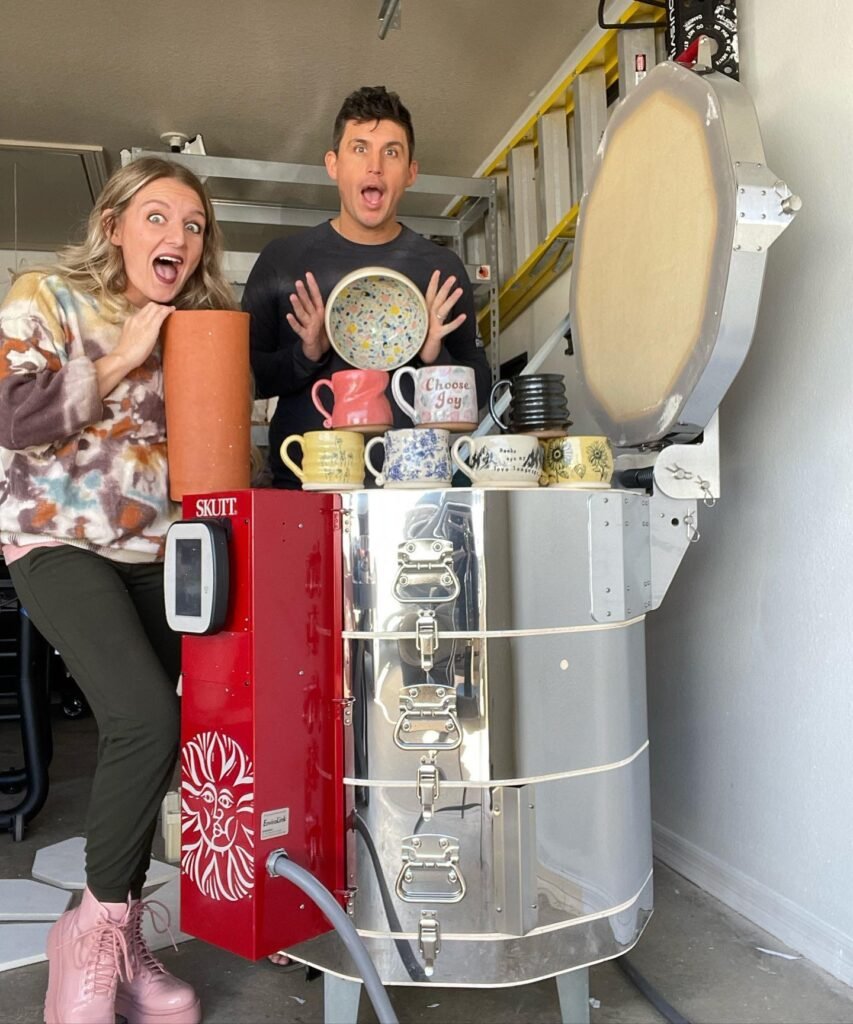
A kiln stand is the structural support beneath a pottery kiln.
Electric kilns are generally elevated rather than placed directly on the floor.
The stand creates a stable base and provides space underneath the kiln.
Depending on the kiln and manufacturer, a stand may consist of:
- A welded metal frame
- Metal legs
- Cross supports
- Adjustable feet
- Fixed feet
- Locking casters
- A lower shelf
- Vent-related mounting provisions
The exact design varies.
Some kiln stands are supplied with the kiln.
Others are available as replacement parts or optional accessories.
Some are stationary.
Others are designed to roll.
The important point is that the stand is part of the kiln installation rather than an unrelated accessory.
Do You Need a Kiln Stand?
For many electric pottery kilns, yes.
The manufacturer determines how the kiln is intended to be supported.
Skutt, for example, supplies stands with its kilns and specifically warns against substituting an inappropriate stand.
The stand is part of the equipment configuration.
That means you should check the kiln’s installation documentation before deciding to put it on a homemade platform, concrete blocks, a wooden frame, or another improvised support.
The fact that something can physically hold the kiln does not mean it is an appropriate kiln stand.
A kiln gets extremely hot.
It is also heavy.
It contains fragile refractory materials and electrical components.
The support needs to account for all of those factors.
Can You Put a Pottery Kiln Directly on the Floor?
Do not assume that you can.
The required installation depends on the kiln manufacturer, model, ventilation system, floor surface, and local requirements.
Some kiln designs specifically require a stand.
Some ventilation systems also depend on the space beneath the kiln.
Skutt’s EnviroVent 2 installation documentation, for example, specifies an 8-inch clearance relationship between the kiln floor and the bottom of the stand or vent components for the applicable installation.
That does not mean every kiln requires exactly the same clearance.
It means the stand and the ventilation system can be interconnected.
Before changing the support arrangement, check the installation requirements for your exact kiln.
Why Kiln Stand Height Matters
Height changes how you interact with the kiln.
A kiln that is too low can force you to bend repeatedly while loading and unloading.
A kiln that is too high can make the upper part of the firing chamber difficult to reach.
The ideal working height therefore depends partly on:
- Your height
- Kiln chamber height
- Kiln loading style
- Shelf arrangement
- Whether you load from the top
- Whether the kiln has a lid lifter
- Whether the kiln is front loading
There is no universal “perfect” stand height.
The manufacturer may specify a particular stand height because the kiln and accessories were designed around it.
For example, Skutt documentation for its kiln setup emphasizes placing the kiln floor evenly on the stand and ensuring that the stand and kiln remain level.
The goal is not simply to raise the kiln as high as possible.
The goal is to create a stable, appropriate working position.
Kiln Stand Height and Ventilation
This is one of the most overlooked reasons to pay attention to the stand.
A kiln vent may draw air from beneath the kiln.
If you change the stand height or modify the underside of the kiln, you can potentially change how that ventilation system operates.
Skutt’s EnviroVent 2 documentation provides specific clearance requirements for the stand and vent plenum.
That means a stand is not necessarily independent of the ventilation system.
If your kiln has a downdraft vent, check the vent manufacturer’s installation requirements before changing the stand.
Do not assume that a taller stand or improvised base is harmless.
Your kiln’s ventilation system was designed around a particular installation arrangement.
How Much Weight Can a Kiln Stand Hold?
The stand needs to support more than the empty kiln.
Consider the complete operating load.
That includes:
- The kiln
- Kiln shelves
- Kiln posts
- Pottery
- Any manufacturer-approved accessories attached to the kiln
The exact weight depends on the model and configuration.
This is why generic furniture stands and homemade platforms can be problematic.
A kiln may weigh hundreds of pounds before you load a single piece of pottery.
Skutt’s installation documentation instructs owners to position the kiln floor on the stand so that the weight is evenly distributed and emphasizes keeping the stand level and stable.
Skutt Kiln Setup Documentation
A stand should therefore be selected according to the kiln manufacturer’s compatibility information, not simply by looking at its physical appearance.
Kiln Stand Stability Matters More Than Mobility
A kiln stand has two basic jobs:
Support the kiln.
Keep the kiln stable.
That sounds obvious, but mobility can complicate the second job.
A rolling kiln stand needs to move when you want it to move.
It also needs to remain stationary when the kiln is being loaded or operated.
That is why locking casters are important on rolling designs.
A stationary stand has fewer moving parts.
For a permanent kiln room, that may be all you need.
For a garage, classroom, or multipurpose studio, mobility can be useful.
But mobility should never come at the expense of stability.
Stationary Kiln Stand vs Rolling Kiln Stand
The choice depends on your workspace.
Stationary Kiln Stand
A stationary stand makes sense when:
- The kiln has a permanent location
- The room is dedicated to firing
- You do not need to clean or reorganize underneath the kiln frequently
- You want the simplest support arrangement
There is no reason to pay for wheels if you will never use them.
Rolling Kiln Stand
A rolling kiln stand can make sense when:
- The kiln is in a garage
- The studio serves multiple purposes
- You periodically need access underneath the kiln
- You rearrange the workspace
- Floor space is limited
- You need occasional mobility
The Kiln Depot’s guide to rolling kiln stands covers caster quality, compatibility, height, stability, clearance, and other factors specific to mobile stands.
The important distinction is simple.
A rolling stand is a workflow solution.
It is not automatically an upgrade to a stationary stand.
Are Rolling Kiln Stands Safe?
They can be, provided the stand is designed for the kiln and used correctly.
The first requirement is compatibility.
The second is stability.
The third is proper installation.
The fourth is correct use.
You should not casually move a kiln while it is hot.
You also need to account for:
- Electrical connections
- Ventilation ducting
- Required clearances
- Floor transitions
- Locked casters
- The weight of the loaded kiln
- The manufacturer’s movement instructions
A rolling stand should make studio organization easier.
It should not become an excuse to repeatedly move a connected kiln around the room.
How to Level a Kiln Stand
A kiln should sit level and stable.
If the stand rocks, teeters, or sits unevenly, correct the problem before operating the kiln.
Skutt’s installation documentation specifically instructs users to make sure the stand and kiln floor are level and do not teeter.
For applicable Skutt stands, the manufacturer recommends using firm shims underneath the stand legs when leveling is necessary rather than placing shims between the stand and kiln in a way that could compromise the support.
The exact leveling method should follow the manufacturer’s instructions.
Do not improvise a complicated support system under a heavy kiln.
The objective is a stable, level base with the load distributed correctly.
Why a Level Kiln Matters
Leveling is not only about aesthetics.
An unstable kiln can place unnecessary mechanical stress on the equipment.
It can also make loading more difficult.
A tilted kiln can complicate the positioning of shelves and posts.
This becomes particularly noticeable when you are loading delicate work or using tall shelf stacks.
A stable stand also makes the kiln easier to service.
When the equipment is properly positioned, maintenance tasks become more predictable.
What Should a Kiln Stand Be Made Of?
Kiln stands are generally made from materials capable of supporting the weight and operating environment of the kiln.
Metal is common because it provides a strong structural frame without requiring a massive amount of material.
The exact construction varies by manufacturer.
Do not select a stand solely because it is made from steel.
The design matters.
A poorly designed steel frame is not automatically better than a properly engineered stand made for the kiln.
Look at:
- Frame construction
- Leg design
- Cross bracing
- Foot design
- Caster design
- Load capacity
- Kiln compatibility
- Ventilation compatibility
The stand needs to function as a complete system.
Can You Build Your Own Kiln Stand?
Technically, a person with the appropriate fabrication skills could build a metal support structure.
But that does not make a homemade stand a good idea for every kiln.
You would need to account for:
- Kiln weight
- Load distribution
- Stand dimensions
- Structural strength
- Heat exposure
- Floor conditions
- Stability
- Required clearances
- Ventilation
- Maintenance access
You would also need to make sure the finished installation does not conflict with the kiln manufacturer’s requirements.
For an expensive kiln, the cost of an approved stand is small compared with the cost of dealing with an unstable or incorrectly supported installation.
Unless you have a specific reason to fabricate your own, a manufacturer-approved stand is generally the simpler route.
Kiln Stand Clearance
Clearance is one of the most important stand considerations.
There are several areas to think about.
Clearance Above the Stand
The kiln needs to sit properly on the stand.
The stand should support the kiln without interfering with the kiln floor or other components.
Clearance Below the Kiln
The space beneath the kiln may be important for ventilation.
It can also prevent heat from being transferred directly to the floor.
Clearance Around the Kiln
The stand does not eliminate the need for appropriate clearance around the kiln itself.
The kiln still needs the space specified by the manufacturer.
Skutt’s current safety documentation emphasizes using the correct stand because it needs to provide adequate clearance as well as support.
Kiln Stand and Combustible Floors
Your stand does not automatically make any floor safe.
The floor underneath and around the kiln still needs to comply with the manufacturer’s installation requirements and local codes.
Skutt’s installation documentation for applicable kilns calls for placement on an appropriate noncombustible surface and specifies clearance requirements around the equipment.
That means a metal stand over a questionable floor is not a complete safety solution.
If your studio has:
- Wood flooring
- Vinyl flooring
- Rubber flooring
- Carpet
- Composite flooring
- Other combustible surfaces
check the manufacturer’s installation instructions before placing the kiln.
Local building and fire requirements may also apply.
Kiln Stand for a Home Studio
Home studios often have less space than commercial studios.
That changes how you should think about the stand.
A good home-studio stand should give you:
- Stable support
- Appropriate working height
- Required floor clearance
- Easy loading access
- Reasonable maintenance access
- Compatibility with ventilation
- Efficient use of floor space
A rolling stand can be useful in a garage or multipurpose room.
A stationary stand can be perfectly adequate in a dedicated studio.
The important thing is to design the entire installation around the kiln rather than buying the stand as an isolated accessory.
The Kiln Depot’s pottery kiln setup guide covers the larger installation picture, including electrical service, ventilation, flooring, clearance, and furniture.
Kiln Stand for a Large Kiln
Large kilns require more attention to support.
As kiln size increases, so does the weight.
The stand therefore becomes more important.
A large kiln also places greater demands on:
- Floor strength
- Stand stability
- Loading height
- Ventilation
- Electrical access
- Maintenance space
Do not assume that a stand designed for a smaller kiln can be adapted to a larger one.
Skutt’s current safety guidance specifically says to use the stand designated for the particular kiln model.
That recommendation becomes even more important as the equipment gets heavier.
Kiln Stand for a Used Kiln
A used kiln may not come with its original stand.
This creates an easy opportunity to make a bad substitution.
Before buying a replacement, identify:
- Manufacturer
- Model
- Kiln dimensions
- Number of sections
- Kiln weight
- Vent system
- Original stand configuration
Then find a compatible replacement.
Do not buy a generic stand just because the kiln fits physically.
Also inspect the used stand itself.
Look for:
- Bent legs
- Cracked welds
- Corrosion
- Missing feet
- Damaged casters
- Loose hardware
- Distorted frame
- Uneven support
A damaged stand can turn a good used kiln into an unsafe installation.
For a broader inspection, see the Kiln Depot’s used pottery kiln guide.
Buying a Replacement Kiln Stand
Before ordering a replacement stand, gather the exact kiln information.
You should know:
- Manufacturer
- Model number
- Serial number if available
- Kiln dimensions
- Kiln configuration
- Vent system
- Whether the kiln is top loading or front loading
Then verify compatibility.
Do not rely solely on a product photograph.
Two kilns can have similar dimensions while requiring completely different stands.
The manufacturer or authorized distributor should be able to confirm the correct stand.
Skutt’s current product information also directs owners to model-specific parts and distributor resources when purchasing kiln equipment.
Skutt Parts and Product Resources
How Much Does a Kiln Stand Cost?
There is no single useful price because stands vary considerably.
A basic stationary stand for a smaller kiln can be relatively simple.
A large stand for a production kiln may be substantially more expensive.
Rolling designs can cost more because they incorporate:
- Casters
- Locks
- Additional frame components
- Bracing
- Mobility features
There may also be shipping costs.
If the stand is large and heavy, freight can become a meaningful part of the total purchase.
That is why you should compare the complete delivered cost rather than looking only at the listed stand price.
Should You Buy a Used Kiln Stand?
Sometimes.
A used stand can make sense if:
- It matches your exact kiln
- The frame is structurally sound
- The legs are straight
- The feet or casters work correctly
- There is no serious corrosion
- The dimensions are correct
- The price is substantially lower than a new compatible stand
Inspect it carefully before purchase.
A cheap stand with bent legs is not a bargain.
Neither is a stand that technically fits but does not provide the manufacturer’s intended clearance.
Kiln Stand Maintenance
A kiln stand does not require the same maintenance as the kiln itself, but it should still be inspected periodically.
Check:
- Legs
- Welds
- Fasteners
- Feet
- Casters
- Locks
- Corrosion
- Stability
- Level
- Clearance beneath the kiln
If you have a rolling stand, check the casters more frequently.
Dust, clay, debris, and moisture can accumulate around wheels and locking mechanisms.
If the stand begins rocking, investigate immediately.
Do not wait until the kiln itself shows a problem.
Common Kiln Stand Mistakes
Using a Generic Furniture Stand
A pottery kiln is not ordinary furniture.
Use equipment designed and rated for the application.
Putting the Kiln on Concrete Blocks
Blocks may appear strong, but the resulting configuration may not provide the correct stability, height, ventilation, or manufacturer-approved support.
Ignoring the Manufacturer’s Stand Requirements
The manufacturer designed the kiln around a specific support arrangement.
Check those requirements before making changes.
Making the Kiln Too High
A taller kiln is not automatically easier to use.
Consider your loading height.
Making the Kiln Too Low
A low kiln can make loading and maintenance unnecessarily uncomfortable and may conflict with required ventilation or floor clearance.
Ignoring Ventilation
The stand can interact with a downdraft ventilation system.
Check the vent installation requirements.
Using a Rolling Stand Without Locking the Wheels
Mobility is useful only when the kiln can remain stable during operation.
Moving a Hot Kiln
Do not treat a rolling kiln stand like a kitchen cart.
Follow the manufacturer’s instructions.
Ignoring Floor Conditions
The stand does not eliminate the need for an appropriate floor surface.
Kiln Stand Buying Checklist
Before buying a stand, check:
☐ Exact kiln manufacturer
☐ Exact kiln model
☐ Kiln dimensions
☐ Kiln weight
☐ Stand compatibility
☐ Stand height
☐ Weight capacity
☐ Floor clearance
☐ Required surrounding clearance
☐ Ventilation compatibility
☐ Stability
☐ Leveling method
☐ Foot or caster design
☐ Locking mechanism if rolling
☐ Condition if used
☐ Shipping cost
☐ Manufacturer installation requirements
If you cannot verify the stand’s compatibility, do not assume it is safe simply because the kiln physically sits on it.
FAQ: Kiln Stand
Do I need a stand for my pottery kiln?
Follow the installation requirements for your specific kiln. Many electric pottery kilns are designed to sit on a manufacturer-specified stand.
Can I use a stand from another kiln?
Only if the manufacturer or qualified source confirms that the stand is compatible with your kiln.
Physical fit alone is not enough.
Can I put my kiln directly on the floor?
Do not assume that you can.
The kiln manufacturer may require a stand for support, clearance, ventilation, or other installation requirements.
How high should a kiln stand be?
There is no universal height.
The correct height depends on the kiln model, manufacturer’s installation requirements, ventilation system, and your working position.
Are rolling kiln stands safe?
A properly designed and compatible rolling stand can be safe when installed and used according to the manufacturer’s instructions.
Lock the casters when the kiln is stationary and do not move the kiln casually while it is hot or connected to services that restrict movement.
Can I build my own kiln stand?
A properly engineered stand can theoretically be fabricated, but it must meet the kiln’s structural, clearance, ventilation, and installation requirements.
For most buyers, a manufacturer-approved stand is simpler.
How do I know if my kiln stand is damaged?
Look for bent legs, cracked welds, corrosion, missing feet, damaged casters, loose hardware, rocking, or uneven support.
Any structural concern should be addressed before operating the kiln.
Does a kiln stand improve firing?
The stand itself does not improve the kiln’s temperature control.
Its job is to provide appropriate support, clearance, stability, and working height.
A proper stand is part of a proper installation.
Final Takeaway
A kiln stand is easy to underestimate because it looks simple.
It is not.
The stand supports a heavy piece of high-temperature equipment, affects working height, contributes to stability, and can interact directly with ventilation and floor clearance.
The safest approach is to start with the kiln manufacturer.
Identify the exact model.
Use the designated stand whenever possible.
If you need a replacement, confirm compatibility rather than guessing.
If you want mobility, consider a rolling kiln stand only when it actually solves a studio problem.
And if you are buying a used kiln, inspect the stand just as carefully as the elements, firebrick, controller, thermocouple, and lid.
The best kiln stand is not necessarily the tallest, cheapest, strongest-looking, or most expensive.
It is the one designed to support your specific kiln correctly while fitting the way you actually work.
That is what turns a kiln stand from an accessory into part of a properly planned pottery kiln installation.
