A clay 3D printer can turn a digital design into a physical ceramic form by depositing clay layer by layer. For some potters, that opens an entirely new way to work. For others, a pottery wheel or hand-building tools still make more sense.
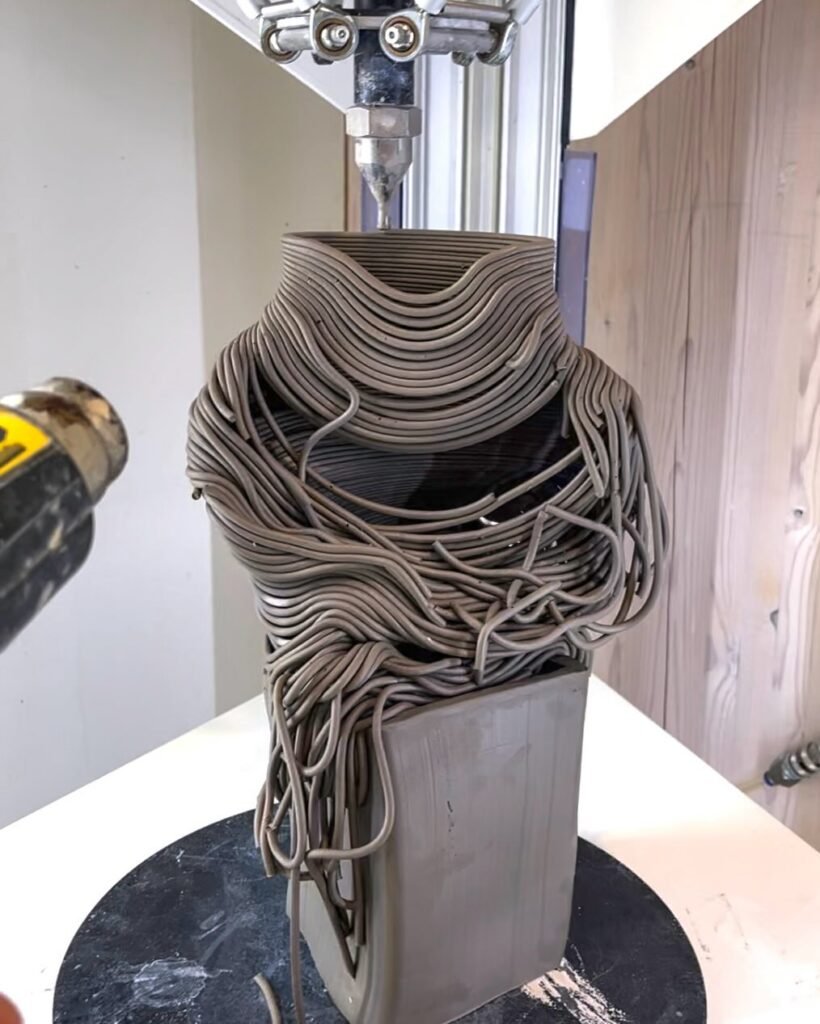
The technology is becoming increasingly relevant in ceramic studios. A pottery discussion posted today, for example, asks whether clay 3D printing could provide an alternative for someone who finds wheel throwing physically difficult. The responses highlight an important point: ceramic 3D printing is not simply a faster pottery wheel. It is a different production method. (Reddit)
So, are clay 3D printers worth it?
For the right studio, they can be. However, the value depends on what you want to make, how much you produce, and whether digital design fits your creative process.
What Is a Clay 3D Printer?
A clay 3D printer uses controlled extrusion to build an object one layer at a time.
Instead of placing a lump of clay on a wheel and shaping it with your hands, you prepare a digital design and send instructions to the printer.
The machine then deposits clay through an extruder.
Layer follows layer.
Eventually, those layers form the walls of the piece.
The process resembles conventional 3D printing, but the material is ceramic clay rather than plastic filament.
That difference creates its own challenges. Clay has to flow through the extrusion system while remaining stable enough to support the layers above it.
How Is 3D Printed Pottery Different From Wheel Throwing?
The biggest difference is how the form is created.
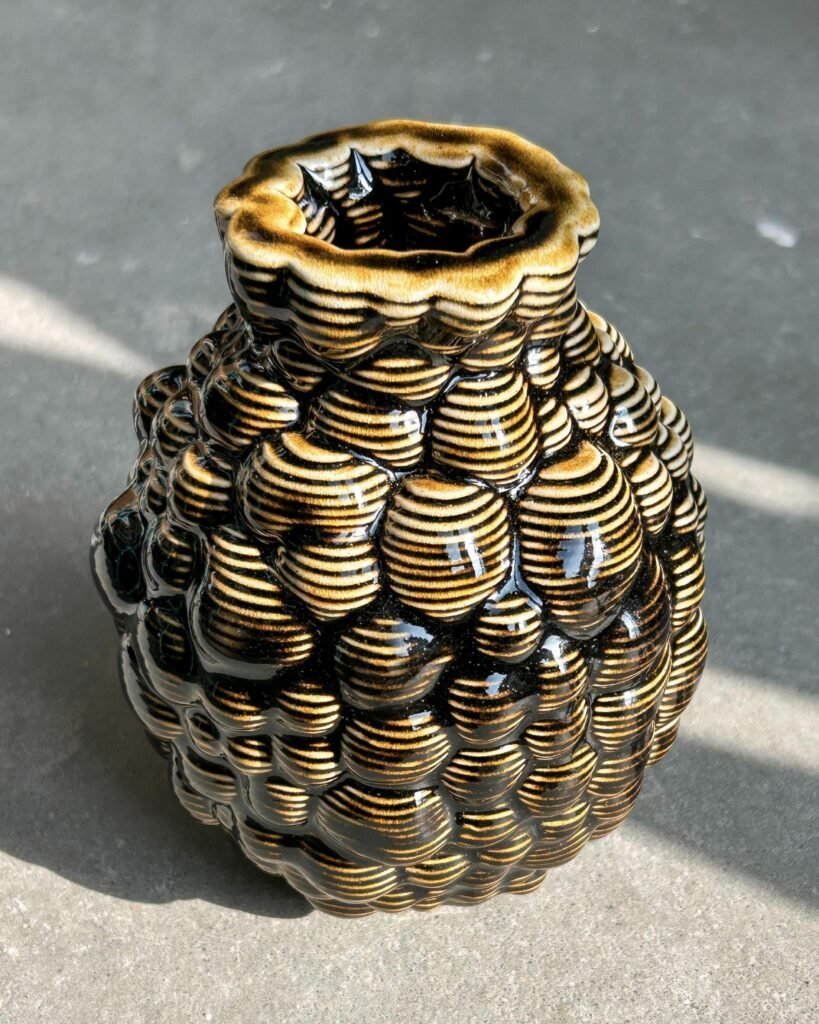
Wheel throwing depends heavily on hand control. You center the clay, open it, pull the walls, shape the form, and finish the rim.
Clay 3D printing shifts much of that work into digital design and automated movement.
As a result, the two processes offer different creative strengths.
| Wheel throwing | Clay 3D printing |
| Hands-on forming | Digital design and extrusion |
| Excellent for organic forms | Excellent for repeatable geometry |
| Immediate tactile feedback | Repeatable automated movement |
| Requires throwing technique | Requires digital workflow |
| Easy to alter forms by hand | Easy to reproduce digital designs |
| Strong traditional studio workflow | Strong for experimentation and production |
Neither approach is automatically better.
Instead, they solve different problems.
Why Are Potters Interested in Clay 3D Printing?
One major attraction is repeatability.
Suppose you create a digital model that works well. You can reproduce the basic form without throwing it from scratch each time.
That can be valuable for production studios.
Designers can also create shapes that would be difficult or time-consuming to construct manually.
For example, complex curves, unusual surface patterns, geometric structures, and large forms can benefit from digital modeling.
The process can also help potters who have difficulty with repetitive physical movements.
That does not make the printer a replacement for traditional ceramics. Rather, it gives the artist another way to produce the form.
Clay 3D Printing Can Change the Design Process
Traditional pottery usually begins with physical clay.
3D printing often begins with a digital model.
That changes the creative workflow.
You may spend more time working in CAD or other modeling software before touching the clay. Consequently, the design process can feel closer to product design, sculpture, or digital fabrication than traditional throwing.
For some artists, that is exciting.
Others may find that it removes part of what they love about pottery.
One recent discussion about clay 3D printers captures this tension. The poster described enjoying the technology but questioned whether moving toward digital design would take away from the hands-on aspect of pottery. (Reddit)
That is an important consideration before spending thousands of dollars on equipment.
What Can You Make With a Clay 3D Printer?
The answer depends on the printer, clay, extrusion system, nozzle, software, and design.
However, ceramic 3D printers can produce:
- Vases
- Sculptural forms
- Planters
- Architectural pieces
- Decorative vessels
- Repeating production forms
- Large-scale ceramic structures
- Experimental forms
The larger machines can go considerably beyond ordinary tabletop pottery.
For example, The Kiln Depot’s PotterBot Scara V4 is designed for large-scale ceramic and paste printing. Its listed printing envelope reaches 72 inches in diameter and 45 inches in height, while larger customized configurations are also available. (The Kiln Depot)
That is a very different use case from a compact home pottery printer.
What Are the Biggest Advantages?
Repeatability
Once a design and printing process are dialed in, reproducing a form can become much easier.
That matters for studios producing multiple versions of the same object.
Complex geometry
Digital modeling allows shapes that can be difficult to throw or construct manually.
You can experiment with unusual curves, patterns, textures, and structures.
Reduced physical demands
A printer can reduce some repetitive manual work.
For certain artists, that can make ceramic production more accessible.
Production potential
A digital workflow can make sense when a studio needs to reproduce designs consistently.
Instead of rebuilding every object by hand, the printer follows the digital instructions.
What Are the Limitations?
Clay 3D printing is not magic.
The material still has to behave correctly.
Clay moisture, consistency, extrusion pressure, nozzle size, layer adhesion, drying, and support all matter.
A design that looks perfect on a computer screen can still fail in clay.
That problem appears in recent ceramic 3D-printing discussions. One video shared on Reddit showed AI-generated forms collapsing during printing, with failures including slumping, tears, open seams, and cracking during drying. Commenters also pointed to clay homogeneity and extrusion consistency as possible factors. (Reddit)
Therefore, digital modeling is only one part of the process.
You Still Need to Understand Clay
A clay 3D printer does not remove the need for ceramic knowledge.
You still need to understand:
- Clay moisture
- Drying
- Shrinkage
- Wall thickness
- Firing temperatures
- Glazes
- Kilns
- Thermal expansion
- Structural stability
The printed object is still clay.
Eventually, it must dry without failing and fire without developing problems.
That is why clay 3D printing should be viewed as another ceramic production method rather than an easy shortcut into pottery.
Do You Need Special Clay?
Not necessarily.
Some ceramic printers are designed to work with conventional clay or other paste-like materials. However, the material has to be suitable for the printer and extrusion system.
The Kiln Depot’s PotterBot Scara V4 listing states that the system can use full-body clays and other paste-like materials, with the clay adjusted to an appropriate wetness for printing. (The Kiln Depot)
In practice, material preparation becomes an important part of the workflow.
Clay that is too stiff may not extrude properly.
Clay that is too wet may fail to hold its shape.
Therefore, consistency matters.
Is a Clay 3D Printer Good for Beginners?
Usually, it is not the first piece of equipment I would recommend for someone completely new to ceramics.
A beginner still needs to understand clay behavior, drying, firing, and glaze chemistry.
Starting with hand-building or wheel throwing can provide a much stronger foundation.
However, there are exceptions.
Someone with digital fabrication experience may find a ceramic printer more intuitive than a traditional wheel. Likewise, an artist interested primarily in digital sculpture may have little reason to become an advanced wheel thrower.
The right starting point depends on the type of maker you want to become.
Who Should Consider Buying One?
A clay 3D printer makes the most sense when at least one of these situations applies:
You want repeatable designs.
Production studios can benefit from consistent digital forms.
You enjoy digital design.
If CAD and modeling already interest you, the workflow may feel natural.
You want unusual geometry.
Digital fabrication can expand what is practical to construct.
You produce large ceramic forms.
Large-scale printers open possibilities that are difficult to achieve with ordinary studio equipment.
Traditional throwing is physically difficult.
A printer can provide another route into ceramic production, although it does not eliminate all physical work.
Who Probably Shouldn’t Buy One?
A clay 3D printer may be unnecessary if you primarily enjoy the tactile process of throwing.
It also may not make financial sense for someone producing only a few small pieces each month.
Likewise, beginners who have not yet developed basic ceramic knowledge may be better served by classes and conventional equipment first.
Remember, the technology should solve a problem.
Don’t buy a printer simply because it looks futuristic.
How Much Space Does a Clay 3D Printer Need?
Space requirements vary dramatically between models.
A compact machine may fit into a relatively small studio.
Large-scale systems are completely different.
The PotterBot Scara V4, for example, lists a normal operating space of approximately 40 by 36 inches with roughly 70 inches of height, while its maximum operating envelope can require substantially more space. (The Kiln Depot)
Therefore, measure your workspace before buying.
Also consider where you will prepare clay, clean the extrusion system, dry printed work, and move finished pieces.
The printer itself is only part of the footprint.
What About the Cost?
Clay 3D printers range from relatively accessible machines to highly specialized industrial systems.
The Kiln Depot currently lists three 3D clay printers, ranging from the PotterBot Micro 10 and PotterBot 10 Pro to the large-scale Scara V4. (The Kiln Depot)
The difference is not simply price.
You are also buying different levels of capacity, automation, workspace requirements, and production potential.
Therefore, start with your intended use.
A home artist making occasional decorative pieces has very different requirements from an architectural ceramics studio.
Do You Still Need a Kiln?
Yes.
A clay 3D printer creates the greenware.
It does not replace ceramic firing.
The printed object still needs to dry appropriately and then go through the required firing process.
That means a serious ceramic printing setup may involve both a printer and a suitable kiln.
This is another reason to think about the complete workflow before buying.
Are Clay 3D Printers Worth It?
For some potters, absolutely.
For others, probably not.
The strongest case exists when a printer solves a specific problem: repetitive production, complex geometry, physical limitations, large-scale work, or a desire for a digital ceramic workflow.
If your favorite part of pottery is centering clay and feeling the form develop under your hands, a printer may not replace that experience.
However, if you see ceramics as a combination of design, material, technology, and production, clay 3D printing can open an entirely different creative path.
Frequently Asked Questions
What is a clay 3D printer?
A clay 3D printer is a machine that extrudes ceramic clay layer by layer to create three-dimensional objects from digital designs.
Can you use regular pottery clay in a 3D printer?
Some ceramic printers can use conventional clay or other ceramic materials, but the clay must have the appropriate consistency and be compatible with the printer and extrusion system.
Does 3D printed pottery need a kiln?
Yes. A clay 3D printer creates the unfired ceramic object. The piece still needs appropriate drying and firing.
Is 3D printed pottery real pottery?
Yes. If the object is made from ceramic clay and properly dried and fired, it is a ceramic piece. The manufacturing method is simply different from wheel throwing or hand-building.
Are clay 3D printers good for production pottery?
They can be. Repeatable digital designs can make them useful for studios producing consistent forms. However, the economics depend on the printer, material, labor, design process, and production volume.
Should a beginner buy a clay 3D printer?
Usually, traditional pottery methods are a better starting point for someone completely new to ceramics. However, artists with digital-design or fabrication experience may find ceramic 3D printing particularly appealing.
Final Thoughts
Clay 3D printing is no longer just a novelty for ceramic artists.
The technology is becoming a legitimate production method, particularly for artists interested in digital design, repeatable forms, unusual geometry, accessibility, and large-scale work.
Still, it does not make traditional pottery obsolete.
Instead, it gives potters another tool.
If you already understand ceramics and have a clear reason to move into digital fabrication, a clay 3D printer could be a powerful addition to your studio.
If you are simply looking for an easier way to learn pottery, however, a traditional wheel or hand-building setup may still be the better starting point.
The best equipment is the equipment that matches the way you actually want to make.
