A clay extruder can turn a frustrating handbuilding process into a much faster and more repeatable one.
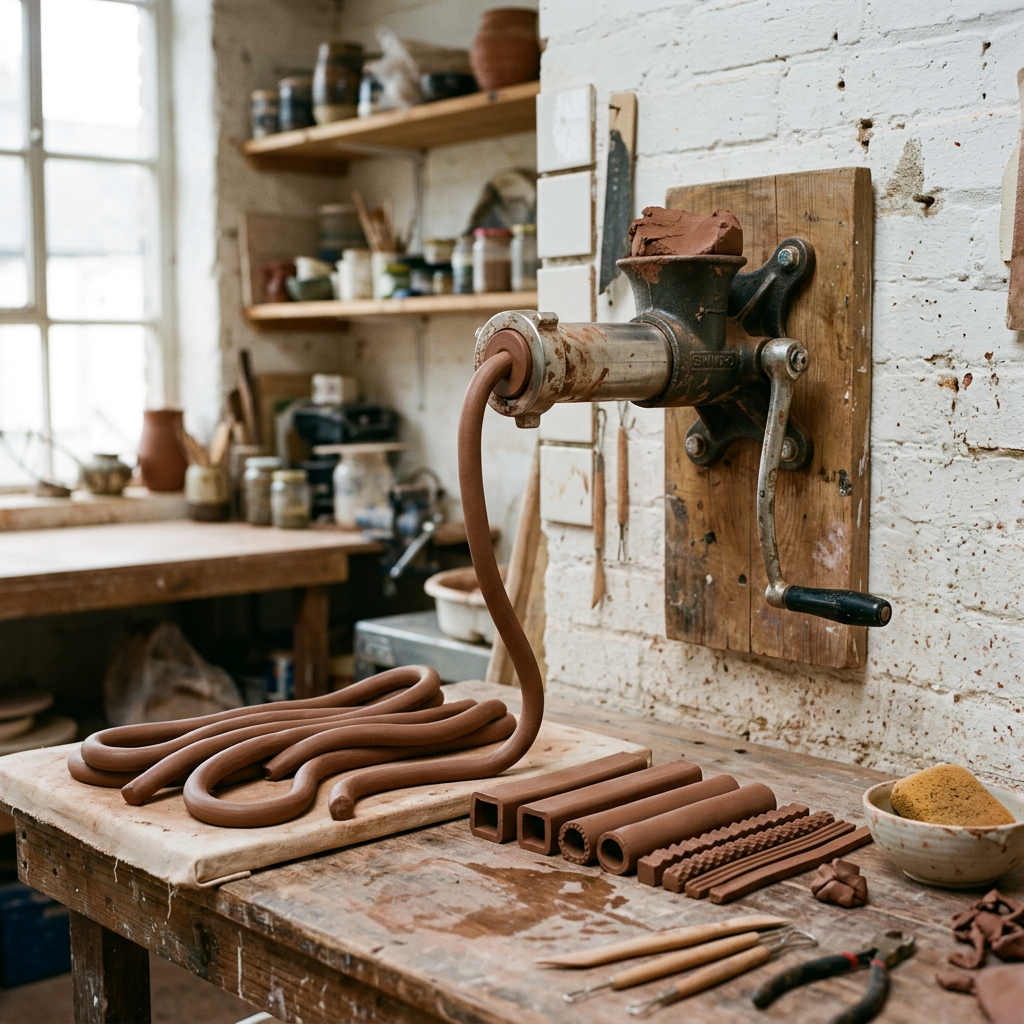
Instead of shaping every coil, handle, tube, or decorative profile by hand, you can push clay through a die and create consistent forms in seconds.
That makes a clay extruder useful for beginners, production potters, teachers, sculptors, and ceramic studios.
But buying the right extruder matters.
A small handheld extruder and a heavy-duty wall-mounted machine are completely different tools.
The right choice depends on what you want to make, how much clay you use, and how frequently you’ll use the machine.
What Is a Clay Extruder?
A clay extruder is a tool that forces clay through a shaped opening called a die.
The die determines the shape of the clay as it exits the machine.
Depending on the die, you can produce:
Coils
Handles
Tubes
Hollow forms
Strips
Rods
Decorative profiles
Architectural shapes
Custom sections
The basic idea is simple.
Load workable clay into the barrel, apply pressure with the plunger, and the clay exits through the selected die.
What Can You Make With a Clay Extruder?
A pottery extruder is much more versatile than it first appears.
Potters commonly use extruders to produce handles for mugs and pitchers.
You can also create consistent coils for handbuilt pottery.
Other applications include:
Legs
Feet
Decorative trim
Hollow tubes
Architectural components
Sculptural forms
Tile accessories
Repetitive pottery components
The biggest advantage is consistency.
If you need twenty similar handles, producing them with an extruder is considerably easier than shaping each one from scratch.
Do You Need a Pottery Clay Extruder?
Not every potter needs one.
If you mainly throw mugs, bowls, and cylinders on the wheel, an extruder may not be an essential purchase.
It becomes much more useful when your work involves repeated shapes.
Consider one if you:
Make lots of handles
Build with coils
Create repetitive forms
Make architectural ceramics
Produce sculpture
Teach handbuilding
Need consistent profiles
Want to reduce repetitive handwork
Run a production studio
If none of those describe your workflow, your money may be better spent on equipment you use more often.
Handheld vs Wall-Mounted Clay Extruder
The first major decision is the type of extruder.
Handheld extruders are compact and portable.
Wall-mounted extruders are larger, heavier, and designed for greater leverage and capacity.
Neither is automatically better.
They are designed for different jobs.
Handheld Clay Extruder
A handheld extruder is useful when portability matters.
You can move it around the studio and store it when you’re finished.
It’s particularly useful for:
Small studios
Classrooms
Occasional projects
Small handles
Decorative coils
Small shapes
Beginners
A handheld machine also tends to cost considerably less than a large studio extruder.
Wall-Mounted Clay Extruder
A wall-mounted pottery extruder provides substantially more leverage.
The machine stays attached to a sturdy wall or mounting system while you operate the handle.
This makes it much more practical for repeated production.
A wall-mounted extruder is particularly useful for:
Large handles
Large coils
Hollow forms
Production pottery
Sculpture
Classrooms
Studios with frequent extruding work
If you’re going to use an extruder several times every week, a wall-mounted model can make more sense than a small handheld tool.
How Much Clay Can a Clay Extruder Hold?
Capacity varies considerably.
For example, Bailey’s Standard 4 Extruder has an 11-pound barrel capacity and can produce solid coils and tubes up to specified dimensions.
Larger extruders can hold considerably more clay.
Capacity matters because repeatedly reloading a small barrel becomes annoying when you’re producing large quantities.
If you’re making one or two handles, capacity barely matters.
If you’re producing fifty identical components, it matters much more.
The Barrel Size Matters
The barrel determines how much clay you can load at once.
A larger barrel isn’t automatically better.
More capacity usually means:
Larger equipment
More weight
More space
Higher price
Greater leverage requirements
For a small home studio, a compact barrel may be exactly what you need.
For production work, the larger capacity can save substantial time.
What Is a Die?
The die is the shaped opening through which the clay exits.
Think of it as a template.
The shape of the die determines the profile of the extruded clay.
Different dies can create:
Round coils
Square profiles
Rectangular profiles
Handles
Hollow tubes
Decorative shapes
Custom forms
A good extruder can become much more versatile when you have a useful collection of dies.
Why Die Selection Matters
Two potters can own the exact same extruder and use it completely differently.
One might use it almost exclusively for handles.
Another might use it for architectural sculpture.
Another might produce hundreds of identical components.
The difference can simply be the die collection.
Before buying, check which dies are included.
Then determine which additional dies are available.
An inexpensive extruder with no useful dies may end up costing more once you build the die collection you actually need.
Hollow Dies
Hollow dies are particularly useful for larger forms.
They allow clay to be extruded with an interior opening.
This can reduce the amount of clay required and make certain structural forms easier to build.
Hollow extrusion can be useful for:
Tubular handles
Architectural elements
Sculptural forms
Large coils
Decorative components
If you know you’ll be making hollow shapes, make sure the extruder supports the appropriate die system.
Clay Consistency Matters
An extruder cannot turn unsuitable clay into good extruded clay.
Clay needs the right consistency.
If it’s too dry, the clay can require excessive force and may crack as it exits.
If it’s too wet, the extrusion can lose its shape.
The ideal moisture level depends on the clay body and the shape you’re producing.
Different clay bodies can also behave differently.
Porcelain, stoneware, grogged clay, and other bodies may require different handling.
Can You Extrude Any Clay?
No.
Some clay bodies extrude much more easily than others.
Clay containing coarse grog can require more force and may produce rougher surfaces.
Very soft clay may deform as it exits.
Plastic clay is generally easier to extrude consistently.
Always consider the characteristics of your clay body before assuming a particular die will work.
Clay Extruder for Pottery Handles
Handles are one of the most practical uses for an extruder.
Instead of pulling every handle individually, you can produce a consistent profile and cut it to the required length.
This is especially useful for production pottery.
You can make a long extrusion, cut sections to length, and attach them to your vessels.
That makes the process considerably more repeatable.
Clay Extruder for Coils
Coil building is another obvious application.
An extruder can produce consistent coils much faster than hand-rolling every coil.
This can be particularly useful for:
Large vessels
Sculpture
Architectural pottery
Coil-built forms
Classroom projects
Large handbuilt work
If you’re building large forms, reducing repetitive clay preparation can save a surprising amount of time.
Clay Extruder for Sculpture
Sculptors can use extruders to create consistent structural components.
You aren’t limited to conventional pottery.
Extruded clay can become part of a larger sculpture.
You can combine different profiles to create complex structures.
The extruder essentially becomes a way of producing repeatable clay components.
Clay Extruder for Architectural Ceramics
Architectural ceramics can require large numbers of similar components.
That’s where extrusion becomes especially valuable.
You can create repeated:
Profiles
Trim
Tubes
Tiles
Brackets
Decorative elements
Structural sections
Consistency becomes much more important when you’re producing dozens or hundreds of pieces.
A hand-shaped component can vary.
An extruded profile is much easier to reproduce.
What Size Clay Extruder Should You Buy?
Start with the largest thing you actually plan to make.
Then look at the amount of clay required.
A small handheld extruder can be enough for occasional handles and decorative shapes.
A standard wall-mounted machine can be better for regular studio work.
A larger production extruder makes more sense when you’re producing large quantities or large profiles.
Don’t buy a large machine simply because it has impressive specifications.
Buy the machine that fits your workload.
Wall Space Matters
A wall-mounted pottery extruder needs a proper mounting location.
The wall must be capable of handling the forces generated during operation.
You also need enough space around the machine to:
Load clay
Operate the handle
Remove the extrusion
Change dies
Clean the barrel
Store accessories
Plan the installation before buying.
A wall-mounted machine isn’t useful if you don’t have a suitable wall.
What Should You Look for in a Clay Extruder?
Compare:
Barrel diameter
Barrel capacity
Construction
Mounting system
Plunger design
Handle leverage
Die compatibility
Included dies
Available dies
Ease of cleaning
Replacement parts
Warranty
Overall dimensions
Weight
Price
The machine should match your actual work.
Steel vs Stainless Steel
Material matters when you’re working with different clay bodies.
Stainless steel components can be particularly useful when working with light-colored clay bodies such as porcelain.
The goal is to minimize contamination from materials that could discolor the clay.
If you regularly work with porcelain or white stoneware, investigate the materials used in the parts that contact the clay.
Cleaning Your Clay Extruder
Cleaning is easy to underestimate.
Clay should not be allowed to dry inside the barrel.
Dried clay can make the next extrusion more difficult and can create unnecessary wear.
After use:
Remove remaining clay
Clean the barrel
Clean the plunger
Clean the die
Remove trapped clay from corners
Dry the components appropriately
Store the dies safely
If you have multiple dies, keep them organized.
Losing one small die can be surprisingly annoying when you’re in the middle of production.
Clay Extruder Maintenance
A well-built manual extruder generally doesn’t require complicated maintenance.
Still, inspect:
Threads
Plunger
Handle
Mounting hardware
Barrel
Dies
Moving components
Lubrication points, where applicable
If something begins requiring excessive force, don’t simply push harder.
Investigate the cause.
The problem could be clay consistency, a blocked die, worn hardware, or incorrect assembly.
Used Clay Extruder
A used clay extruder can be an attractive way to save money.
Unlike equipment with complex motors and electronics, a manual extruder has fewer components that can fail.
Still, inspect it carefully.
Check:
Barrel condition
Plunger
Handle
Threads
Die condition
Mounting hardware
Cracks
Bent components
Missing parts
Rust
If possible, assemble and operate the machine before buying.
Make sure the plunger moves smoothly.
What Does a Clay Extruder Cost?
Prices vary widely.
Small handheld tools can cost less than $100.
Professional wall-mounted extruders commonly cost several hundred dollars.
For example, current US listings show Bailey Standard 4 extruders around the $400 range, while Scott Creek’s professional wall-mounted models are around $550 to $650.
Larger or specialized systems can cost considerably more.
The right comparison is not simply price.
Compare what you get for the money.
Pottery Extruder for Sale
When shopping for a pottery extruder for sale, look beyond the photograph.
Check:
Capacity
Dimensions
Included dies
Construction
Mounting hardware
Replacement parts
Warranty
Shipping
Total cost
A machine that appears inexpensive may require additional dies or mounting equipment.
Calculate the complete setup.
Clay Extruder Brands
Several established manufacturers produce ceramic extruders.
Names you may encounter include:
Brent
Bailey
North Star
Scott Creek
Steel Pottery
Each has different designs and configurations.
The right choice depends on the kind of work you’re doing.
Don’t choose a brand simply because another potter uses it.
Choose the machine that fits your process.
Bailey Clay Extruders
Bailey offers several clay extruder configurations.
Its Standard 4 model, for example, has an 11-pound barrel and supports solid coils and hollow tubes within its specified extrusion range.
Bailey also offers larger models and stainless versions.
You can review the manufacturer’s current specifications here:
Brent Clay Extruders
Brent also produces wall-mounted clay extruders.
Their heavy-duty model uses a 4-inch barrel and is designed around leverage and repeatable extrusion.
The manufacturer’s design includes a safety system and interchangeable die options.
This type of machine makes more sense for a serious studio than for someone who only needs an occasional small coil.
Scott Creek Clay Extruders
Scott Creek specializes in studio clay extruders and accessories.
Its lineup includes handheld clay guns as well as 4-inch and 5-inch wall-mounted models.
The company also offers a large selection of dies and accessories.
You can see the current range here:
Clay Extruder vs Pugmill
These machines are sometimes confused because both involve pushing clay through an opening.
They serve very different purposes.
A clay extruder is primarily used to create specific shapes.
A pugmill is primarily used to process, reclaim, mix, and often de-air clay.
An extruder is useful for:
Handles
Coils
Profiles
Tubes
Decorative shapes
A pugmill is useful for:
Clay reclaim
Mixing
De-airing
Clay preparation
If your problem is producing consistent shapes, look at an extruder.
If your problem is processing large quantities of clay, look at a pugmill.
Clay Extruder vs Handbuilding
An extruder doesn’t replace handbuilding.
It makes certain parts of handbuilding faster.
You still need to:
Cut clay
Join pieces
Compress seams
Shape forms
Score and slip
Dry work properly
An extruder simply gives you a repeatable starting component.
That can be extremely useful when you’re building the same form repeatedly.
Is a Clay Extruder Worth It?
For occasional use, maybe not.
For regular production, it can be one of the most useful small pieces of equipment in the studio.
The value comes from time saved.
Imagine making 100 identical handles by hand.
Now imagine extruding a consistent profile, cutting it into sections, and attaching those sections to your pots.
The machine doesn’t just save clay preparation time.
It makes the entire process more repeatable.
When You Should Buy One
A clay extruder becomes easier to justify when:
You’re making the same component repeatedly
You’re producing large quantities
You’re making large coils
You’re building architectural ceramics
You’re teaching handbuilding
You’re producing sculpture
Your hands are tired from repetitive shaping
You want more consistent components
If none of those apply, put the money toward equipment you use more frequently.
Where to Buy a Clay Extruder
The Kiln Depot carries ceramic studio equipment including clay extruders and other equipment used for pottery and handbuilding.
Browse the main equipment selection:
The site currently lists an Extruders category alongside kilns, pottery wheels, pug mills, and slab rollers.
For studio equipment, start here:
Clay Extruder Buying Checklist
Before purchasing, confirm:
What you want to make
Maximum extrusion size
Barrel capacity
Clay compatibility
Handheld or wall-mounted design
Available wall space
Die selection
Included accessories
Replacement dies
Construction
Maintenance requirements
Warranty
Shipping
Total cost
That checklist will eliminate most unsuitable machines before you spend any money.
Final Thoughts
A clay extruder is a relatively simple machine that can have a surprisingly large impact on a ceramics studio.
It can turn repetitive work into a fast, consistent process.
The right extruder depends on your pottery.
If you occasionally need a small coil or handle, a handheld model may be enough.
If you regularly produce repeated components, a wall-mounted extruder can save significant time.
If you’re producing architectural ceramics or large sculptural work, capacity and die selection become much more important.
Don’t buy the biggest extruder.
Don’t buy the cheapest extruder.
Buy the one that solves the specific clay-shaping problem slowing down your studio.
