Slab roller vs rolling pin is not really a question of which tool makes better pottery.
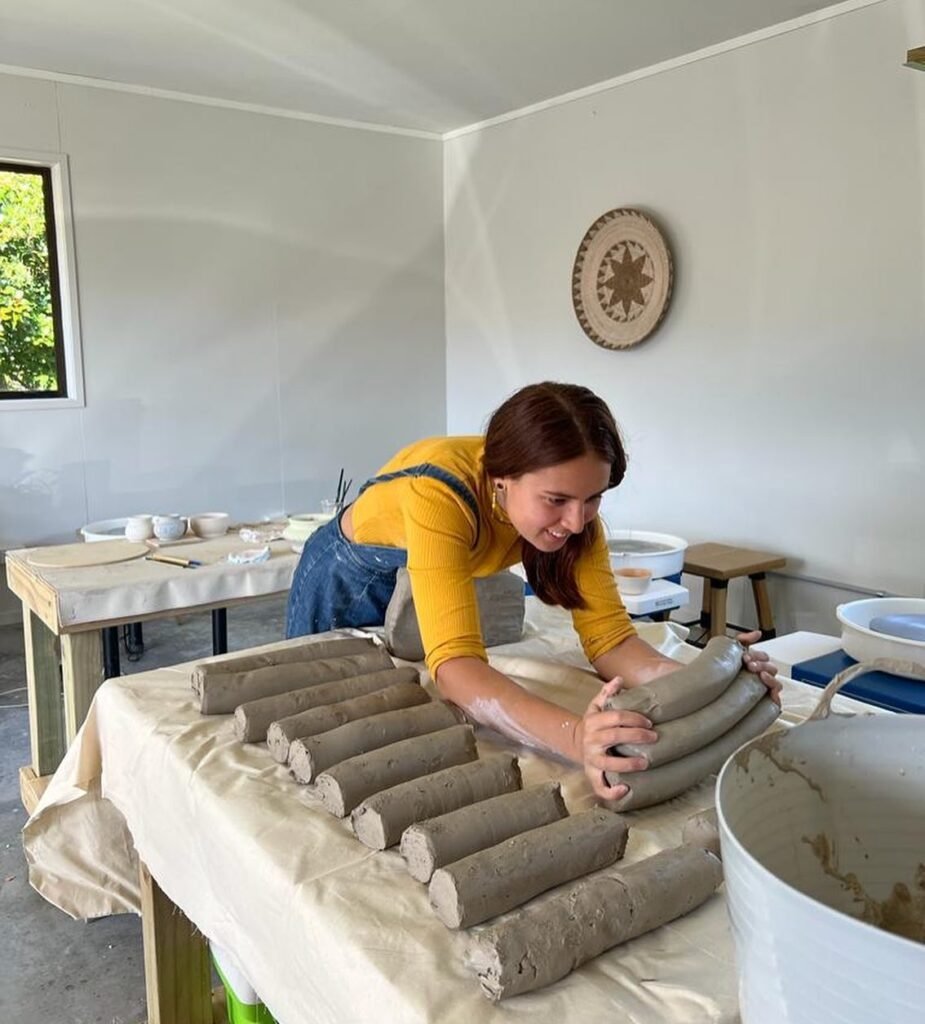
Both can produce good slabs.
The real difference is how much clay you process, how consistent your slabs need to be, how often you make them, and whether the cost of a slab roller is justified by your workflow.
A rolling pin, dowel, or similar hand tool can be perfectly adequate for occasional slab building.
A slab roller becomes much more attractive when you regularly make large slabs, need repeatable thickness, or spend significant time preparing clay by hand.
The simplest way to think about it is:
Occasional slabs and small projects → rolling pin.
Frequent slabs and consistent production → slab roller.
Large slabs or heavy studio use → dedicated slab roller.
That distinction matters because a slab roller is a substantial equipment purchase. There is little reason to spend hundreds or thousands of dollars on one if a simple rolling setup already meets your needs.
Slab Roller vs Rolling Pin: Quick Comparison
| Factor | Rolling Pin | Slab Roller |
|---|---|---|
| Initial cost | Very low | Moderate to high |
| Space required | Minimal | Moderate to substantial |
| Portability | Excellent | Model dependent |
| Setup | Immediate | Usually requires workspace |
| Thickness consistency | Depends on technique | Generally easier to repeat |
| Large slabs | More difficult | Much easier |
| Repeated production | Labor intensive | More efficient |
| Small projects | Excellent | Often unnecessary |
| Schools and production studios | Limited | Better suited |
| Storage | Easy | Requires planning |
Neither tool is automatically better.
The right choice depends on your studio.
How Does a Rolling Pin Make Pottery Slabs?
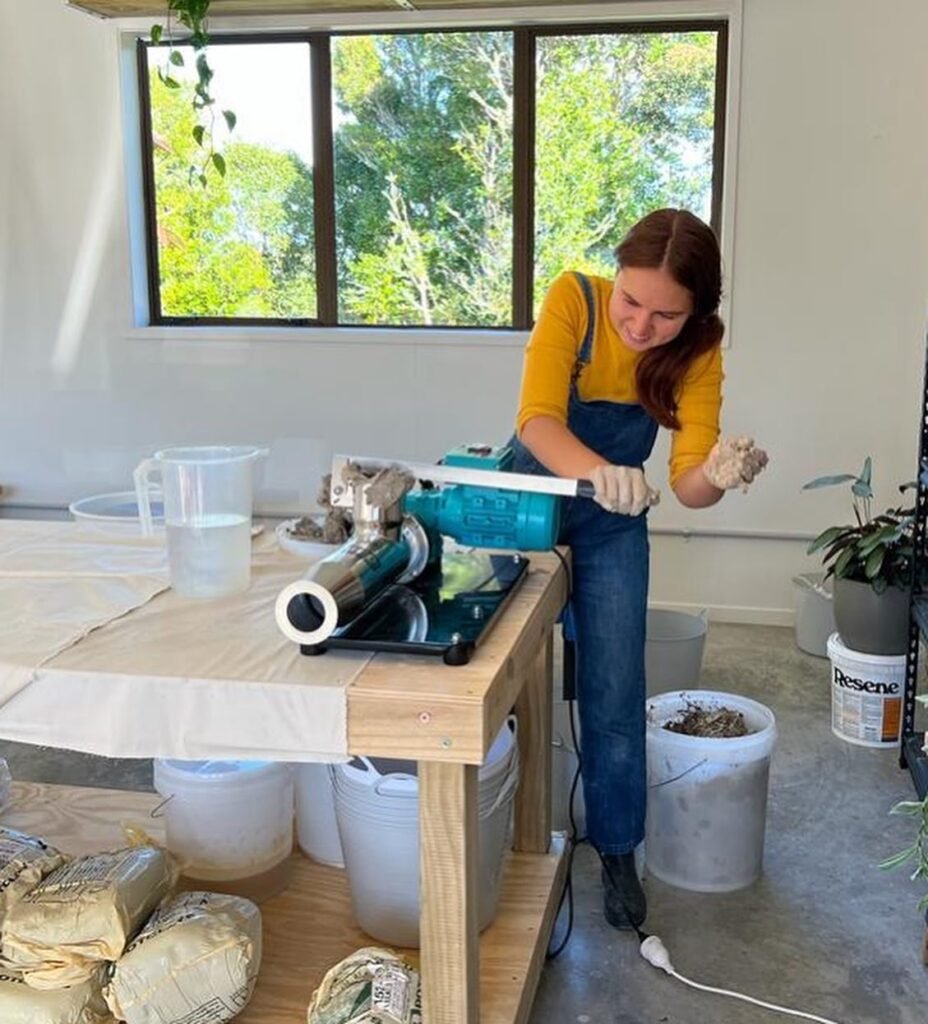
The basic process is straightforward.
Place your clay between two thickness guides.
Cover it with canvas or another suitable surface.
Roll across the clay repeatedly while maintaining even pressure.
Turn or reposition the clay as necessary.
Continue until the slab reaches the desired thickness.
The method works.
Potters have been making slabs this way long before dedicated slab rollers became common studio equipment.
The limitations become more obvious as the slabs get larger or production becomes more frequent.
Your arms provide the pressure.
Your technique controls the thickness.
Your workspace determines how large you can comfortably work.
How Does a Slab Roller Work?
A slab roller passes clay between rollers or through a rolling mechanism that compresses the clay to a controlled thickness.
Depending on the model, thickness may be controlled with:
- Shims
- Adjustable rollers
- Thickness scales
- Mechanical adjustment systems
- Gear-driven mechanisms
Professional machines can also provide much larger working surfaces.
For example, Bailey’s SRT-30 tabletop slab roller uses two independent height-adjustment knobs with scales and can produce slabs up to 30 inches wide by 24 inches long.
Larger Bailey machines use substantially more robust roller systems.
Its current DB 30 manual model has 4-inch-diameter rollers, a 30-inch roller width and an infinitely variable thickness range from 0 to 1¾ inches.
That is a completely different class of equipment from a rolling pin.
Is a Slab Roller More Consistent?
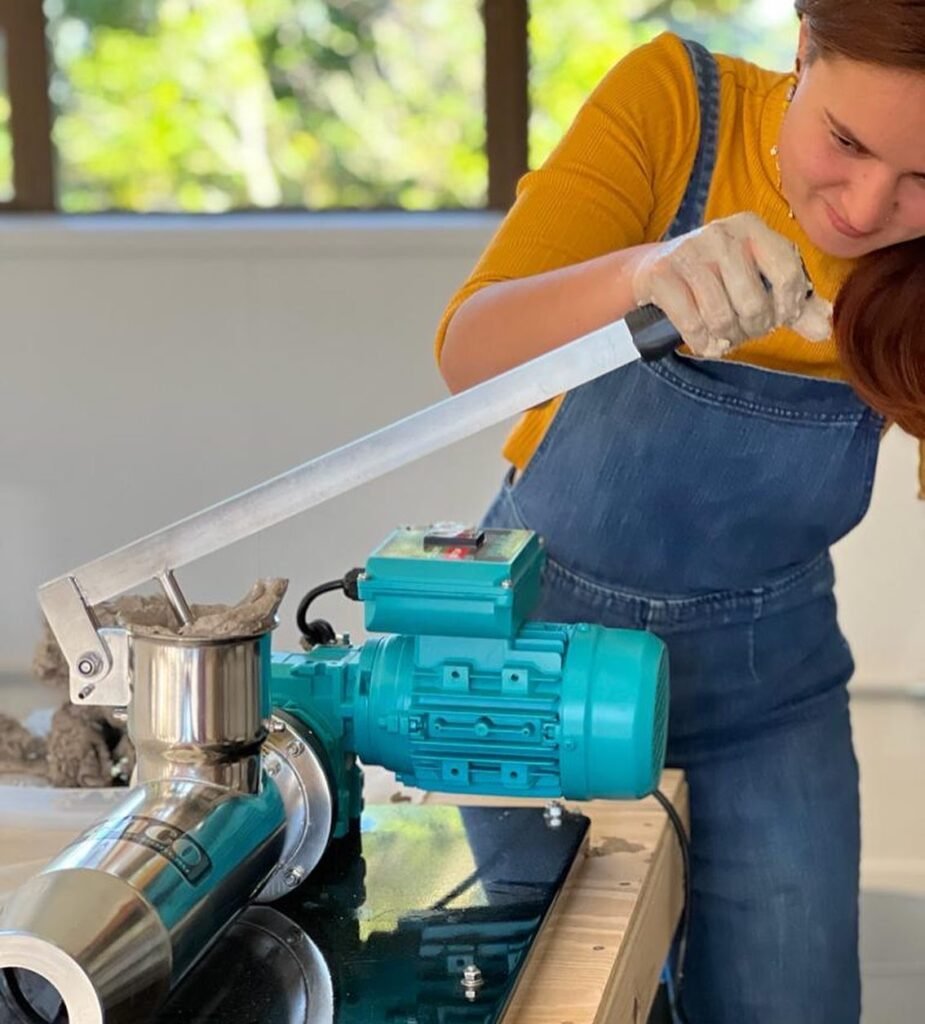
Usually, yes.
That is one of the strongest reasons to buy one.
With a rolling pin, maintaining identical pressure across a large slab takes practice.
The edges can become thinner.
The center can remain thicker.
The slab can become uneven as you roll.
You can improve the process with thickness guides and careful technique, but the operator remains responsible for maintaining consistency.
A slab roller gives you a more controlled mechanical process.
That becomes particularly valuable when making:
- Tiles
- Plates
- Wall pieces
- Boxes
- Furniture components
- Repeated forms
- Large panels
If every slab needs to be approximately the same thickness, mechanical control becomes increasingly useful.
Is a Rolling Pin Better for Small Projects?
Often, yes.
If you are making a few small slabs for a handbuilt mug, small tray, ornament, or test piece, setting up a large slab roller may be unnecessary.
A rolling pin takes almost no preparation.
You can pull out your clay, place it between guides, roll the slab, and put the tool away.
That simplicity is difficult to beat.
For a potter who makes slabs only occasionally, buying a dedicated machine may not make financial sense.
Is a Slab Roller Worth It?
A slab roller becomes easier to justify when it removes a recurring bottleneck.
Ask yourself:
How often do I make slabs?
If the answer is once every few months, a rolling pin may be enough.
If you make slabs every week, the calculation changes.
If you make them every day, the time and labor savings become much more significant.
The purchase makes even more sense when you routinely make large slabs.
The Kiln Depot’s existing best slab roller guide covers the major slab roller types and studio applications.
Slab Roller vs Rolling Pin for Large Slabs
This is where the difference becomes obvious.
A small slab is manageable with a rolling pin.
A large slab becomes physically awkward.
As the clay gets wider and longer, maintaining even pressure becomes more difficult.
You also need more table space.
You may have to reposition the clay repeatedly.
The clay can stretch or distort during handling.
A slab roller gives you a more controlled way to move the clay through the rolling mechanism.
For large-format work, that can save substantial effort.
AMACO’s Brent SR-36, for example, is designed for large projects and can produce slabs up to 36 inches wide by 52 inches long. The manufacturer lists a maximum slab thickness of 7/8 inch.
That is a scale of work that becomes cumbersome to achieve with a conventional rolling pin.
Slab Roller vs Rolling Pin for Thickness Control
Thickness control is another major difference.
With a rolling pin, your thickness guides determine the minimum spacing, but your technique still affects the result.
A slab roller uses a mechanical relationship between the rollers and the clay.
Some machines allow infinitely variable adjustment.
Bailey’s SRT-30, for example, lists an infinitely variable slab thickness from 0 to 3 inches.
Larger Bailey machines also use mechanical adjustment systems designed to maintain parallel rollers.
This makes repeatability much easier when producing a series of slabs.
Can a Rolling Pin Produce Professional Slabs?
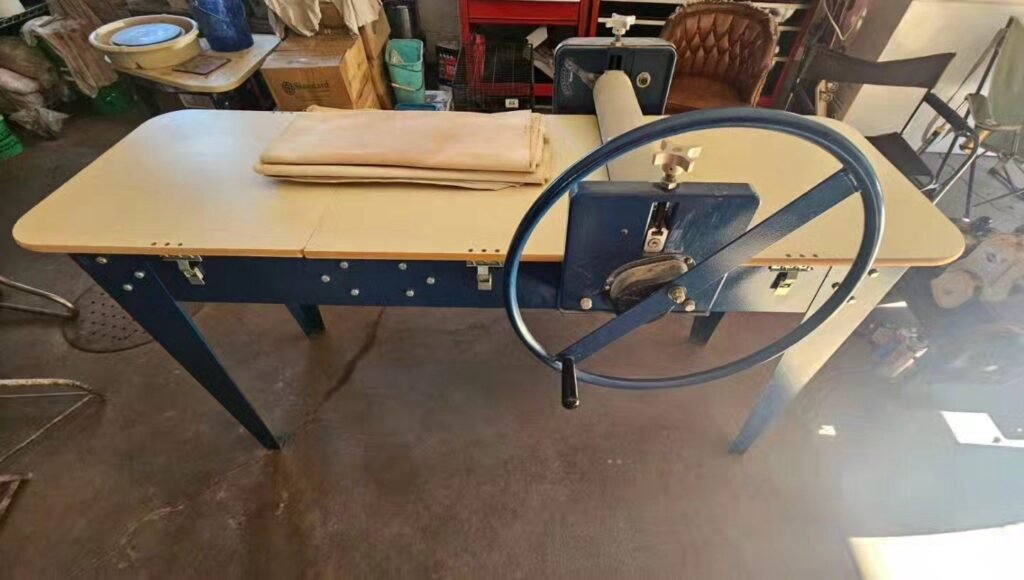
Absolutely.
The tool does not determine the quality of the finished pottery by itself.
A skilled potter can produce excellent slabs using basic tools.
The difference is efficiency and repeatability.
A rolling pin requires more operator control.
A slab roller shifts more of that control to the machine.
If you are making one unique sculptural piece, that may not matter.
If you are making 30 identical tiles, it matters considerably more.
Slab Roller vs Rolling Pin for Beginners
Beginners usually do not need to buy a slab roller immediately.
Learning to roll slabs by hand teaches useful skills.
You learn:
- How clay responds to pressure
- How moisture affects rolling
- How slabs stretch
- How thickness changes
- How to compress surfaces
- How to prevent warping
- How to handle large pieces
A rolling pin and a few thickness guides can be a very inexpensive way to determine whether slab building is actually something you enjoy.
If you eventually find yourself making slabs constantly, then upgrade.
What Can You Use Instead of a Slab Roller?
You have several options.
Rolling pin
The simplest solution.
Dowel
A straight dowel can work as a basic rolling tool.
Thickness guides
These help keep the rolling tool at a consistent height.
Slab mat
A suitable surface can make handling easier.
Two boards
Boards of known thickness can serve as guides.
Homemade slab frame
Some potters build simple systems using wood and rollers.
These approaches can work well for occasional slab work.
The trade-off is that they require more manual effort and generally offer less convenience than a dedicated machine.
Slab Roller vs Rolling Pin for Home Studios
Home studios often have limited space.
That changes the calculation.
A rolling pin can live in a drawer.
A dedicated slab roller needs a permanent or semi-permanent location.
Before buying, measure:
- Available floor space
- Table space
- Storage
- Doorways
- Working clearance
- Access around the machine
A tabletop machine can reduce the footprint.
Bailey’s SRT-30 is designed as a tabletop model and weighs 96 pounds, according to its current specifications.
That is still substantial compared with a rolling pin, but considerably more manageable than a large production machine.
Tabletop vs Floor Slab Rollers
If you decide a slab roller is worthwhile, the next decision is size.
Tabletop slab rollers
Best for:
- Home studios
- Small projects
- Limited space
- Occasional production
- Portability
Floor-standing slab rollers
Best for:
- Large slabs
- Regular production
- Schools
- Dedicated studios
- Commercial pottery
The Kiln Depot’s guide to slab rollers for small studios covers the compact end of this market.
The important point is not to jump from a rolling pin directly to a huge commercial machine.
There is a substantial middle ground.
Slab Roller vs Rolling Pin for Schools
Schools have a different set of requirements.
A rolling pin is inexpensive and easy to replace.
But a classroom can have many students using the equipment repeatedly.
That makes consistency and durability more important.
A tabletop roller may work well for smaller projects.
A larger floor model becomes more useful when students regularly make large slabs or the studio runs multiple handbuilding classes.
Bailey explicitly positions its SRT-30 for serious hobbyists and lower-volume slab production while recommending its more robust professional models for schools and demanding studio use.
That is a useful distinction.
The right machine depends on workload, not simply whether the buyer is a school.
Slab Roller vs Rolling Pin for Production Pottery
For production work, labor becomes part of the equipment calculation.
Imagine making the same slab repeatedly.
With a rolling pin, every slab requires manual rolling.
With a slab roller, the machine handles the mechanical rolling.
The savings compound over time.
This is particularly relevant when your pottery business produces:
- Tile
- Dinnerware
- Wall panels
- Trays
- Architectural ceramics
- Repeated handbuilt forms
At this scale, the slab roller is no longer simply a convenience.
It becomes production equipment.
What About Very Large Slabs?
Very large slabs can expose another advantage of dedicated machines.
The roller, table and drive system are designed around the forces generated during rolling.
Bailey’s current DB 40 manual roller has a 40-inch roller width, a 4-inch roller diameter and a listed slab size of 40 inches by 4 feet. The machine weighs 336 pounds.
That kind of equipment is designed for a completely different workload from a rolling pin.
But it also requires:
- More space
- More money
- More difficult transportation
- More substantial installation
There is no reason to buy this class of machine if your work does not require it.
Slab Roller vs Rolling Pin: Cost
The cost difference is substantial.
A rolling pin may cost only a small amount.
A tabletop slab roller can cost hundreds or more.
Professional machines can cost several thousand dollars.
For example, Bailey currently lists its SRT-30 at $929.40, while its DB 30 manual model is listed at $2,719.
The price difference reflects more than size.
You are paying for:
- Larger rollers
- Stronger construction
- Better adjustment
- Greater capacity
- More durable drive systems
- Larger working surfaces
This is why the purchase should be based on workflow.
Should You Buy a Used Slab Roller?
If a new slab roller is outside your budget, used equipment can make sense.
But compare the total cost.
A used machine may require:
- Transportation
- Replacement parts
- New canvas
- Gear repairs
- Bearing work
- Cleaning
- Adjustment
The Kiln Depot’s used slab roller guide explains what to inspect before buying.
A used professional machine can be excellent value when the condition is good.
A cheap damaged machine can become expensive quickly.
Slab Roller vs Rolling Pin: Which Is Better for You?
Use this simple decision tree.
Choose a rolling pin if:
You make slabs occasionally.
Your slabs are relatively small.
You have very limited space.
You are learning handbuilding.
You want the lowest-cost option.
You do not mind manual work.
Choose a tabletop slab roller if:
You make slabs regularly.
You want more consistent thickness.
Space is limited.
You make small or medium-sized work.
You want to reduce manual rolling.
Choose a floor-standing slab roller if:
You make large slabs.
You work frequently.
You run a school or production studio.
You need a larger working surface.
You want the machine permanently available.
Choose a production slab roller if:
Slab preparation is a major part of your business.
You process large amounts of clay.
You need substantial throughput.
You have the space and budget for industrial equipment.
What About Clay Thickness?
Your intended slab thickness should influence your equipment choice.
Some projects need thin slabs.
Others require thick structural slabs.
If you repeatedly work at unusual thicknesses, check the manufacturer’s adjustment range before purchasing.
Bailey’s larger DB machines, for example, are designed for a much wider thickness range than many compact tabletop rollers. The current DB 30 specification lists 1/16 inch to 1¾ inches, infinitely variable.
Do not assume that every slab roller handles the same thickness range.
Does a Slab Roller Eliminate Wedging?
No.
A slab roller does not replace every part of clay preparation.
Your clay still needs to be suitable for the machine.
You may still need to:
- Wedge
- Condition
- Reclaim
- Adjust moisture
- Compress surfaces
- Rest the clay
A slab roller is a forming tool.
It is not a substitute for understanding your clay body.
Can a Slab Roller Reduce Physical Effort?
Yes.
Rolling a large slab repeatedly by hand requires physical effort.
A mechanical roller takes over much of that work.
That can be particularly useful for potters who produce slabs frequently.
But the machine does not eliminate every physical task.
You still have to:
- Move clay
- Load the machine
- Position canvas
- Handle slabs
- Transfer pieces
- Clean the equipment
The larger the machine, the more important material handling becomes.
Slab Roller vs Rolling Pin: Final Decision
The slab roller vs rolling pin decision comes down to frequency, scale and consistency.
Choose the rolling pin when you want simplicity, low cost and portability.
Choose a tabletop slab roller when you make slabs regularly but have limited space.
Choose a floor-standing machine when slabs are a major part of your studio workflow.
Choose production equipment when slab preparation is a genuine business bottleneck.
There is no prize for owning the largest machine.
A $2,700 slab roller does not automatically produce better pottery than a rolling pin.
It simply gives you more mechanical assistance, capacity and repeatability.
That distinction matters.
If you make three slabs a month, spend your money elsewhere.
If you make three hundred, the calculation changes completely.
Before buying, look at the actual size of your work, your required thickness, your available space and how often you roll clay.
Then compare the equipment that fits those requirements.
For current slab roller options, compare manufacturers such as Bailey Pottery and AMACO/Brent rather than choosing solely on brand reputation.
The right slab-building tool is the one that makes your actual workflow easier without paying for capacity you will never use.
