The best pottery wheel for large pottery needs more than a powerful motor on paper. When you start throwing 10, 20, 30 pounds of clay or more, torque, stability, wheelhead size, pedal response, and motor performance under load become much more important.
A wheel that feels excellent with three pounds of clay can behave very differently when you put a large block of clay on the wheelhead.
That is why large-format potters should shop differently from beginners making mugs and small bowls.
The key specifications to examine are:
- Continuous clay capacity
- Motor power
- Torque under load
- Wheelhead diameter
- Speed control
- Frame stability
- Drive system
- Pedal response
- Parts availability
- Long-term serviceability
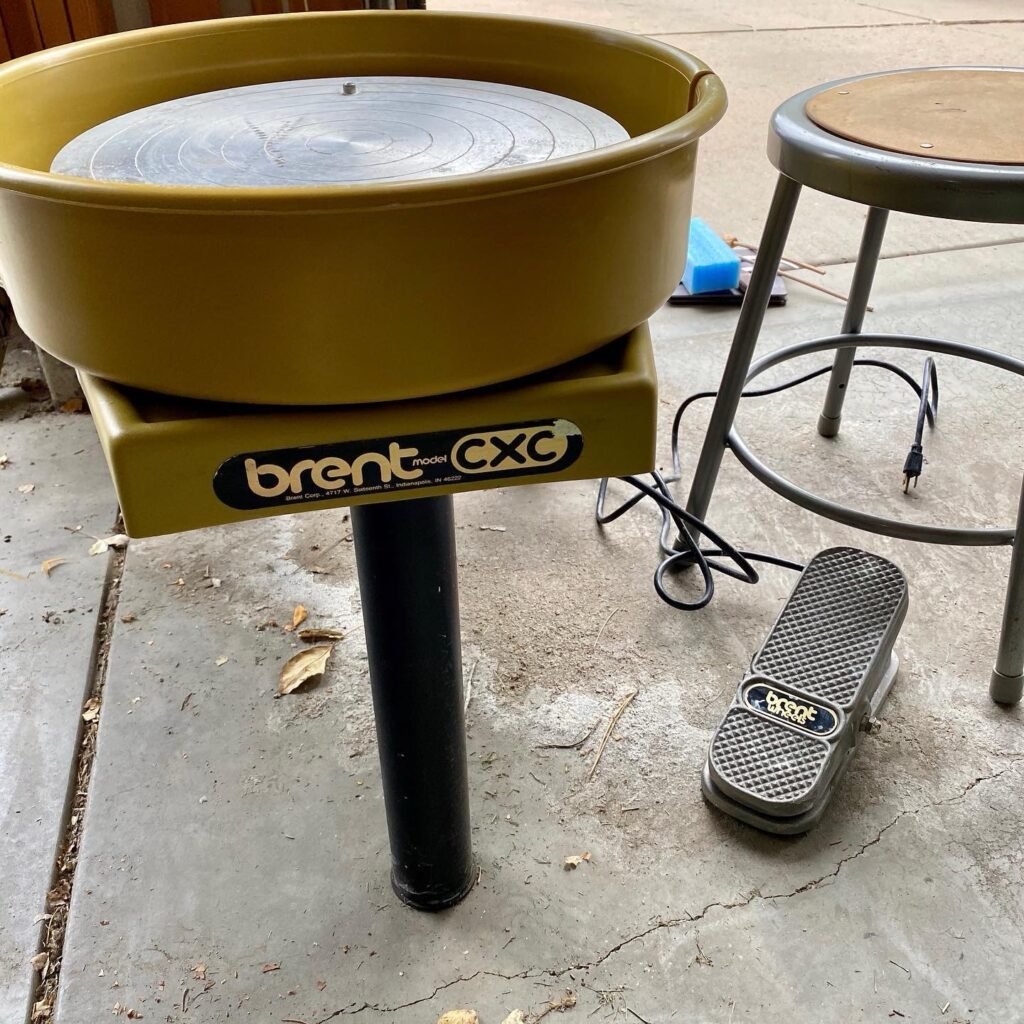
For genuinely large work, professional wheels such as the Brent C and Brent CXC deserve particular attention. AMACO currently lists the Brent C at 3/4 HP with a 225-pound continuous clay capacity and the CXC at 1 HP with a 300-pound continuous capacity.
Those capacities are far beyond what most potters will ever need.
That is exactly why you should not automatically buy the largest wheel.
Best Pottery Wheel for Large Pottery: Quick Comparison
| Wheel | Motor | Listed Continuous Capacity | Wheelhead | Best Use |
|---|---|---|---|---|
| Brent B | 1/2 HP | 150 lb | 14 in | Everyday studio work |
| Brent C | 3/4 HP | 225 lb | 14 in | Large throwing and serious studio use |
| Brent CXC | 1 HP | 300 lb | 14 in | Heavy-duty and large-format work |
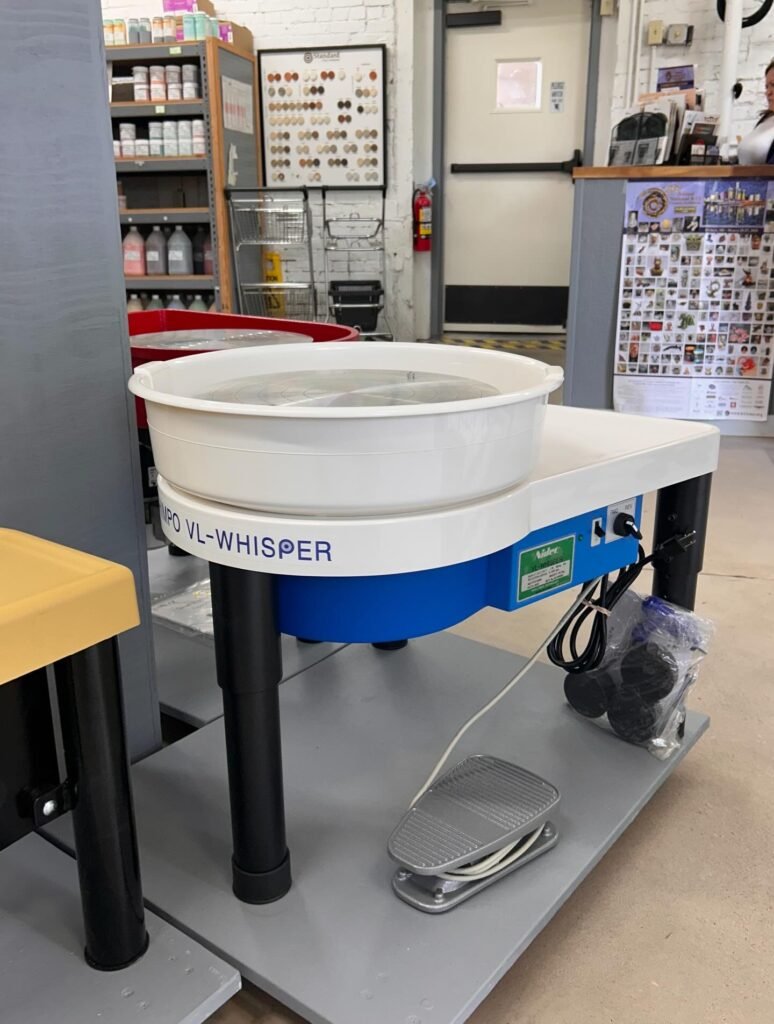
| Shimpo VL-Whisper | Model dependent | Verify current specification | 12 in | Quiet studio throwing |
| Used professional wheel | Varies | Model dependent | Varies | Buyers seeking capacity for less |
The listed capacities above come from current manufacturer information for the Brent models. They should not be interpreted as recommended throwing weights for every potter or every type of form.
What Makes the Best Pottery Wheel for Large Pottery?
Large pottery puts greater mechanical demands on a wheel.
You need the wheelhead to keep turning when your hands apply substantial pressure.
You also need the machine to remain stable while you work.
That makes several features especially important.
Torque
Torque is the wheel’s ability to keep turning against resistance.
When centering a large amount of clay, resistance increases substantially.
A wheel with adequate torque should maintain useful rotation instead of slowing dramatically whenever you apply pressure.
Continuous Capacity
Manufacturers sometimes publish maximum or continuous clay capacities.
These numbers are useful for comparison, but they are not a substitute for understanding your actual work.
If you normally throw 8 pounds of clay, you do not need a wheel rated for 300 pounds simply because the number is impressive.
Wheelhead
A 14-inch wheelhead gives you a generous working area for large forms.
It also gives you more room for bats and larger pieces.
However, wheelhead diameter alone does not determine whether a machine can handle large pottery.
A large wheelhead attached to a weak motor is still a weak wheel.
Stability
Large clay creates greater forces.
A stable frame helps keep the wheel planted while you work.
A lightweight portable wheel may be excellent for small pottery but less suitable for heavy throwing.
Pedal control
When working with large forms, precise speed changes matter.
The pedal should respond smoothly rather than jumping between speeds.
How Much Clay Do You Need to Throw?
This is the first question to answer before buying.
Think about your normal maximum rather than your theoretical maximum.
For example:
1 to 5 pounds: Most quality studio wheels are more than capable.
5 to 10 pounds: A solid intermediate wheel should be sufficient.
10 to 20 pounds: Torque and stability become increasingly important.
20 to 30 pounds: Look seriously at professional heavy-duty wheels.
30 pounds and above: Compare professional wheels specifically designed for substantial loads.
You may occasionally throw a very large piece without needing an enormous wheel.
What matters is how often you work at that scale.
If large throwing is your normal workflow, buy accordingly.
Best Pottery Wheel for Large Pottery: Brent C vs CXC
The Brent C and CXC are particularly relevant because their current specifications provide a useful illustration of how professional wheels scale.
The Brent C uses a 3/4 HP permanent-magnet DC motor and is listed at a continuous capacity of 225 pounds. It has a 14-inch cast aluminum wheelhead, reversible electronic speed control, and a speed range of 0 to 240 RPM.
The Brent CXC increases the motor to 1 HP and the listed continuous capacity to 300 pounds. It also has a 14-inch wheelhead and 0 to 240 RPM speed control.
For a potter choosing the best pottery wheel for large pottery, the practical difference is not simply that one has a bigger number.
The question is whether your work regularly demands the additional capacity.
If you routinely throw very large vessels, planters, wide forms, or substantial amounts of clay, the CXC gives you more headroom.
If your largest work is substantial but does not approach that level, the C may provide enough capacity without moving to the top of the range.
Do You Need a 1 HP Pottery Wheel?
No.
A 1 HP motor is not a requirement for making large pottery.
It is simply one way to get substantial capacity.
The Brent C demonstrates this clearly.
Its 3/4 HP motor is paired with a listed 225-pound continuous clay capacity.
For many serious potters, that is already far more capacity than they will use.
A 1 HP wheel becomes more relevant when you regularly work with very heavy clay loads or want significant headroom for large production work.
Do not buy horsepower for bragging rights.
Buy it because your workload requires it.
Torque Matters More Than Maximum RPM
Maximum RPM is rarely the deciding factor for large pottery.
You need enough speed for your throwing technique, but large-form throwing is much more concerned with how the wheel behaves under load.
A wheel that reaches 300 RPM but loses power when you push against a large clay mass is not necessarily better than a wheel with a lower maximum speed that maintains steady torque.
This is why the Kiln Depot’s existing guide on pottery wheel torque is useful background when comparing heavy-duty wheels.
For the best pottery wheel for large pottery, think about usable power rather than the largest RPM number on the specification sheet.
Wheelhead Size for Large Pottery
Wheelhead size matters, but it is easy to overstate its importance.
A 14-inch wheelhead gives you more working area than a smaller 10- or 12-inch wheelhead.
That can be useful for:
- Large bowls
- Platters
- Wide vessels
- Planters
- Large cylinders
- Bats
But the wheelhead does not support the entire finished piece by itself.
Your throwing technique, bats, clay consistency, and body position also matter.
For very large forms, you may use a bat system or other support method that extends beyond the wheelhead.
That means you should consider the complete setup rather than choosing solely by wheelhead diameter.
Stability Becomes More Important With Large Clay
A large lump of clay changes how the wheel feels.
The forces generated during centering can be substantial.
You don’t want the machine moving around the floor while you work.
This is one reason professional floor-standing wheels are so useful for large pottery.
The weight and frame construction can provide a more secure working platform.
That does not mean every heavy wheel is automatically better.
Inspect the frame, legs, feet, wheelhead and overall construction.
The wheel should feel planted while throwing.
Belt Drive vs Direct Drive for Large Pottery
Both systems can produce excellent pottery.
The more important question is how the complete machine handles your workload.
Belt-drive wheels have a long history in professional pottery studios.
The Brent C and CXC, for example, use a six-groove Poly-V belt with automatic belt tensioning.
Direct-drive wheels eliminate the traditional belt and can offer very quiet operation and smooth electronic control.
The Kiln Depot’s direct-drive vs belt-drive guide explains the practical differences.
For large pottery, don’t choose the drive system based on marketing language.
Evaluate torque, load behavior, reliability, serviceability and the type of work you actually do.
Best Pottery Wheel for Large Pottery at Home
Large pottery and home studios create a difficult combination.
The wheel needs enough power for your work without becoming impractical for your room.
Consider:
- Footprint
- Noise
- Weight
- Floor stability
- Seating position
- Access around the wheel
- Storage
- Clay cleanup
A professional wheel can be excellent mechanically and still be a poor home-studio purchase if you cannot comfortably fit it into the room.
Measure the complete workstation.
Don’t measure only the wheel.
You need space for your stool, tools, water, bats and finished work.
Large Pottery Does Not Always Mean Large Wheel
This is an important distinction.
A potter might make a large handbuilt vessel using slabs and coils rather than throwing the entire form on a wheel.
Another potter might throw a large base and add components later.
If you only occasionally make large forms, you may not need the best pottery wheel for large pottery in the heavy-duty sense.
Your existing professional wheel may already be sufficient.
The right question is:
How much large throwing do I actually do?
If the answer is “occasionally,” don’t overbuy.
If the answer is “every day,” invest accordingly.
Large Platters Need a Different Approach
Large platters can be especially demanding.
The diameter can become much larger than the amount of clay would suggest.
A wide platter requires:
- Stable rotation
- Good centering
- Controlled speed
- Adequate wheelhead support
- Careful moisture management
A powerful wheel helps, but it does not solve every problem.
A large platter can become distorted during removal or drying even when it was thrown successfully.
Your clay body, slab thickness, compression and drying process still matter.
The wheel is only one part of the system.
Best Pottery Wheel for Large Pottery: How Much Power Is Enough?
Use your normal clay weight as the starting point.
If you throw 3 to 5 pounds most of the time, there is little reason to choose a 300-pound-rated machine solely for the capacity.
If you routinely throw 15 to 25 pounds, a professional wheel becomes more attractive.
If you’re consistently above that range, heavy-duty models deserve serious consideration.
This is where the best pottery wheel for large pottery becomes a workload question rather than a brand question.
Brent B, C or CXC?
The current Brent range gives buyers a useful progression.
Brent B
The Model B has a 1/2 HP motor and is listed at 150 pounds of continuous capacity. It uses a 14-inch wheelhead and reversible electronic speed control.
For many studio potters, this is already plenty.
Brent C
The Model C moves to 3/4 HP and 225 pounds of continuous capacity.
This is where the range becomes particularly interesting for large-format throwing.
Brent CXC
The CXC moves to 1 HP and 300 pounds of continuous capacity.
This is the model that makes the most sense when heavy throwing is genuinely part of your daily workload.
The important point is that these capacities are far above the amount of clay most potters routinely use.
Choose the smallest model that comfortably exceeds your real requirements.
What About a Used Heavy-Duty Wheel?
Buying used can be particularly attractive at the professional end.
A used Brent C or CXC can give you access to a machine designed for substantial loads without requiring the full new-equipment investment.
But condition becomes critical.
Check:
- Motor
- Foot pedal
- Wheelhead
- Bearings
- Belt
- Controller
- Forward/reverse switch
- Splash pan
- Electrical system
- Frame
Then test the machine under load.
The Kiln Depot’s used pottery wheel inspection guide provides a more detailed checklist.
Don’t judge a heavy-duty wheel by how clean it looks.
Judge it by how it performs.
What About a Refurbished Heavy-Duty Wheel?
Refurbished equipment can make sense when you want professional capacity but don’t want to pay full new-equipment pricing.
The critical question is what refurbishment actually means.
Ask:
- Was the motor tested?
- Were bearings inspected?
- Was the pedal tested?
- Was the belt replaced or inspected?
- Was the wheelhead checked?
- Was the controller tested?
- Was the wheel operated under load?
- Are replacement parts available?
- Is there a warranty?
The Kiln Depot’s refurbished pottery wheel guide covers the distinction between genuine refurbishment and basic cleaning.
Does the Potter’s Height Matter?
Yes.
Large pottery often requires longer throwing sessions and more substantial body movement.
Your wheel should put you in a comfortable working position.
If you’re tall, consider whether the wheel can be raised appropriately.
For example, AMACO sells Brent wheel risers that can raise compatible Brent models by two or four inches.
This is a small detail, but ergonomics can make a major difference during long throwing sessions.
Don’t choose a powerful wheel and then spend hours fighting an uncomfortable seating position.
What About Left-Handed Large-Format Throwing?
If you throw large pottery left-handed, reversible rotation becomes particularly useful.
AMACO lists forward and reverse operation on current Brent B, C and CXC models.
That allows you to choose the direction that works with your technique.
You do not necessarily need reverse rotation simply because you are left-handed.
But when you’re already shopping for a professional wheel, having the option gives you more flexibility.
The Kiln Depot’s guide to pottery wheels for left-handed potters covers this issue in more detail.
Common Mistakes When Buying a Large Pottery Wheel
Buying the biggest wheel available
More capacity does not automatically mean better value.
Looking only at horsepower
Motor horsepower does not tell you everything about how a wheel behaves under load.
Ignoring the wheelhead
Large forms need appropriate working space and support.
Forgetting stability
A powerful wheel that moves around the floor is frustrating.
Ignoring ergonomics
Your body position matters more during long sessions.
Buying used without a load test
An empty wheel can hide problems.
Paying for capacity you never use
A 300-pound rating means little if you throw two pounds at a time.
A Practical Buying Checklist
Before buying the best pottery wheel for large pottery, check:
Typical clay weight: What do you actually throw?
Maximum clay weight: What is the largest amount you regularly use?
Torque: Does the wheel maintain rotation under pressure?
Motor: Is the power appropriate for your workload?
Wheelhead: Is the diameter suitable for your forms?
Stability: Does the wheel remain firmly planted?
Speed control: Is the pedal smooth and predictable?
Direction: Do you need forward and reverse?
Noise: Does the studio environment require quiet operation?
Ergonomics: Is the height comfortable?
Service: Are parts and support available?
Condition: If buying used or refurbished, what was tested?
Total price: What will the equipment cost after shipping and repairs?
Frequently Asked Questions
What is the best pottery wheel for large pottery?
The best pottery wheel for large pottery is a professional wheel with enough torque, stability and clay capacity for your normal workload. For genuinely heavy throwing, models such as the Brent C and CXC are worth comparing because AMACO currently lists them at 225 and 300 pounds of continuous capacity respectively.
What pottery wheel is best for large amounts of clay?
Look for a wheel designed to maintain useful torque under load. Motor power, drive system, frame stability and manufacturer-rated capacity all matter.
Do I need a 1 HP pottery wheel for large pots?
No. A 1 HP wheel provides substantial capacity, but many potters can throw large pottery comfortably with less. The Brent C, for example, uses 3/4 HP and is listed at 225 pounds of continuous capacity.
Is the Brent C good for large pottery?
The Brent C is designed for demanding studio use and is currently listed with a 3/4 HP motor and 225-pound continuous clay capacity.
Is the Brent CXC better for large pottery?
The CXC provides more motor capacity than the C, with a 1 HP motor and listed 300-pound continuous capacity. That additional capacity becomes relevant for potters who regularly work with very heavy clay loads.
Does wheelhead size matter for large pottery?
Yes, but it is only one factor. A larger wheelhead provides more working area, but torque, stability and the overall wheel design remain critical.
Can I make large pottery on a beginner wheel?
You can make some relatively large forms on a capable entry-level wheel, but the machine may become limiting as clay weight increases. If large-format throwing is your regular work, a professional wheel gives you more headroom.
Should I buy a used professional wheel?
A used professional wheel can make financial sense when it is in good mechanical condition. Test it under load and inspect the motor, pedal, wheelhead, bearings, belt and controls before buying.
Is direct drive better for large pottery?
Not automatically. Both direct-drive and belt-drive wheels can handle serious pottery. Compare the complete machine rather than choosing based only on the drive system.
Final Thoughts
The best pottery wheel for large pottery is not necessarily the wheel with the largest motor or highest advertised capacity.
Start with your clay.
If you regularly throw 5 pounds, buy for 5 pounds with some room to grow.
If you regularly throw 15 or 20 pounds, move into a more substantial professional wheel.
If you’re routinely throwing very large amounts of clay, the additional capacity of machines such as the Brent C or CXC becomes much more relevant.
The current Brent specifications provide a useful benchmark:
Brent B: 1/2 HP, 150-pound continuous capacity.
Brent C: 3/4 HP, 225-pound continuous capacity.
Brent CXC: 1 HP, 300-pound continuous capacity.
Those numbers are not targets.
They are reference points.
Your goal is to buy a wheel that handles your largest normal workload comfortably without paying for capacity you will never use.
For current model information, compare the Brent pottery wheel range directly with the manufacturer’s specifications.
Then compare new, used and refurbished equipment before making the final purchase.
For a potter working seriously with large forms, the right wheel should disappear beneath the work.
You should be thinking about the clay, not whether the machine can handle it.
