The best pottery wheel for left handed potters does not need to be a completely different machine from the one used by right-handed potters. The most important feature is usually reversible wheel rotation, followed by comfortable controls, smooth speed adjustment, adequate torque, and a setup that allows you to throw naturally.
Many left-handed potters can use a standard pottery wheel without changing anything. Others find that reversing the wheel direction makes centering, pulling, trimming, and certain hand positions feel considerably more natural.
The important thing is not to assume that being left-handed automatically means you need a special wheel.
Instead, look for a wheel that gives you control over direction and lets you establish a throwing position that feels comfortable.
If you are shopping for the best pottery wheel for left handed potters, prioritize:
- Forward and reverse rotation
- Convenient direction controls
- Smooth speed adjustment
- Adequate torque
- Comfortable pedal placement
- Appropriate wheelhead size
- Stable construction
- Reliable service and replacement parts
Then consider price, noise, portability, and whether a new, used, or refurbished wheel makes the most sense.
What Is the Best Pottery Wheel for Left Handed Potters?
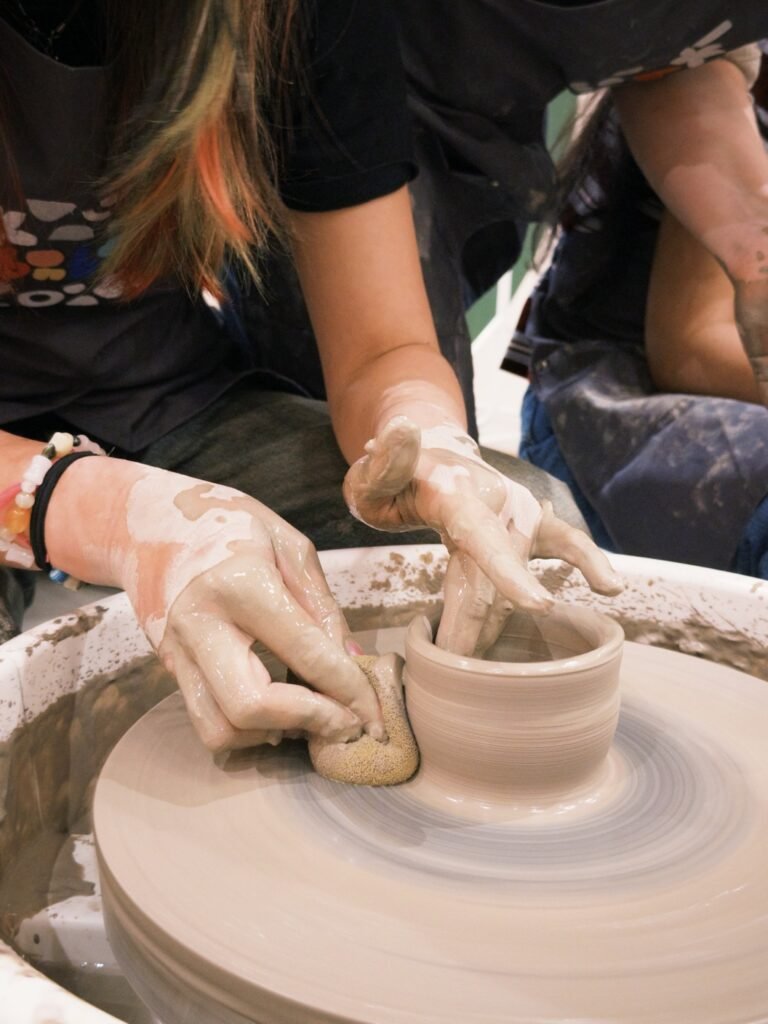
The best pottery wheel for left handed potters is generally a wheel that allows you to choose the direction of rotation that works best with your throwing technique.
That does not mean every left-handed potter needs reverse rotation.
Some left-handed potters learn to throw comfortably on a conventional wheel rotating in the same direction used by most right-handed potters.
Others prefer the opposite direction because it changes how their dominant hand interacts with the clay.
A reversible pottery wheel gives you the choice.
That flexibility can be particularly valuable if you are still developing your throwing technique.
Instead of buying a wheel based solely on whether it is marketed as “left-handed,” look for a machine with:
- Forward and reverse operation
- A reliable speed controller
- Good torque under load
- Comfortable pedal control
- A stable wheelhead
- Suitable wheelhead diameter
- Available replacement parts
A reversible wheel can also be useful if more than one person uses the machine.
One potter can use forward rotation while another can use reverse.
That makes reversibility useful beyond left-handed throwing.
Do Left Handed Potters Need a Special Pottery Wheel?
No.
There is no universal requirement for a special left-handed pottery wheel.
Most conventional electric pottery wheels can be used by left-handed potters.
The question is whether the controls and direction of rotation suit your technique.
This distinction is important.
A wheel does not know whether you are left-handed or right-handed.
The machine simply rotates.
Your throwing technique determines how useful a particular direction feels.
Some potters use the conventional direction without difficulty.
Others prefer to reverse the wheel.
Neither approach is inherently wrong.
The best pottery wheel for left handed potters is therefore usually a flexible machine rather than a specialized machine.
Why Does Wheel Direction Matter?
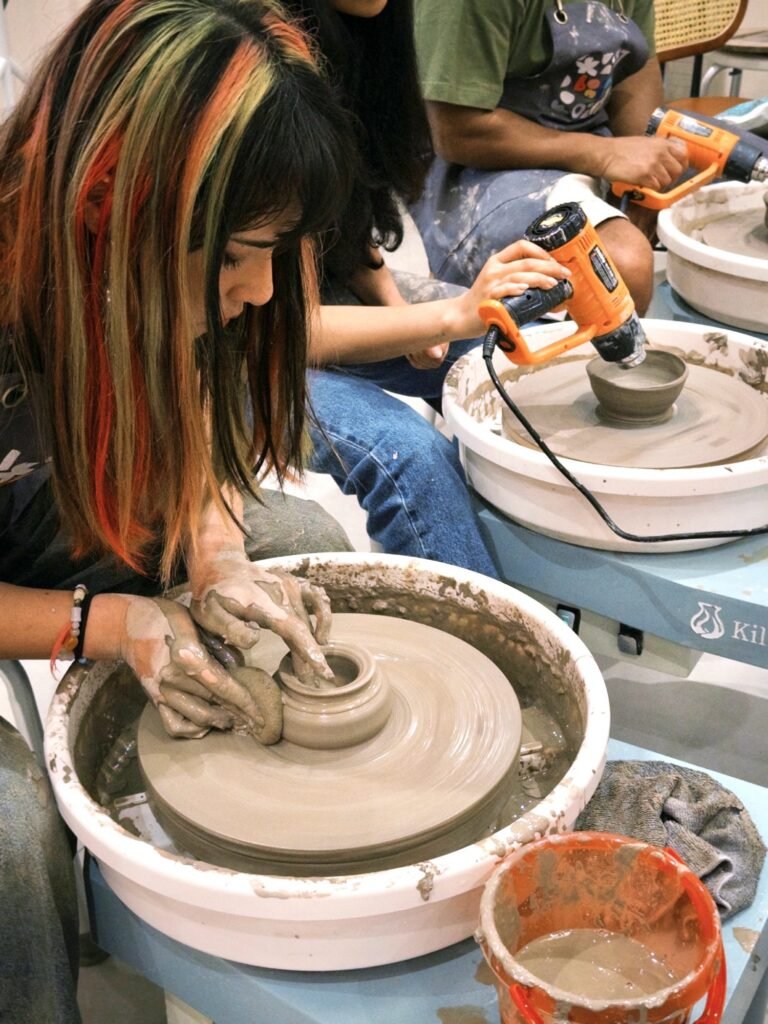
The direction of rotation changes how the clay moves relative to your hands.
When the wheel rotates in one direction, your dominant hand may naturally perform one part of the throwing process while the opposite hand performs another.
Reverse the direction and those relationships change.
For a left-handed potter, that can make certain techniques feel more intuitive.
This can be particularly noticeable during:
- Centering
- Opening
- Pulling walls
- Shaping
- Compressing rims
- Trimming
- Decorating
However, technique matters more than the label.
Experienced potters often adapt to different wheel directions.
A beginner may also develop a successful technique in either direction.
The ability to experiment is therefore one of the strongest reasons to consider a reversible machine.
Clockwise vs Counterclockwise Pottery Wheels
Pottery wheels can rotate clockwise or counterclockwise.
The terminology can become confusing because the potter’s position and viewing angle affect how people describe direction.
Rather than relying on verbal descriptions, look directly at the wheelhead.
If the wheel can rotate both ways, test both directions.
Sit at the wheel.
Place your hands on the clay.
Try centering.
Try opening.
Try pulling.
Notice which direction feels more natural.
That practical test is more useful than assuming that one direction is universally correct for left-handed potters.
Should Left Handed Potters Throw in Reverse?
Some do.
Not all need to.
Reverse rotation can make certain hand positions more comfortable, particularly if you prefer your dominant hand to perform a particular part of the throwing process.
But reversing the wheel does not automatically make someone a better potter.
Good throwing still depends on:
- Centering technique
- Hand pressure
- Body position
- Water control
- Clay preparation
- Speed control
- Consistent pressure
- Practice
The direction simply changes the movement relationship between the potter and the clay.
If reverse feels more natural, use it.
If conventional rotation works well, there is no requirement to change.
What Makes the Best Pottery Wheel for Left Handed Potters?
A good left-handed setup has several characteristics.
Reversible rotation
This is the most obvious feature.
If you can change direction, you can experiment with the throwing direction that feels natural.
Accessible controls
The direction switch should be easy to reach.
You do not want to reach awkwardly around the wheel every time you change direction.
Smooth speed control
A good pedal should let you make gradual adjustments.
Adequate torque
The wheel should maintain useful speed when you apply pressure to the clay.
Stable construction
The wheel should remain stationary while you work.
Comfortable height
Your body position matters just as much as the machine.
Appropriate wheelhead
Choose the diameter according to the size of your work.
Serviceability
Replacement parts and support matter if you plan to keep the wheel for years.
Why Reversible Rotation Is So Useful
Reversible rotation gives you flexibility.
A reversible wheel can accommodate:
- Left-handed potters
- Right-handed potters
- Different throwing techniques
- Trimming preferences
- Teaching situations
- Shared studios
- Different users
This can make a reversible wheel a sensible long-term investment even if you are not certain you will use reverse rotation permanently.
If you buy a non-reversible machine and later decide that reverse rotation works better for you, changing equipment can be expensive.
Buying a reversible machine gives you more options from the beginning.
Is a Reversible Pottery Wheel Better?
Not automatically.
Reversibility is a feature, not a complete measure of quality.
A wheel with reverse rotation but poor torque, unstable construction, uncomfortable ergonomics, or unreliable controls may still be a poor choice.
When comparing the best pottery wheel for left handed potters, evaluate the entire machine.
Ask:
- Does it reverse?
- How easy is direction selection?
- Is speed control smooth?
- Does it maintain speed under load?
- Is the pedal comfortable?
- Is the machine stable?
- Is the wheelhead appropriate?
- Can parts be obtained?
- Is the warranty useful?
- Does the price make sense?
A wheel should never win the purchase decision simply because it has a reverse switch.
Torque Still Matters for Left Handed Potters
Being left-handed does not change the mechanical requirements of throwing.
If you work with large amounts of clay, torque remains important.
During centering, you apply force against the clay.
A wheel with inadequate torque may slow under pressure.
This becomes particularly noticeable when working with larger pieces.
The Kiln Depot’s guide to pottery wheel torque explains why load performance matters more than simply choosing a wheel based on its maximum RPM.
When evaluating the best pottery wheel for left handed potters, therefore, direction is only one part of the mechanical equation.
The wheel must still perform under the amount of clay you actually throw.
Does Horsepower Matter?
Horsepower can provide useful context, but it should not be considered in isolation.
Also evaluate:
- Torque
- Motor design
- Controller
- Drive system
- Wheelhead
- Speed response
- Stability
- Intended clay capacity
Two wheels with similar horsepower can feel different during throwing because of differences in motor control, gearing, drive design, wheelhead mass, and overall construction.
The best approach is to look at the complete specification and, when possible, test the wheel under load.
Wheelhead Size for Left Handed Potters
Left-handed potters do not need a special wheelhead diameter.
Choose wheelhead size according to your work.
Small wheelheads can work well for:
- Cups
- Mugs
- Small bowls
- Test pieces
- Small sculptures
Larger wheelheads can be useful for:
- Large bowls
- Platters
- Planters
- Large vases
- Wide vessels
Your throwing direction does not determine the required wheelhead size.
Your pottery does.
That is why the best pottery wheel for left handed potters should be chosen around the same basic production requirements as any other wheel.
The difference is primarily in control and throwing orientation.
Foot Pedal Position Matters
The foot pedal is particularly important because left-handed potters sometimes focus heavily on wheel direction while overlooking body position.
The pedal still needs to be positioned where your foot can operate it naturally.
Sit at the wheel.
Place both feet comfortably.
Make sure the pedal does not force you to twist your body.
The ideal position should allow you to adjust speed without moving your torso.
This matters even more during long throwing sessions.
Poor ergonomics can cause discomfort regardless of whether the wheel rotates clockwise or counterclockwise.
Should Left Handed Potters Use a Different Throwing Position?
Not necessarily.
Some left-handed potters mirror the conventional throwing position.
Others develop their own arrangement.
There is no single correct left-handed posture.
The goal is to create a stable position where:
- Your elbows can be controlled
- Your shoulders remain relaxed
- Your spine is reasonably comfortable
- Your hands can maintain consistent pressure
- Your dominant hand can perform the tasks you prefer
- The pedal is easily controlled
If you are learning, experiment.
Do not force yourself into a technique simply because another potter says it is the “correct” left-handed method.
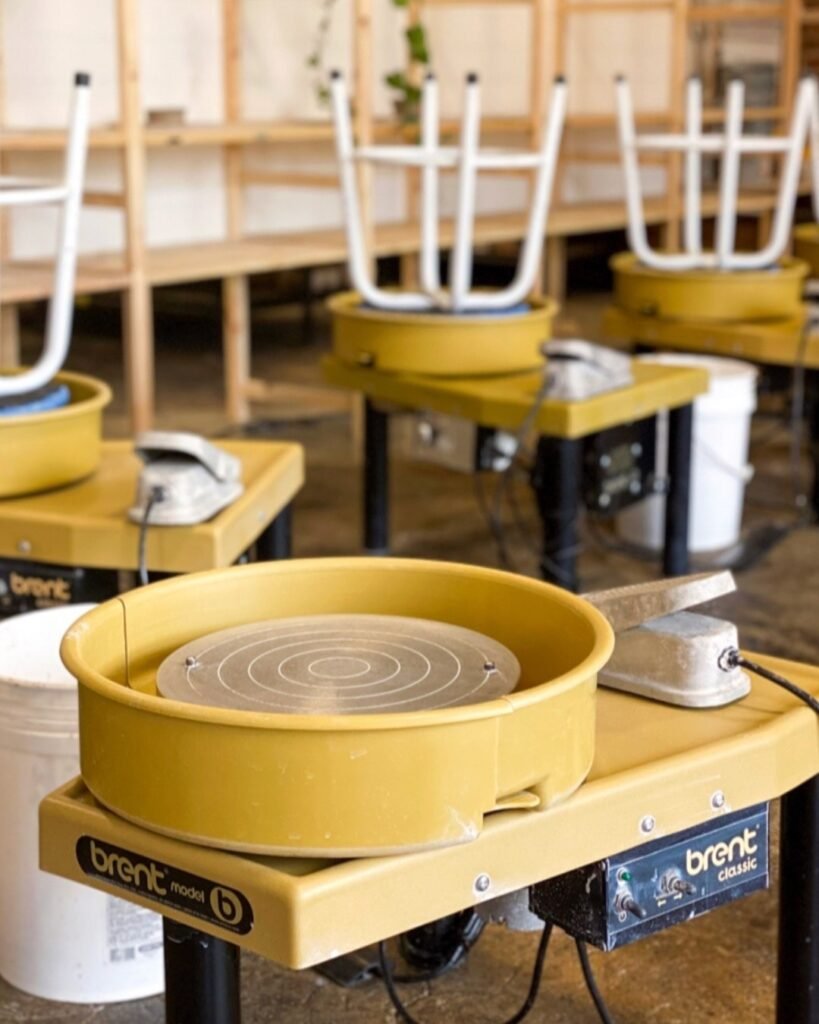
Can Brent Pottery Wheels Be Used by Left Handed Potters?
Yes, provided the specific model includes the direction-control features you need.
AMACO’s current Brent Model B documentation describes forward and reverse controls along with a neutral safety position. Brent Model B
That makes the model relevant to left-handed potters who want the option to change rotation direction.
AMACO’s current Brent range includes multiple models, so buyers should verify the exact specifications of the model they are considering rather than assuming that every Brent machine has identical controls.
See the current Brent wheel range for manufacturer information.
A Brent wheel can therefore be a useful option for a left-handed potter who values established studio construction, serviceability, and reversible operation.
Can Shimpo Pottery Wheels Be Used by Left Handed Potters?
Shimpo produces pottery wheels with different control and drive configurations, so the exact model matters.
If reverse operation is important to you, verify the manufacturer’s current documentation for the specific wheel.
Do not assume that every Shimpo wheel offers the same direction-control arrangement.
For a left-handed buyer, the question should be:
Does this exact model provide the rotation control I want?
That is more useful than asking whether an entire brand is “left-handed.”
What About Direct-Drive Wheels?
Direct-drive wheels can be attractive for left-handed potters because some models combine smooth speed control with reversible operation.
They can also be quiet, which matters in home studios.
The advantages can include:
- Smooth speed response
- Quiet operation
- No traditional belt
- Compact mechanical design
- Convenient electronic controls
Potential disadvantages include:
- More specialized electronic components
- Potentially higher repair costs
- Model-specific service requirements
The best pottery wheel for left handed potters should not be chosen because it is direct drive alone.
Compare the entire machine.
What About Belt-Drive Wheels?
Belt-drive wheels remain widely used.
A belt-drive machine can be an excellent choice for a left-handed potter if it provides the required direction control.
Potential advantages include:
- Familiar mechanical construction
- Established service procedures
- Replaceable belts on applicable models
- Long history in pottery studios
Potential disadvantages include:
- Belt wear
- Possible belt adjustment
- Additional mechanical components
Again, the drive system should be considered alongside torque, stability, speed control, noise, and maintenance.
Best Pottery Wheel for Left Handed Potters: New vs Used
Buying used can make sense when you want a professional wheel without paying the full new-equipment price.
This is particularly useful if you want features such as:
- Reverse operation
- Strong torque
- Large wheelhead
- Professional construction
- Established parts availability
Before buying a used wheel, verify the exact model.
Then inspect:
- Wheelhead
- Motor
- Pedal
- Bearings
- Belt if applicable
- Direction switch
- Controller
- Frame
- Electrical components
- Splash pan
Most importantly, test the direction switch.
A used wheel that is advertised as reversible should actually be tested in both directions.
The Kiln Depot’s used pottery wheel guide provides a broader inspection checklist for buyers.
Refurbished Pottery Wheels for Left Handed Potters
A refurbished wheel can be attractive when you want professional equipment at a lower initial cost.
But the word “refurbished” should never replace an actual inspection record.
Ask:
- What was replaced?
- Was the direction switch tested?
- Was the pedal tested?
- Was the motor tested?
- Were bearings inspected?
- Was the wheelhead checked?
- Was the electrical system inspected?
- Was the wheel operated under load?
- Is there a warranty?
The direction switch is particularly important for this buyer group.
If reversibility is one of the main reasons you are buying the wheel, verify that reverse operation actually works.
The Kiln Depot’s guide to refurbished pottery wheels explains what buyers should ask before purchasing refurbished equipment.
Best Pottery Wheel for Left Handed Potters on a Budget
If budget is your main constraint, start with features rather than brands.
Your minimum checklist should be:
- Reliable rotation
- Adequate torque
- Smooth speed control
- Reverse capability if required
- Stable construction
- Functional pedal
- Serviceable components
You do not necessarily need the newest model.
A well-maintained used professional wheel can provide substantially better long-term value than a cheap new machine.
However, do not buy an old wheel solely because it is inexpensive.
A machine with failing bearings, worn motor components, damaged electronics, or unavailable parts can become expensive quickly.
Best Pottery Wheel for Left Handed Beginners
Beginners should be particularly careful about buying equipment based entirely on handedness.
The most important thing is learning good throwing technique.
A reversible wheel gives you the ability to experiment.
That can be useful during the learning process.
Try conventional rotation.
Try reverse rotation if the wheel supports it.
Notice which direction makes your hand positions easier.
Then practice consistently.
Do not keep changing direction every session simply because one day feels awkward.
Throwing requires repetition.
Once you find a comfortable direction, develop consistency.
Does Wheel Direction Change How You Center Clay?
It can change how your hands interact with the rotating clay.
But the fundamental principles of centering remain the same.
You still need:
- Proper clay preparation
- Controlled pressure
- Stable body position
- Consistent speed
- Appropriate water
- Coordinated hand movement
Changing direction does not remove the need to learn these skills.
It simply changes the movement pattern.
If you are struggling with centering, do not assume that changing direction will solve the problem.
Technique is usually the larger variable.
Does Wheel Direction Matter During Pulling?
It can.
Your dominant hand may naturally feel more comfortable performing certain pulling movements when the wheel rotates in a particular direction.
This is one reason some left-handed potters prefer reverse rotation.
But experienced potters can adapt.
There is no universal direction that produces better pottery.
The best pottery wheel for left handed potters is the one that gives you enough control to choose the technique that works for you.
What About Trimming?
Trimming is another area where direction can matter.
Some potters prefer one direction for throwing and another for trimming.
A reversible wheel gives you that flexibility.
However, trimming also depends on:
- Tool angle
- Clay dryness
- Bat attachment
- Speed
- Hand position
- Body position
Do not assume that reversing the wheel automatically improves trimming.
Use the direction that gives you the best control.
Left-Handed Pottery Wheel Comparison
| Feature | Standard Wheel | Reversible Wheel | Professional Reversible Wheel |
|---|---|---|---|
| Forward rotation | Yes | Yes | Yes |
| Reverse rotation | Model dependent | Yes | Yes on suitable models |
| Left-handed flexibility | Moderate | High | High |
| Torque | Model dependent | Model dependent | Generally higher on professional models |
| Speed control | Model dependent | Model dependent | Usually advanced |
| Best for beginners | Yes | Yes | Yes, if budget allows |
| Best for experienced potters | Model dependent | Excellent flexibility | Excellent |
| Long-term versatility | Moderate | High | High |
| Price | Lower to higher | Moderate to higher | Higher |
This table is a buying framework, not a claim that every wheel in a category has identical performance.
Always verify the exact model.
How Much Does a Left-Handed Pottery Wheel Cost?
There is no separate universal “left-handed pottery wheel price.”
The cost depends on the same factors that affect other pottery wheels:
- Manufacturer
- Motor
- Torque
- Wheelhead
- Controller
- Drive system
- Construction
- Warranty
- New vs used
- Refurbishment
- Accessories
Reversible operation may be standard on some models and unavailable or configured differently on others.
Rather than searching specifically for a “left-handed wheel,” search for a wheel with the features you need.
That usually produces a much larger and more useful selection.
Noise for Left Handed Home Potters
If you are setting up the wheel at home, noise can matter considerably.
This is especially true if your studio is:
- In an apartment
- In a bedroom
- In a basement
- Near a living room
- Near a neighbor’s wall
- In a shared workspace
A quiet wheel may be worth prioritizing.
However, do not assume that a quiet machine automatically has the torque or capacity you need.
Compare the entire specification.
The Kiln Depot’s existing home pottery wheel guide covers the broader considerations involved in selecting equipment for residential studios.
Small Studio Considerations
Left-handed potters working in compact spaces have another consideration: ergonomics.
You need enough room for:
- Your dominant hand
- Your opposite hand
- Your knees
- Your stool
- Your pedal
- Your tools
- Your splash pan
A wheel that allows reverse rotation can make hand positioning easier, but the overall workstation still needs to be comfortable.
Measure the complete throwing area.
Do not measure only the machine.
How to Test a Pottery Wheel as a Left Handed Potter
If you can test the wheel before purchasing, use both directions.
Test 1: Empty wheel
Run it slowly.
Listen for unusual noises.
Test 2: Increase speed
Check whether speed changes smoothly.
Test 3: Test reverse
Switch direction.
Confirm that the wheel responds correctly.
Test 4: Center clay
Place a realistic amount of clay on the wheel.
Test both directions if appropriate.
Test 5: Apply pressure
See whether the wheel maintains speed.
Test 6: Test the pedal
Make sure speed changes are predictable.
Test 7: Check stability
Make sure the machine remains stable under pressure.
Test 8: Check the wheelhead
Look for wobble or irregular movement.
This is particularly important with used equipment.
Common Mistakes Left Handed Potters Make
Buying a “left-handed” wheel without checking reversibility
The label is less important than the actual controls.
Assuming reverse is mandatory
Many left-handed potters can throw comfortably in conventional rotation.
Choosing a wheel based only on reverse capability
Torque, stability, speed control, and serviceability still matter.
Ignoring ergonomics
Your body position matters more than the direction switch.
Buying used without testing reverse
If reverse is important, test it.
Ignoring future growth
Choose capacity according to where your pottery is going, not only where it is today.
Assuming all wheels from one brand are identical
Models can differ significantly.
Always verify the exact model.
Questions to Ask a Seller
If you are buying a used or refurbished wheel, ask:
Does the wheel reverse?
Does reverse work reliably?
Was the direction switch tested?
How much clay has the wheel handled?
Has the motor been serviced?
Are the bearings quiet?
Does the wheelhead wobble?
Does the pedal respond smoothly?
Are replacement parts available?
What repairs have been performed?
Is there a warranty?
These questions are more useful than simply asking whether the wheel is “good.”
What Should You Look for in a Refurbished Left-Handed Wheel?
A refurbished wheel should ideally have documented work.
Look for evidence that the seller has checked:
- Motor
- Bearings
- Wheelhead
- Pedal
- Direction controls
- Electrical system
- Frame
- Splash pan
- Speed control
If reverse operation is important to you, it should be explicitly tested.
Do not assume it works because the model originally supported reverse.
A switch can fail.
Electrical components can deteriorate.
A previous owner may have replaced components incorrectly.
Is the Best Pottery Wheel for Left Handed Potters Also Good for Right Handed Potters?
Usually, yes.
That is one reason reversible wheels can be excellent choices for shared studios.
A reversible machine can accommodate different users.
This is useful when:
- Partners share a home studio
- Teachers demonstrate techniques
- Students have different preferences
- A studio has multiple potters
- You occasionally switch between techniques
The added flexibility can therefore justify choosing a reversible machine even when you are not strictly dependent on reverse rotation.
A Practical Buying Framework
Use this order when comparing wheels.
Step 1: Decide whether reverse is important
If you already know you prefer reverse rotation, make it a requirement.
Step 2: Determine your clay capacity
Estimate your normal and maximum throwing loads.
Step 3: Choose wheelhead size
Match it to your work.
Step 4: Compare torque
Look at load performance rather than RPM alone.
Step 5: Evaluate speed control
The pedal should provide smooth adjustment.
Step 6: Consider noise
Especially important for home studios.
Step 7: Check ergonomics
Make sure your stool, pedal, and body position work.
Step 8: Check parts and service
Think about the next five years, not just the day you buy it.
Step 9: Compare new, used, and refurbished
A professional used wheel may be more valuable than a cheap new wheel.
Step 10: Test direction
If possible, physically test both directions with clay.
Frequently Asked Questions
What is the best pottery wheel for left handed potters?
The best pottery wheel for left handed potters is generally a reliable wheel with reversible rotation, smooth speed control, adequate torque, comfortable ergonomics, and good parts availability. However, not every left-handed potter needs reverse rotation.
Do left handed potters need a special pottery wheel?
No. Most left-handed potters can use conventional pottery wheels. A reversible wheel simply gives them more control over rotation direction.
Should left handed potters use a pottery wheel in reverse?
Some prefer it, while others do not. Reverse rotation can make certain hand positions feel more natural, but there is no universal requirement.
Can pottery wheels spin counterclockwise?
Some can. Check the exact model specifications for forward and reverse operation.
Is a reversible pottery wheel better?
Reversibility adds flexibility, but it does not automatically make a wheel better. Torque, stability, controller quality, ergonomics, and serviceability still matter.
Can Brent wheels be used by left handed potters?
Yes, where the specific Brent model provides the necessary direction controls. AMACO’s current Model B documentation describes forward and reverse controls.
Can Shimpo wheels be used by left handed potters?
It depends on the model. Check the current manufacturer’s specifications for the exact Shimpo wheel you are considering.
Does pottery wheel direction affect throwing?
It can change how your hands interact with the rotating clay, but it does not replace proper throwing technique.
Does wheel direction matter for trimming?
It can. Some potters prefer a particular direction for trimming, while others adapt comfortably to either direction.
What matters more than wheel direction?
For most buyers, the overall combination of torque, speed control, stability, wheelhead size, ergonomics, serviceability, and price matters more than direction alone.
Final Buying Checklist
Before buying the best pottery wheel for left handed potters, confirm:
- Forward rotation
- Reverse rotation if required
- Direction controls
- Smooth speed adjustment
- Adequate torque
- Appropriate wheelhead size
- Stable frame
- Comfortable pedal
- Suitable throwing height
- Acceptable noise level
- Available replacement parts
- Warranty
- Used-equipment condition if applicable
- Refurbishment history if applicable
- Shipping requirements
- Total cost of ownership
If buying used, test the wheel under load.
If buying refurbished, ask what was actually repaired.
If buying new, verify the exact current model specifications.
Final Thoughts on the Best Pottery Wheel for Left Handed Potters
The best pottery wheel for left handed potters is not necessarily a special machine designed exclusively for left-handed users.
In most cases, the better strategy is to buy a good pottery wheel that gives you control over direction.
If you prefer reverse rotation, use it.
If conventional rotation feels natural, there is no reason to change simply because you are left-handed.
What matters most is whether the wheel lets you work comfortably and consistently.
Prioritize:
Direction → torque → speed control → stability → wheelhead → ergonomics → serviceability → price.
For buyers starting their research, The Kiln Depot’s broader pottery wheel buying guide covers the major equipment considerations.
If torque is unfamiliar, read Pottery Wheel Torque: Why It Matters When Throwing.
For buyers interested in buying below new-equipment pricing, compare used pottery wheels and refurbished pottery wheels.
For manufacturer information, review the current Brent wheel range and the Brent Model B specifications.
The important thing is not to shop for a wheel simply because it has the words “left-handed” attached to it.
Shop for the machine that gives you the control, torque, comfort, and flexibility to throw the way you work.
best pottery wheel for left handed potters
