Shopping for pottery kilns for sale is easier when you know exactly what your studio needs. Kiln size, firing temperature, electrical requirements, controller, insulation, and available space can all change which model makes sense.
The cheapest pottery kiln is not necessarily the best value.
A kiln that is too small can quickly become frustrating. A kiln that is too large can waste money and studio space. The right choice gives you enough capacity for your actual production without paying for features you don’t need.
Here are seven pottery kiln options worth considering when you’re ready to buy.
1. Skutt KM-818
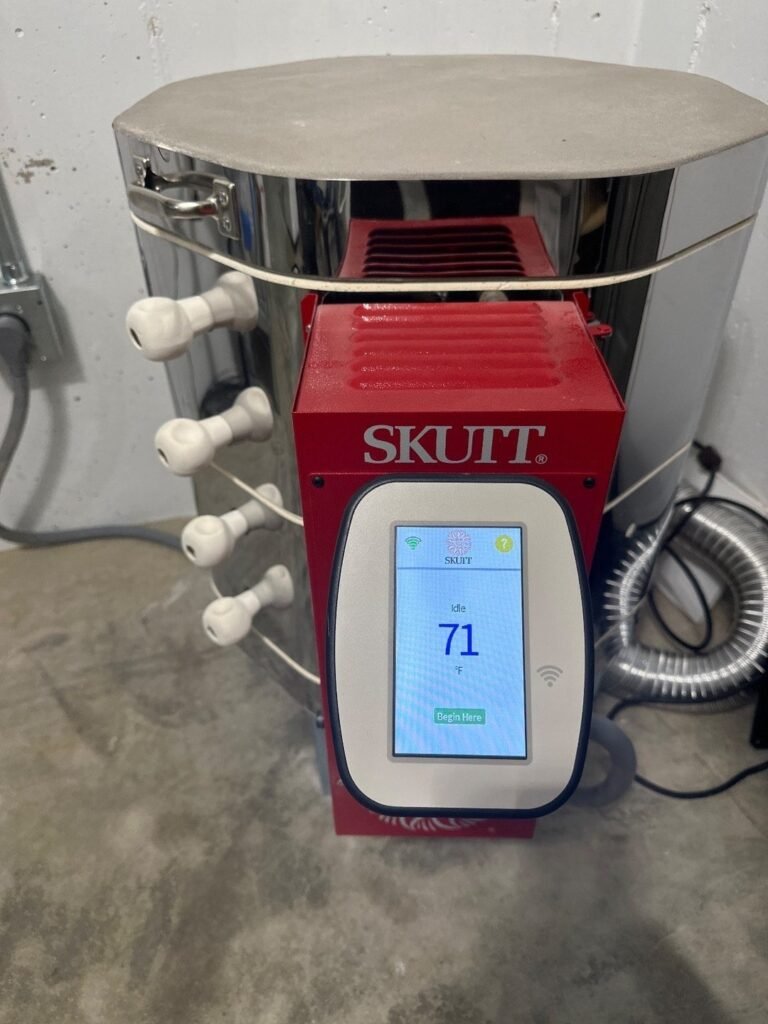
The Skutt KM-818 is one of the strongest choices for a smaller pottery studio.
Its compact chamber gives you professional firing capability without requiring the footprint of a larger production kiln.
The KM-818 is especially attractive for potters who regularly fire mugs, bowls, small sculptures, tiles, and other studio work but don’t need the capacity of a larger kiln.
It also reaches Cone 10, giving you flexibility for high-fire ceramic work.
If you’re upgrading from a small test kiln, the KM-818 can provide a significant jump in usable firing capacity without immediately moving into a much larger kiln.
The Kiln Depot currently lists the Skutt KM-818 as part of its electric kiln selection.
2. Skutt KM-1027
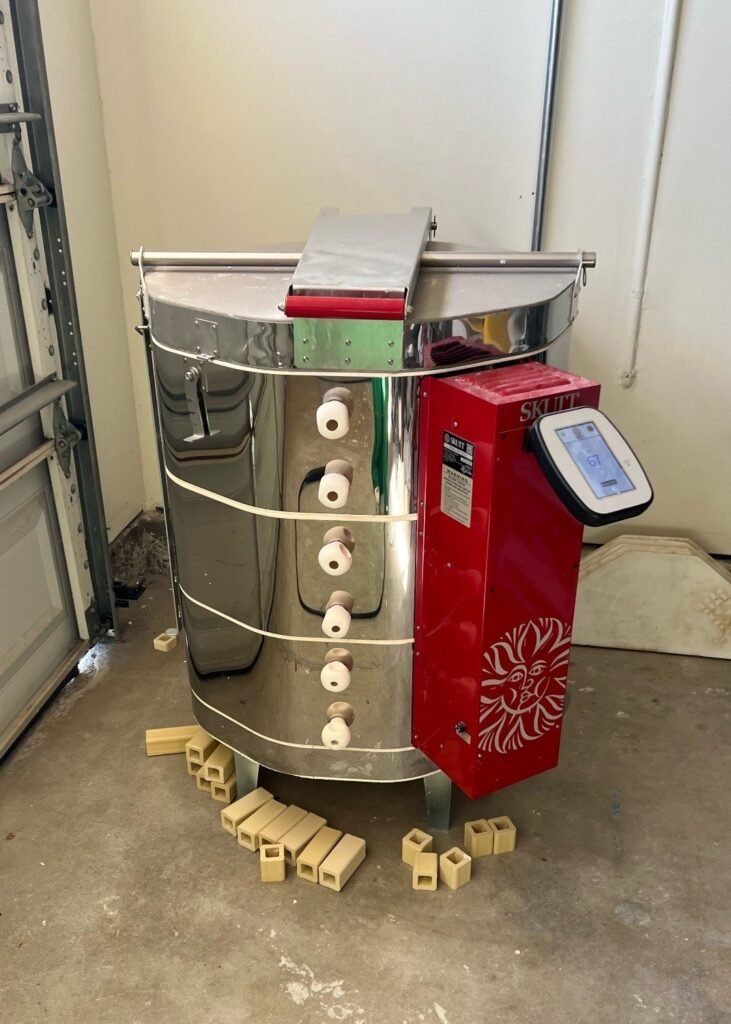
For many serious home studios, the Skutt KM-1027 hits a very useful middle ground.
The chamber provides considerably more space than a compact kiln, making it better suited to regular production.
That extra capacity matters if you’re firing several times per week or regularly producing larger quantities of work.
The KM-1027 is also a popular choice for studios that need a kiln capable of handling both bisque and glaze firing.
If you routinely find yourself waiting to accumulate enough work for a small kiln, moving up to a larger chamber can make your firing schedule much more efficient.
The Kiln Depot currently lists the Skutt 1027 at $3,145.77.
3. Skutt KMT-1027-3
If you want the capacity of the 1027 but prefer thicker insulation and touchscreen control, the Skutt KMT-1027-3 deserves a close look.
This model provides a 6.4-cubic-foot chamber and fires to Cone 10.
The 3-inch brick construction provides additional insulation compared with standard 2.5-inch construction, making the model particularly attractive for potters who fire frequently.
The touchscreen controller is another advantage for buyers who want modern programming and monitoring features.
The Kiln Depot currently lists the KMT-1027-3 at $2,999.99, reduced from $4,207.50.
Check the electrical requirements before ordering. This model uses 240V power, draws 48 amps, and requires a suitable circuit.
4. Skutt KM-1227-3
If you’re running a high-volume studio, a larger kiln can make much more sense.
The Skutt KM-1227-3 gives you substantially more firing capacity than the KM-818 or KM-1027.
That makes it a better fit for production potters, studios firing large work, and businesses that need to process more pieces per firing.
The additional capacity comes with higher purchase cost, greater electrical requirements, and a larger physical footprint.
Don’t buy a large kiln simply because you can afford one.
Buy it when your actual production justifies it.
A larger kiln becomes valuable when the additional capacity reduces the number of firings you need to complete your normal workload.
5. Paragon Caldera
Not every pottery studio needs a large top-loading kiln.
The Paragon Caldera is a more compact option that can make sense for smaller work, testing, teaching, and studios with limited space.
The Kiln Depot currently lists the Paragon Caldera at $1,149.99.
A compact kiln can also work well as a second kiln for a studio that already owns a larger production model.
That gives you the flexibility to run small loads without firing a large chamber unnecessarily.
6. Evenheat Studio Copper 120V
If electrical installation is one of your biggest concerns, a 120V kiln can be worth considering.
The Kiln Depot currently lists the Evenheat Studio Copper 120V 3-key at $1,980.49.
A 120V setup can be attractive for certain smaller studio applications, but you still need to verify the kiln’s exact electrical requirements and whether its maximum temperature and chamber size match your work.
Do not choose a kiln solely because it plugs into a familiar outlet.
Temperature, capacity, firing frequency, and the type of clay you use matter just as much.
7. Choose the Kiln Based on Your Actual Production
Sometimes the best pottery kiln for sale isn’t a particular brand or model.
It’s the model that matches your workload.
A beginner who fires occasionally may have no reason to buy a large production kiln.
A potter selling work every week may quickly outgrow a small kiln.
A ceramic teacher may need a larger chamber because multiple students contribute work to each firing.
A production studio may need even more capacity.
Think about how much work you expect to fire over the next two to three years rather than buying only for today’s workload.
That can prevent an expensive upgrade later.
Pottery Kiln Size Matters More Than You Think
Kiln capacity directly affects how much work you can fire at once.
A small kiln may be cheaper and easier to install.
A larger kiln can reduce the number of firings needed for the same amount of work.
Neither is automatically better.
The right size depends on your production.
If you’re unsure, The Kiln Depot’s guide to choosing kiln size can help you compare compact, mid-size, and larger studio options:
Think about the size of your typical pieces, how many pieces you make, and how often you expect to fire.
Those three factors usually tell you more than a generic “best kiln” list.
Electric Pottery Kiln or Something Else?
Electric pottery kilns remain one of the most practical choices for many home and small commercial studios.
They are relatively straightforward to operate, offer programmable firing schedules, and come in a wide range of sizes.
However, electrical requirements vary considerably between models.
Before purchasing, check:
- Voltage
- Amperage
- Phase
- Plug configuration
- Dedicated circuit requirements
- Available studio power
Never assume your existing electrical setup can support a kiln simply because the kiln physically fits in your studio.
For larger models, confirm the requirements with a qualified electrician before ordering.
Should You Buy a Used Pottery Kiln Instead?
Used pottery kilns can provide significant savings.
However, you need to inspect the firebrick, heating elements, controller, wiring, lid, electrical configuration, and firing history.
A cheap kiln that needs thousands of dollars in repairs may cost more than buying a properly maintained machine in the first place.
If you’re considering used equipment, read The Kiln Depot’s guide to inspecting a used pottery kiln before buying:
This is especially important when buying privately.
Ask for a test firing whenever possible.
What Should You Look for in Pottery Kilns for Sale?
Before you order, compare the features that actually affect your work.
Look at:
- Chamber size
- Maximum firing temperature
- Brick thickness
- Controller
- Voltage
- Amperage
- Plug type
- Interior dimensions
- Warranty
- Replacement parts
- Furniture included
- Shipping requirements
- Installation requirements
Don’t compare models based only on price.
A kiln that costs several hundred dollars more may provide substantially better capacity or insulation.
On the other hand, spending thousands more for capacity you never use makes little financial sense.
Find the Right Pottery Kiln for Your Studio
The Kiln Depot carries a range of electric and gas kiln options, including Skutt, Paragon, and other equipment for ceramic studios.
Browse the current kiln selection here:
If you’re unsure which model fits your studio, compare the chamber size and electrical requirements first.
Then consider the firing temperature and controller.
Those four factors will eliminate many unsuitable options before price becomes the deciding factor.
Final Thoughts
The best pottery kiln for sale is the one that matches your actual studio.
The Skutt KM-818 makes sense for smaller studios.
The KM-1027 gives serious home potters more room to grow.
The KMT-1027-3 adds thicker insulation and touchscreen control.
The KM-1227-3 makes more sense when production volume justifies a larger chamber.
The Paragon Caldera offers a compact alternative.
The Evenheat Studio Copper 120V provides another option for certain smaller studio setups.
Before you buy, measure your space, check your electrical service, estimate your firing volume, and choose a chamber size that gives you room to grow.
Then compare the available pottery kilns for sale based on total value rather than simply choosing the lowest price.
When you’re ready to buy, browse the current kiln selection and compare models, specifications, and pricing before placing your order.
