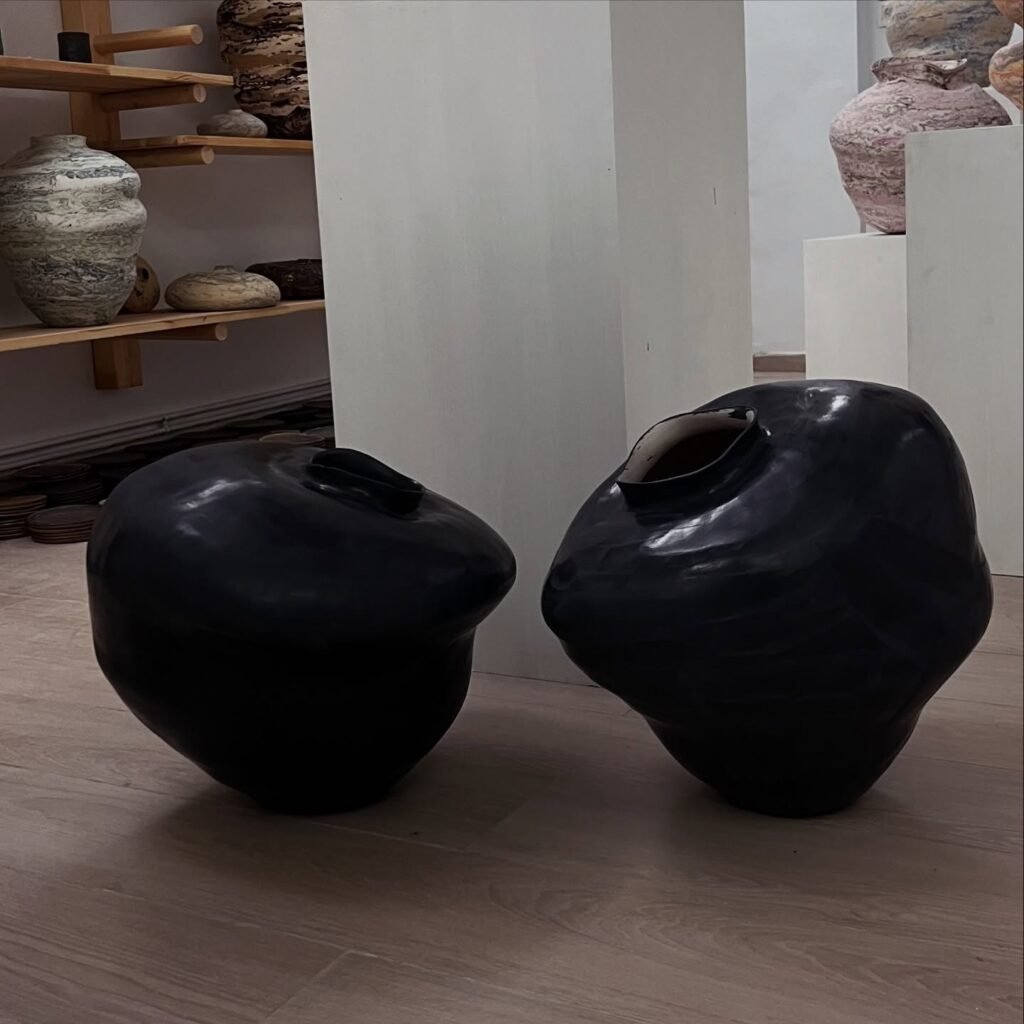
Terra sigillata pottery has a distinctive surface that sits somewhere between raw clay and traditional glaze. When applied correctly, this extremely fine clay coating can produce a soft sheen, smooth feel, and rich color.
The technique is also surprisingly versatile.
You can burnish it for a polished surface, leave it relatively matte, layer different colors, or use it as a foundation for other surface treatments.
Most importantly, you do not need to treat terra sigillata as a traditional glaze.
Understanding that difference makes the technique much easier to control.
What Is Terra Sigillata?
Terra sigillata is an extremely fine clay slip made from very small clay particles.
The material is separated from coarser particles so that the finest fraction remains suspended in water. When applied to clay, those fine particles create a remarkably smooth coating.
The technique has ancient roots. Greek and Roman potters used related fine-clay surfaces long before modern ceramic glazes became common. Ceramic Arts Network describes terra sigillata as an ultrarefined clay slip capable of producing a soft sheen and, when burnished, a high gloss. (Default)
Unlike a glaze, terra sigillata does not simply melt into a glassy coating during firing.
Instead, the character of the clay surface remains central to the finished result.
Why Are Potters Using Terra Sigillata?
One reason is control.
Traditional glaze can completely change the visual character of a piece. Terra sigillata can preserve much more of the original form and surface marks.
That makes it especially useful when the shape itself matters.
A ribbed throwing mark can remain visible.
A carved line can stay crisp.
A subtle handbuilding texture can continue to show through the surface.
The September/October 2026 issue of Pottery Making Illustrated is specifically focused on developing unique ceramic surfaces, and its terra sigillata feature discusses using the material beyond the traditional polished finish. (Default)
How Is Terra Sigillata Different From Slip?
The two materials are related, but they are not interchangeable.
Regular slip contains a broader range of clay particles.
Terra sigillata concentrates the finest particles.
That difference affects the final surface.
Regular slip can produce a more substantial coating.
Terra sigillata can create a much finer, smoother surface that responds particularly well to burnishing.
Therefore, if your goal is a polished, almost wax-like finish, terra sigillata offers properties that ordinary slip does not.
When Should You Apply Terra Sigillata?
Traditionally, potters apply terra sigillata to bone-dry or nearly bone-dry clay.
The surface should also be clean and relatively smooth.
Dust creates problems.
If dust remains on the clay, the terra sigillata may fail to bond properly and can peel during firing. Ceramic Arts Network’s technical guidance specifically emphasizes removing dust before application. (Default)
However, contemporary use is broader.
The current 2026 discussion around terra sigillata emphasizes using it as a surface treatment even when a traditional high-gloss burnished finish is not the goal. (Default)
That gives potters more freedom to experiment.
How Do You Apply Terra Sigillata?
You can brush or spray terra sigillata onto the clay.
Brushing requires less equipment and works well for smaller pieces.
Spraying can provide more even coverage on larger forms, but it requires appropriate equipment and careful studio practice.
For brush application, use a soft brush.
Apply thin coats rather than trying to cover the entire piece with one heavy layer.
Allow each coat to soak into the surface before adding another.
The goal is a controlled coating, not a thick layer.
Keep the Surface Clean
Before applying terra sigillata, inspect the piece carefully.
Remove loose dust.
Avoid repeatedly wiping the surface with a wet sponge because excessive sponging can alter the clay surface.
A clean, smooth surface gives the fine particles a much better foundation.
How Many Coats Should You Apply?
There is no universal number because different clay bodies and terra sigillata mixtures behave differently.
However, multiple thin coats are generally preferable to one heavy coat.
Ceramic Arts Network’s technical guide notes that brushing commonly involves several coats and recommends keeping the final layer very thin. (Default)
Watch the surface as you work.
If the coating becomes too thick, it can create adhesion problems.
If it remains too thin, the underlying clay may continue to show more than you want.
Testing helps you find the balance.
How Do You Burnish Terra Sigillata?
Burnishing compresses and polishes the fine particles on the surface.
You can use your fingers, a soft cloth, chamois, or another suitable polishing material.
The timing matters.
If the surface is too wet, you can disturb the coating.
If it becomes too dry, polishing becomes much harder.
Look for a surface that has absorbed the material but still has enough moisture for the particles to respond to gentle pressure.
Then polish gradually.
Do not press aggressively.
Several light passes are safer than trying to create a high sheen immediately.
Does Terra Sigillata Have to Be Burnished?
No.
This is one of the most useful things to understand about modern terra sigillata practice.
Traditional applications often emphasize burnishing because the polished surface is part of the desired result.
However, contemporary potters also use terra sigillata for its color and extremely fine surface without pursuing a mirror-like finish.
The current 2026 Ceramic Arts Network coverage specifically highlights this expanded approach. (Default)
That means you can treat terra sigillata as a surface material rather than following one rigid historical recipe.
What Happens When Terra Sigillata Is Fired?
Firing changes the surface permanently.
The exact result depends on the clay, terra sigillata formulation, application thickness, firing temperature, and firing atmosphere.
Low-temperature firing is traditionally associated with the strongest burnished effects.
At higher temperatures, the material can begin to change significantly.
Some potters deliberately explore those changes.
Ceramic Arts Network has documented terra sigillata used successfully in wood firing, where it can develop glossy to satin surfaces at much higher temperatures. (Default)
That does not mean every terra sigillata recipe is suitable for high-temperature firing.
Always test the specific material and clay combination first.
Can You Put Glaze Over Terra Sigillata?
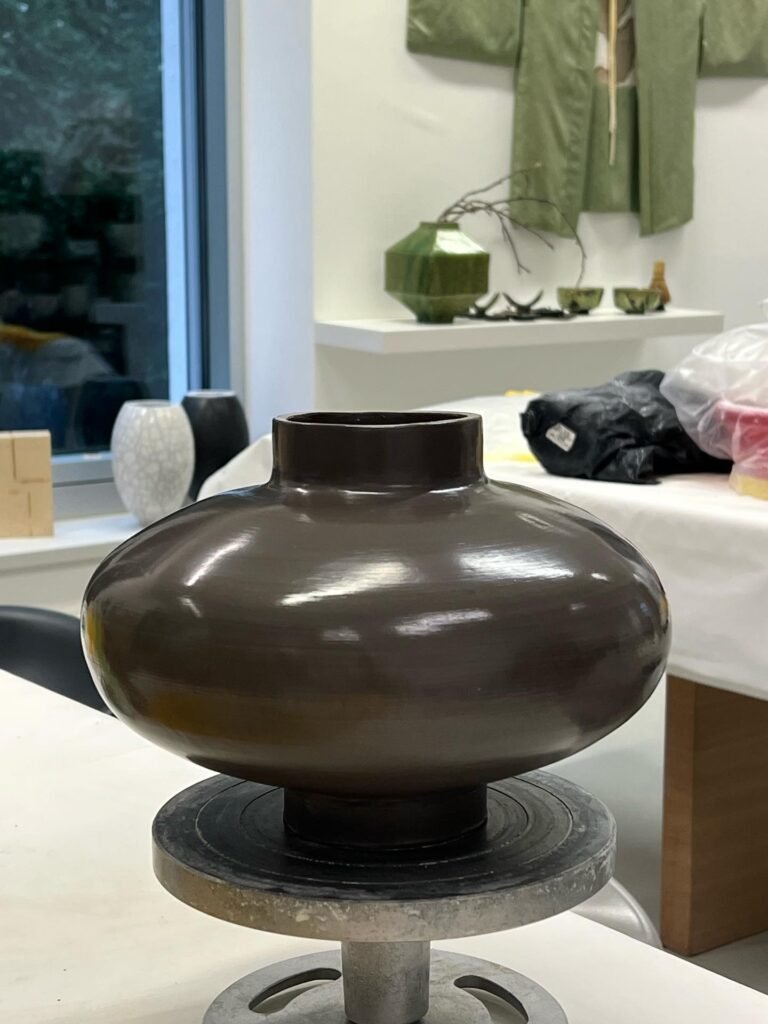
Sometimes, but you need to test the combination.
Burnished terra sigillata can create a surface that behaves differently from ordinary bisqueware.
Some techniques deliberately leave the terra sigillata exposed.
Others combine it with glaze, underglaze, or additional surface decoration.
The important point is compatibility.
Do not assume that a glaze that works beautifully on your normal bisque surface will behave identically over a burnished terra sigillata surface.
Make test tiles first.
What Causes Terra Sigillata to Peel?
Peeling usually means something went wrong with the relationship between the coating and the clay surface.
Common causes include:
- Applying the material too thickly
- Applying it to a dusty surface
- Using an unsuitable clay
- Allowing the coating to dry improperly
- Firing too aggressively
- Using a terra sigillata mixture with unsuitable consistency
Ceramic Arts Network notes that keeping the material thin and the clay clean and dry can help reduce adhesion problems. (Default)
If peeling continues, change one variable at a time.
That makes troubleshooting much easier.
Should You Make Your Own Terra Sigillata?
You can.
Traditional terra sigillata is made by separating fine clay particles from heavier material using water and a deflocculant.
However, the process requires careful measurement and patience.
The clay settles into different layers.
The useful fine-particle fraction must then be separated from the heavier sediment.
Ceramic Arts Network’s detailed guide explains the process and notes that clay type, water, deflocculant, and settling time all influence the result. (Default)
For beginners, making a small experimental batch can be more useful than immediately making a large quantity.
You will learn how your particular clay behaves.
How Should You Test Terra Sigillata?
Make several small test tiles.
Use the same clay body you plan to use for your pottery.
Then vary one factor at a time.
For example:
| Test | Variable |
| 1 | One coat |
| 2 | Two coats |
| 3 | Three coats |
| 4 | Burnished |
| 5 | Unburnished |
| 6 | Different firing temperature |
| 7 | Different clay body |
Label everything.
Record the application method.
Write down the firing temperature.
Note whether you burnished the surface.
This kind of record keeping becomes extremely valuable once you start developing your own surfaces. Current Ceramic Arts Network guidance also recommends systematic records when testing terra sigillata and other ceramic surface treatments. (Default)
Does Your Kiln Matter?
Yes.
Your kiln determines the firing environment that ultimately transforms the decorated clay.
However, the correct kiln is not necessarily the largest kiln.
Instead, choose equipment that matches your clay, firing temperature, studio space, and production volume.
The Kiln Depot currently carries a range of electric and gas kilns, including the Skutt and Olympic models shown in its kiln collection. (The Kiln Depot)
If you are experimenting with terra sigillata, the most important thing is knowing the firing range of the materials you are using.
Frequently Asked Questions
What is terra sigillata in pottery?
Terra sigillata is an ultrafine clay coating used to create smooth, refined ceramic surfaces. It can be burnished for a polished finish or used without high polishing for other surface effects.
Can you put terra sigillata on bone-dry clay?
Yes. Bone-dry or nearly bone-dry clay is commonly used for terra sigillata application.
Does terra sigillata need to be burnished?
No. Burnishing creates a characteristic polished surface, but contemporary potters also use terra sigillata without burnishing.
Can terra sigillata be fired?
Yes. Terra sigillata can be fired, but the suitable temperature depends on the specific clay and formulation.
Why does terra sigillata peel off?
Peeling can result from excessive thickness, dust, poor adhesion, unsuitable consistency, or an inappropriate firing process.
Is terra sigillata a glaze?
No. Terra sigillata is an extremely fine clay slip rather than a conventional glass-forming glaze.
Final Takeaway
Terra sigillata gives potters another way to finish a ceramic surface without covering the character of the clay beneath it.
Start with a clean, smooth piece.
Apply thin coats.
Experiment with burnishing.
Then fire a small test before committing to a finished work.
You can follow traditional methods, but you do not have to stop there.
The current ceramic conversation is moving toward more individual, tactile, and experimental surfaces, and terra sigillata fits that direction particularly well. The September/October 2026 issue of Pottery Making Illustrated is devoted to unique ceramic surfaces, with terra sigillata among the featured techniques. (Default)
For potters looking to develop a more personal surface language, it is a technique worth testing.
