The best electric pottery kiln depends less on the brand name than on four things: what you fire, how much you fire, what your electrical service can support, and how much chamber space you actually need.
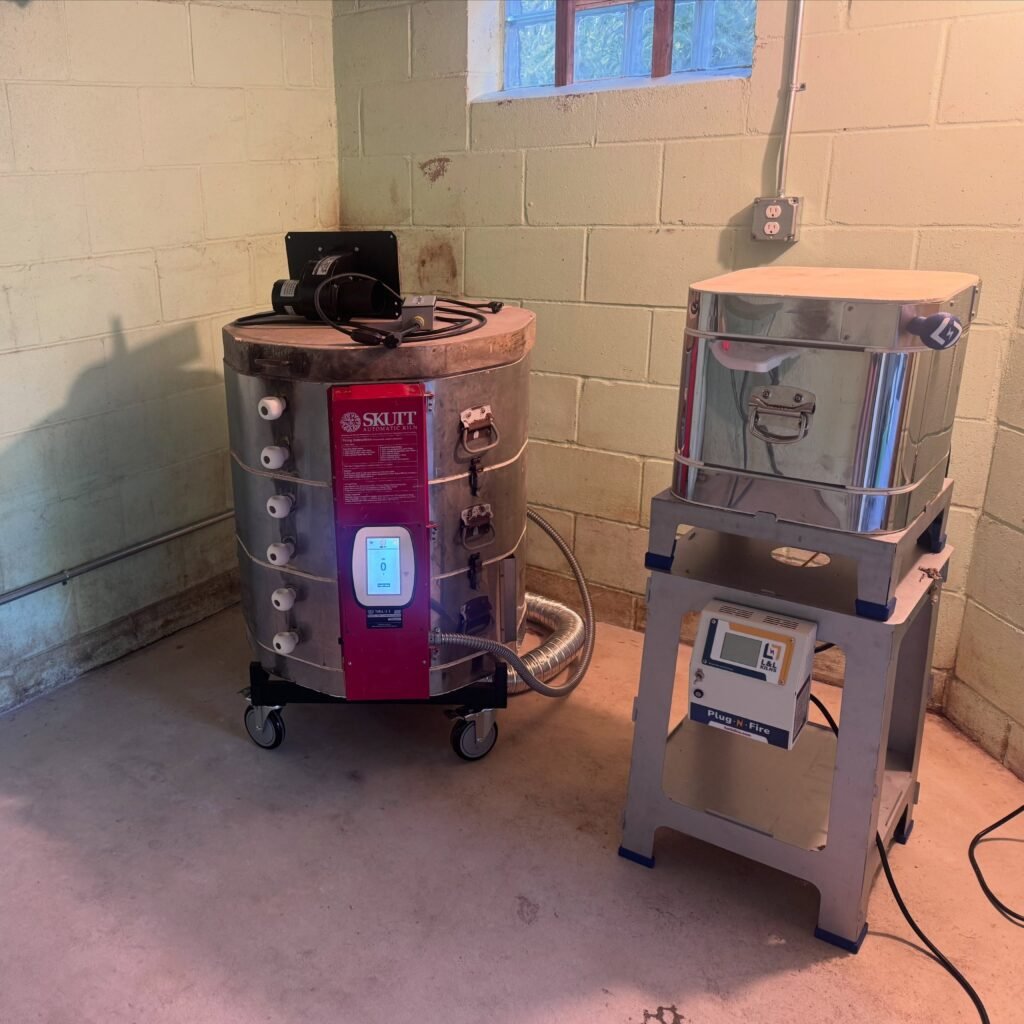
For a small home studio, a compact kiln such as the Skutt KM-818 can provide 2.6 cubic feet of firing space and reach Cone 10. For a larger studio, the 7 cubic foot Skutt KM-1027 offers substantially more capacity. At the production end, the KM-1227 provides nearly 10 cubic feet of chamber space.
That does not make the largest kiln the best.
A kiln that is too large wastes money and space. A kiln that is too small becomes frustrating once your work outgrows it.
The right electric pottery kiln is the one that matches your actual production.
Best Electric Pottery Kiln: Quick Comparison
| Kiln | Capacity | Max Rated Temperature | Best For |
|---|---|---|---|
| Skutt KM-818 | 2.6 cu. ft. | Cone 10 | Small studios and lower-volume potters |
| Skutt KM-1027 | 7.0 cu. ft. | Cone 10 at 240V configuration | General studio and production work |
| Skutt KM-1227 | 9.9 cu. ft. | Cone 8 at listed 240V configuration | Higher-volume firing |
| L&L Easy-Fire range | Varies | Model dependent | Buyers wanting different sizes and configurations |
| Used professional kiln | Varies | Model dependent | Buyers prioritizing capacity per dollar |
Specifications vary by voltage, phase, and model configuration. Always check the exact kiln before ordering.
What Makes a Good Electric Pottery Kiln?
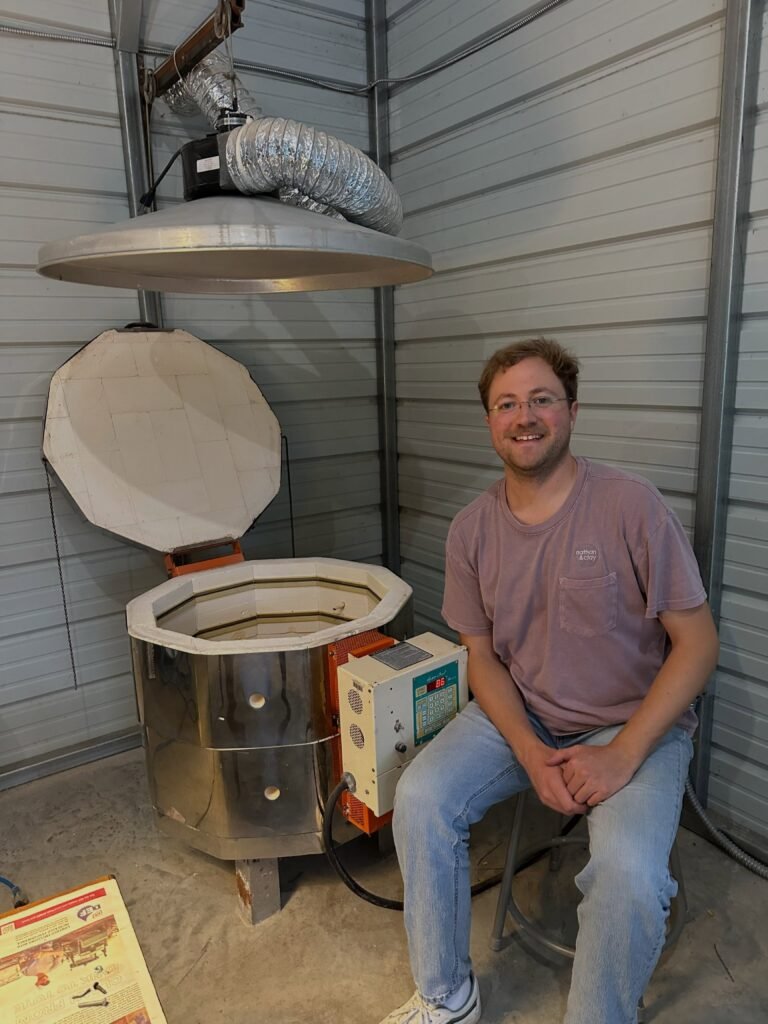
An electric kiln converts electrical energy into heat through resistance heating elements.
For pottery, the important question is not simply whether the kiln can get hot enough.
You also need to consider:
- Maximum firing temperature
- Interior dimensions
- Chamber volume
- Electrical requirements
- Controller
- Insulation
- Element configuration
- Loading method
- Ventilation
- Replacement parts
- Service support
- Purchase price
- Installation cost
These factors determine whether a kiln actually fits your studio.
For example, Skutt’s KM-1027 is a 7 cubic foot kiln with a 23-inch by 23-inch opening and a 27-inch chamber depth. Its 240V single-phase configuration is listed at 48 amps and 11,520 watts.
That is a very different installation requirement from a compact kiln.
The electrical system has to be considered before the kiln is purchased, not after it arrives.
How to Choose the Best Electric Pottery Kiln
Start with your pottery rather than the kiln.
Ask yourself five questions.
1. What temperature do you fire?
If your work is primarily Cone 06 earthenware, you do not necessarily need a kiln designed around high-fire production.
If you regularly fire Cone 6 stoneware, choose a kiln appropriately rated for that temperature.
If you work with Cone 10 materials, verify the exact model and electrical configuration.
Do not confuse a kiln’s maximum temperature with the temperature you should routinely fire it at.
2. How much pottery do you make?
This determines capacity.
A hobby potter producing a few mugs each month has very different requirements from a studio producing dozens of pieces every week.
3. What is the largest piece you make?
Capacity is not only about cubic feet.
Interior width and height matter.
A kiln with plenty of volume can still be unsuitable if the chamber dimensions do not accommodate your work.
4. What electrical service do you have?
This can eliminate certain kilns immediately.
Voltage, amperage, phase and receptacle requirements vary between models and configurations.
5. Where will the kiln go?
A kiln needs an appropriate location with sufficient clearance, ventilation, access and electrical service.
If you have not solved those questions, you are not ready to choose a specific model.
Best Electric Pottery Kiln for a Small Studio
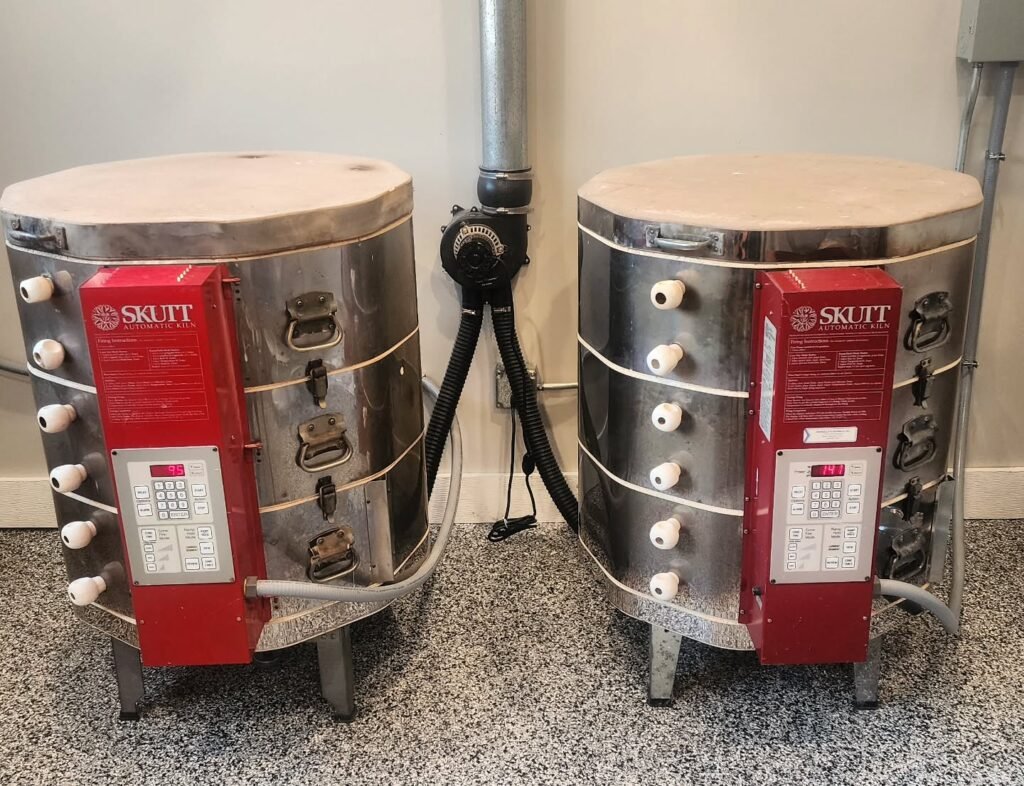
For a small studio, capacity is usually the first constraint.
The Skutt KM-818 is a useful example.
Its chamber is approximately 18 inches wide, 18 inches deep and 18 inches high, giving it 2.6 cubic feet of space. Skutt lists it at Cone 10 and 26.7 amps on its 240V configuration.
That is enough room for relatively small production without requiring the footprint of a much larger kiln.
The KM-818 also uses Skutt’s sectional construction, which can make moving and servicing the kiln easier.
For a small home studio, that combination of chamber size and full-featured control makes this type of kiln worth considering.
But do not buy it simply because you have limited space.
If you routinely make large platters, tall vases or substantial production batches, the capacity may become restrictive.
Best Electric Pottery Kiln for General Studio Use
The 7 cubic foot class is where many potters find a useful middle ground between compact hobby equipment and large production kilns.
The Skutt KM-1027 is a prominent example.
Its chamber measures approximately 23 by 23 inches with a depth of 27 inches and a total capacity of 7 cubic feet. Skutt describes the model as being designed around the needs of potters and lists features including programmable firing, current sensing, sectional construction and balanced elements.
For many studios, that capacity is enough to make the kiln useful for both individual pieces and regular batches.
The downside is electrical demand.
The 240V single-phase KM-1027 configuration is listed at 48 amps and 11,520 watts.
That means the kiln should be evaluated alongside the electrical service, not independently of it.
Best Electric Pottery Kiln for Higher Production
If you fire frequently, capacity becomes more important.
The Skutt KM-1227 has approximately 9.9 cubic feet of chamber space with a 28-inch diameter and 27-inch depth. Its listed 240V single-phase configuration draws 48 amps.
That extra chamber space can make a major difference in production.
You can fit more ware into each firing, assuming the pieces are appropriately sized and loaded.
But bigger is not automatically cheaper.
A larger kiln generally means:
- More expensive equipment
- Greater electrical requirements
- More studio space
- More ware needed to justify each firing
- Higher consequences if something goes wrong
- More weight and more difficult installation
If you are only firing a few small pieces at a time, a 10-cubic-foot kiln can be unnecessary overkill.
Cone 6 vs Cone 10
This is one of the most important specifications to understand.
Cone 6 and Cone 10 represent different firing ranges.
Many stoneware potters work around Cone 6.
Others use Cone 10.
Your kiln should be rated appropriately for your intended firing schedule.
Do not buy a kiln based only on the phrase “high temperature.”
Look at the manufacturer’s exact temperature rating for the configuration you are buying.
This matters because electrical configuration can affect the rated firing temperature of some models.
For example, Skutt’s current specifications show different ratings for some KM-1027 and KM-1227 configurations depending on voltage and phase.
Always check the exact specification sheet.
Kiln Size: How Much Capacity Do You Actually Need?
Kiln capacity is one of the easiest places to overspend.
Think about your typical firing.
If you normally fire six mugs and a few bowls, a small kiln may be sufficient.
If you routinely fire large batches of functional ware, you need more volume.
If you make large sculptural pieces, interior dimensions may matter more than total cubic feet.
A useful approach is to measure your largest pieces and estimate the amount of shelf space you actually use.
Then choose a kiln with some room for growth.
Do not buy the largest kiln you can afford simply because more capacity sounds better.
Top-Loading vs Front-Loading Electric Kilns
Most pottery kilns used by small and medium studios are top-loading.
They are relatively straightforward to load from above and are available in many sizes.
Front-loading kilns can be attractive for larger production environments or for potters who prefer loading at a more accessible height.
The choice becomes increasingly important as kiln size increases.
For a small studio, a top-loader may be perfectly practical.
For high-volume production, a front-loading configuration can offer ergonomic and workflow advantages.
There is no universal winner.
Choose based on how you physically load and unload your kiln.
Why the Controller Matters
A modern kiln controller is more than an on/off switch.
It determines how you program and monitor your firing.
Useful controller features can include:
- Cone firing modes
- Ramp and hold programming
- Multiple programs
- Diagnostics
- Temperature monitoring
- Firing history
- Safety features
- Remote monitoring on applicable models
Skutt’s current KM series controllers can store up to 12 programs with up to 32 segments per program, and the system includes diagnostic capabilities.
Skutt’s KMT models add a touchscreen interface and built-in WiFi.
The controller should match your skill level and firing needs.
A beginner does not necessarily need every advanced feature.
A production studio may appreciate them.
Does Three-Inch Brick Matter?
Insulation thickness can influence heat retention and kiln construction.
Some Skutt models are available in versions using 3-inch brick, such as the KM-818-3 and KM-1027-3.
If you fire frequently, energy efficiency and heat retention become more relevant.
But do not buy thicker brick purely because it sounds more efficient.
Compare the complete kiln specification, purchase price, firing schedule and expected usage.
For occasional firing, the economics can be different from a studio firing several times each week.
Electrical Requirements Are a Deal Breaker
This is where many first-time kiln buyers make an expensive mistake.
The kiln has to match the electrical service.
Check:
- Voltage
- Amperage
- Phase
- Breaker requirements
- Receptacle
- Wiring
- Available panel capacity
For example, the Skutt KM-818 is listed at 26.7 amps and 6,400 watts on 240V. The KM-1027 is listed at 48 amps and 11,520 watts on 240V single phase.
Those are not interchangeable installations.
Before ordering an electric pottery kiln, have the electrical requirements reviewed by a qualified electrician.
Do not assume that because you have a 240V outlet, every 240V kiln will work with it.
The amperage and circuit requirements matter too.
Kiln Ventilation Still Matters
Electric does not mean emission-free.
Clay bodies, glazes, kiln shelves, organic materials and other firing materials can release fumes and gases during firing.
A suitable ventilation system helps move unwanted kiln emissions away from the studio.
Ventilation should be planned alongside the kiln location.
The Kiln Depot’s pottery kiln setup guide covers placement, electrical planning and ventilation in more detail.
Do not wait until the kiln is installed to think about ventilation.
New vs Used Electric Pottery Kiln
Buying new gives you the clearest equipment history.
You know:
- The firing history
- The condition of the elements
- The condition of the thermocouple
- The age of the controller
- The warranty status
Used equipment can offer substantially more capacity for the money, but condition matters.
Elements gradually wear.
Thermocouples wear.
Relays and electrical components can fail.
Firebrick can become damaged.
Controllers can develop problems.
A cheap kiln is not necessarily a cheap kiln after repairs.
The Kiln Depot’s used pottery kiln guide covers the main inspection points.
When a Used Kiln Makes Sense
A used electric pottery kiln can make sense when:
- The model is established
- Replacement parts are available
- The firing history is known
- The elements are in good condition
- The controller works properly
- The electrical configuration matches your studio
- You can inspect or test the kiln
- The price leaves room for maintenance
For older kilns, documentation becomes particularly important.
Find the model number.
Find the data plate.
Confirm voltage and amperage.
Check the controller.
Inspect the elements.
Then calculate the real purchase cost.
The Kiln Depot’s new vs used kiln guide explains why purchase price alone is a poor way to compare used equipment.
What About Refurbished Electric Kilns?
Refurbished equipment sits between buying new and buying unknown used equipment.
The important question is what “refurbished” actually means.
Ask what was inspected or replaced.
A credible refurbishment should tell you something about:
- Elements
- Thermocouple
- Controller
- Relays
- Wiring
- Brick condition
- Electrical components
- Firing performance
Do not pay a premium for the word “refurbished” without knowing what work was performed.
How Much Does an Electric Pottery Kiln Cost?
There is a huge range.
Small electric kilns can cost around the low thousands.
Medium studio kilns can cost several thousand dollars.
Large production kilns can cost substantially more.
Current Kiln Depot listings illustrate the range. The site currently lists models including the Skutt KM-818, Skutt KM-1027, Skutt KM1227-3, Skutt e23S-3 and smaller Paragon and Evenheat models.
But the purchase price is only part of the budget.
Also account for:
- Electrical installation
- Ventilation
- Kiln furniture
- Shelves
- Posts
- Stand
- Shipping
- Maintenance
- Replacement elements
- Future repairs
A $2,000 kiln that requires a major electrical upgrade may cost more to install than a more expensive kiln that fits an existing suitable circuit.
Best Electric Pottery Kiln for a Home Studio
For a home studio, I would narrow the decision to three questions.
First: Does it fit the available electrical service?
Second: Does it fit the largest pieces you make?
Third: Will you actually use its capacity?
For many small studios, a 2.6 to 4.5 cubic foot kiln can be enough.
For serious home production, something around 7 cubic feet can make more sense.
For very high production, larger kilns become practical only when the studio, electrical system and workload justify them.
The Kiln Depot’s existing best kilns for a home pottery studio guide goes deeper into home-studio sizing.
Best Electric Pottery Kiln for Beginners
Beginners should resist buying equipment based on maximum capacity.
You need enough kiln to grow, but not so much that you spend money on space and power you will not use.
A compact kiln can be a better first purchase if you are still learning:
- How often you fire
- What clay bodies you use
- What cone you fire
- How large your work becomes
- How much production you actually need
A beginner who eventually starts producing large amounts of stoneware may outgrow a small kiln.
That is fine.
The goal is to buy appropriate capacity rather than imaginary future capacity.
Best Electric Pottery Kiln for Cone 6
Cone 6 is a particularly common firing range for stoneware studios.
If Cone 6 is your primary target, verify that the exact kiln configuration is rated appropriately.
Do not rely only on the model name.
Check:
- Rated temperature
- Voltage
- Phase
- Amperage
- Controller
- Insulation
- Manufacturer firing recommendations
For example, the Skutt KM-1027 has different listed specifications depending on electrical configuration, so the exact version matters.
Your firing temperature should drive the specification, not the other way around.
Best Electric Pottery Kiln Brands
There is no single brand that is right for every studio.
Skutt
Skutt has a broad ceramic kiln range, extensive documentation, and models ranging from compact studio kilns to large production equipment.
Current examples include the KM-818, KM-1027 and KM-1227.
L&L
L&L offers electric pottery kilns in multiple configurations, including top-loading, front-loading and production models. Its current range includes Easy-Fire, School-Master, eQuad-Pro and eFL series.
Its kiln selection system allows buyers to filter by voltage, loading style, capacity and temperature rating.
Olympic
Olympic is another established kiln manufacturer with models aimed at hobby, studio and production applications.
Paragon
Paragon offers electric kilns across a broad range of sizes and applications, including ceramic and test kilns.
What matters most?
Do not choose a brand first.
Choose your:
temperature → capacity → electrical configuration → loading style → controller → budget.
Then compare brands and models that satisfy those requirements.
Five Mistakes to Avoid
1. Buying the biggest kiln
More capacity is not automatically better.
2. Ignoring electricity
This can turn a seemingly good deal into an expensive installation.
3. Choosing based on price alone
The cheapest kiln may have the highest ownership cost.
4. Forgetting kiln furniture
Shelves and posts are part of the operating setup.
5. Buying without considering service
Elements eventually wear.
Controllers can fail.
Thermocouples need replacement.
Choose equipment you can maintain.
Best Electric Pottery Kiln: Buying Checklist
Before ordering, confirm:
Firing temperature: Does it meet your highest firing requirement?
Capacity: Is the chamber large enough for your typical work?
Dimensions: Will your largest pieces fit?
Electrical: Does your electrical service support the exact model?
Controller: Can it run the firing programs you need?
Ventilation: Can the kiln be safely ventilated?
Location: Is there adequate space around it?
Furniture: Are shelves and posts included?
Service: Can you obtain replacement parts?
Budget: Have you included installation and accessories?
Future use: Will the kiln still suit your studio in three years?
If you can answer all of those questions, you are much closer to the right kiln.
Frequently Asked Questions
What is the best electric pottery kiln?
The best electric pottery kiln is the one that matches your firing temperature, chamber size, electrical service, production volume and budget. A compact studio may need a completely different kiln from a production pottery studio.
What is the best electric pottery kiln for beginners?
A compact kiln is often easier to justify for beginners because it costs less and requires less space. The correct size depends on the type and amount of pottery you plan to fire.
What is the best electric pottery kiln for Cone 6?
Choose a model whose exact electrical configuration is rated appropriately for Cone 6 firing. Always verify the manufacturer’s current specification rather than assuming every configuration of a model has the same rating.
How much does an electric pottery kiln cost?
Small kilns can cost around the low thousands, while larger studio and production kilns can cost several thousand dollars or substantially more. Installation, ventilation and kiln furniture can add significantly to the total.
Can I use an electric pottery kiln at home?
Yes, many electric kilns are used in home studios, but the installation must satisfy the manufacturer’s clearance, electrical and ventilation requirements as well as applicable local codes.
What size pottery kiln should I buy?
Choose based on your typical firing load and largest pieces. A kiln should provide enough room for your current work with reasonable room for growth, not simply the maximum capacity you can afford.
Is a bigger pottery kiln better?
No. A larger kiln gives you more capacity but also requires more space, power and investment. If you rarely fill it, the extra capacity may provide little practical benefit.
Should I buy a new or used electric kiln?
New is generally easier to evaluate because the equipment history is known and manufacturer warranty may apply. Used can offer more capacity for less money, but condition and repair costs need to be investigated carefully.
Does an electric kiln need ventilation?
Yes. Electric kilns can release heat and firing-related fumes and gases, so appropriate ventilation should be part of the installation plan.
Final Verdict: Choosing Your Electric Kiln
There is no single model that deserves to be called the best electric pottery kiln for every potter.
Instead, match the kiln to the studio.
Small studio: Start with compact models such as the Skutt KM-818 class.
General studio production: Look at the 7-cubic-foot class, including models such as the Skutt KM-1027.
High-volume production: Consider larger kilns such as the KM-1227 class when your production and electrical infrastructure justify them.
Budget buyer: Compare reputable used and refurbished kilns rather than automatically buying the cheapest new model.
Technology-focused buyer: Compare current touchscreen and connected controllers.
High-fire potter: Pay close attention to the exact temperature rating of the electrical configuration you are purchasing.
Most importantly, solve the electrical and installation questions before paying for the kiln.
A kiln is not just a box that gets hot. It is a major piece of studio infrastructure.
Choose the chamber you actually need, the firing temperature you actually use, and the electrical configuration your studio can safely support.
Then compare the models that remain.
For current equipment, browse The Kiln Depot’s electric kiln collection and compare the specifications of the individual models before buying.
