The best pottery wheel for small studio spaces is not necessarily the smallest wheel you can buy. In a compact studio, the right machine needs to balance footprint, stability, throwing capacity, noise, storage, cleanup, and the amount of clay you actually work with.
A wheel that saves 12 inches of floor space but struggles under heavier clay may create more frustration than it solves. On the other hand, a full-size professional wheel can be unnecessarily bulky if your studio is a spare bedroom, apartment, garage corner, or shared workspace.
The best choice is the wheel that gives you the throwing performance you need without consuming space your studio cannot spare.
For most small studios, start by looking at five things:
- Wheel footprint
- Centering torque
- Wheelhead size
- Noise and vibration
- How permanently you need the wheel installed
Then consider price, motor design, pedal control, reversibility, splash-pan design, maintenance, and whether buying used or refurbished makes sense.
Quick Answer: What Is the Best Pottery Wheel for Small Studio Space?
The best pottery wheel for small studio use depends on how much space you have and what you throw.
A compact tabletop or portable wheel can make sense when storage and floor area are your biggest limitations. A full-size studio wheel can still be the better choice when you have a permanent corner available and regularly throw larger amounts of clay.
For a small but serious studio, do not automatically prioritize the smallest machine.
Prioritize the best combination of:
- Compact footprint
- Stable construction
- Adequate torque
- Appropriate wheelhead size
- Smooth speed control
- Manageable noise
- Easy cleanup
- Parts availability
- Comfortable throwing height
- Reliable long-term operation
Established studio wheels such as Brent and Shimpo remain relevant because small-space buyers still need real throwing performance. The current Brent lineup, for example, includes models ranging from the Model B through the larger C and CXC wheels.
The important question is not simply which wheel is physically smallest.
It is which wheel uses your limited studio space efficiently.
How Much Space Does a Pottery Wheel Need?
A pottery wheel needs more space than the machine’s dimensions suggest.
You need room for:
- The wheel itself
- Your stool
- Your legs
- The foot pedal
- Your throwing position
- Clay storage
- Splash and cleanup
- Access to the wheel
- Movement around the studio
A wheel that technically fits into a 3-by-3-foot area may be uncomfortable if your stool blocks a doorway or the pedal has nowhere to sit.
Think in terms of a throwing station, not simply a wheel.
The throwing station includes the machine and the space around it.
This distinction becomes especially important in a small studio.
You might have enough floor space for a professional wheel but not enough clearance to comfortably wedge clay, move drying shelves, or clean the splash pan.
The Kiln Depot’s existing guide to setting up a pottery wheel at home covers the practical space and installation considerations involved in creating a throwing area.
Best Pottery Wheel for Small Studio: What Actually Matters?
When space is limited, buyers sometimes focus too heavily on dimensions.
That is only one part of the decision.
1. Footprint
Measure the actual floor or bench area available.
Do not rely only on the manufacturer’s advertised dimensions.
2. Stability
A compact wheel still needs to remain stable when you lean into the clay.
A lightweight machine that moves across the floor during centering can be more frustrating than a larger, heavier machine.
3. Torque
Torque determines how well the wheel maintains rotational force when your hands apply pressure to the clay.
A small wheel with insufficient torque can struggle as your work gets larger.
The Kiln Depot’s existing guide on pottery-wheel torque explains why motor performance under load is more important than simply looking at maximum RPM.
4. Wheelhead size
A larger wheelhead provides more working area and can make larger forms easier to throw.
But it also increases the physical footprint.
5. Noise
Noise matters much more when your studio shares a wall with a bedroom, living room, office, neighbor, or another workspace.
6. Storage
If you need to put the wheel away after every session, portability becomes more important.
7. Cleanup
A compact studio needs efficient cleanup because there is less room to create a dedicated wet area.
Small Studio Does Not Mean Beginner Studio
This is one of the most important distinctions.
A small studio can belong to an experienced professional.
You might have:
- A 100-square-foot spare room
- A garage corner
- A basement
- A converted shed
- A compact commercial workspace
- A shared studio station
- A teaching room
- A small apartment workspace
None of these automatically means you need an entry-level wheel.
Your studio size and your skill level are separate variables.
A professional potter working in a small studio may still need a powerful wheel because the size of the room has nothing to do with the amount of clay being thrown.
That is why the best pottery wheel for small studio use should be selected around workflow, not simply experience level.
Tabletop vs Floor-Standing Pottery Wheels
One of the biggest decisions for a compact studio is whether to use a tabletop wheel or a conventional floor-standing wheel.
Tabletop pottery wheels
A tabletop wheel is designed to sit on a sturdy bench, table, or other suitable support.
Advantages include:
- Reduced floor footprint
- Easier storage
- Potential portability
- Flexible placement
- Useful for temporary studios
But there are tradeoffs.
You need a sturdy support surface.
The bench must be comfortable at the correct throwing height.
The wheel should not move or vibrate excessively.
The setup also needs enough room for the pedal.
A tabletop wheel therefore saves floor space but does not eliminate the need for a properly designed throwing station.
Floor-standing pottery wheels
A conventional studio wheel occupies more floor space but provides an integrated workstation.
Advantages include:
- Greater stability
- Dedicated throwing height
- Larger working area
- More substantial construction
- Better suitability for permanent setups
If your studio has one permanent corner available, a floor-standing wheel can actually be more efficient than constantly moving a tabletop machine.
The decision depends on whether your problem is total floor area or simply lack of a permanent workstation.
When a Tabletop Wheel Makes Sense
A tabletop wheel can be the right solution if:
- You share your workspace with another activity
- You need to store the wheel after throwing
- Your studio has very limited floor area
- You already have a strong workbench
- You travel between teaching locations
- You throw relatively small forms
- You need a secondary wheel
The tabletop format is particularly useful when the studio has vertical storage but little open floor.
However, do not place a pottery wheel on an unstable folding table simply because the table happens to fit.
The supporting surface should be strong, stable, level, and appropriate for the wheel’s weight and throwing forces.
When a Full-Size Wheel Makes More Sense
A full-size wheel can still be the better option if:
- You throw several times a week
- You work with larger amounts of clay
- You make large bowls or vessels
- You need maximum stability
- The wheel will remain permanently installed
- You have a dedicated studio corner
- You want equipment that can grow with your practice
A small studio can justify a professional wheel.
The goal is to minimize wasted space, not necessarily minimize the size of every piece of equipment.
Wheelhead Size in a Small Studio
Wheelhead diameter is easy to overlook when shopping for compact equipment.
A smaller wheelhead can be perfectly adequate for mugs, cups, small bowls, and other modest forms.
Larger work changes the calculation.
If you regularly throw:
- Large bowls
- Wide platters
- Tall vessels
- Large planters
- Sculptural forms
you may benefit from a larger wheelhead.
The challenge is that wheelhead size is only one component of the overall footprint.
A larger wheelhead may also require a larger splash pan and more clearance around the machine.
The correct question is:
What is the largest work I realistically expect to throw?
Do not buy a large wheelhead because it sounds impressive.
Do not buy a tiny wheelhead simply because your studio is small.
Match the wheelhead to your work.
Torque Matters More Than Maximum RPM
Maximum RPM is one of the least useful numbers for many buyers.
Most potters are not choosing a wheel because it can spin at an exceptionally high speed.
What matters during throwing is control.
You want the wheel to maintain useful rotational force when your hands apply pressure to the clay.
This is where torque matters.
Imagine centering a large lump of clay.
Your hands are applying force against the clay.
The wheel needs to keep turning smoothly rather than losing speed dramatically.
That is why the best pottery wheel for small studio use still needs enough torque for your intended workload.
The Kiln Depot’s torque guide explains this distinction in greater detail.
If you only throw one or two pounds of clay, you may never approach the limits of a professional wheel.
If you routinely throw ten, twenty, or more pounds, the difference becomes much more important.
Motor Horsepower Is Not the Whole Story
Horsepower can be useful when comparing wheels.
But it should not be treated as a complete performance measurement.
Also consider:
- Torque
- Drive system
- Controller
- Wheelhead
- Speed response
- Construction
- Bearings
- Foot pedal
- Stability
- Intended clay capacity
For example, the current Brent Model B is designed for school and studio potters and is specified by AMACO/Brent for continuous work with up to 150 pounds of clay. Its controller is designed to maintain speed under varying loads.
That does not mean every small-studio potter needs that capacity.
Most buyers will never throw anywhere close to it.
The point is that a wheel’s rated capacity tells you more when considered alongside the rest of the machine.
Noise Can Become a Major Issue in a Small Studio
Noise is easy to ignore when shopping online.
It becomes much harder to ignore when you are throwing every evening.
In a large commercial studio, several wheels can run simultaneously.
In an apartment or spare bedroom, a noisy motor may affect the rest of the household.
This makes quiet operation an important buying criterion.
A direct-drive wheel can be attractive in this environment because the motor drives the wheelhead directly rather than using a traditional belt arrangement.
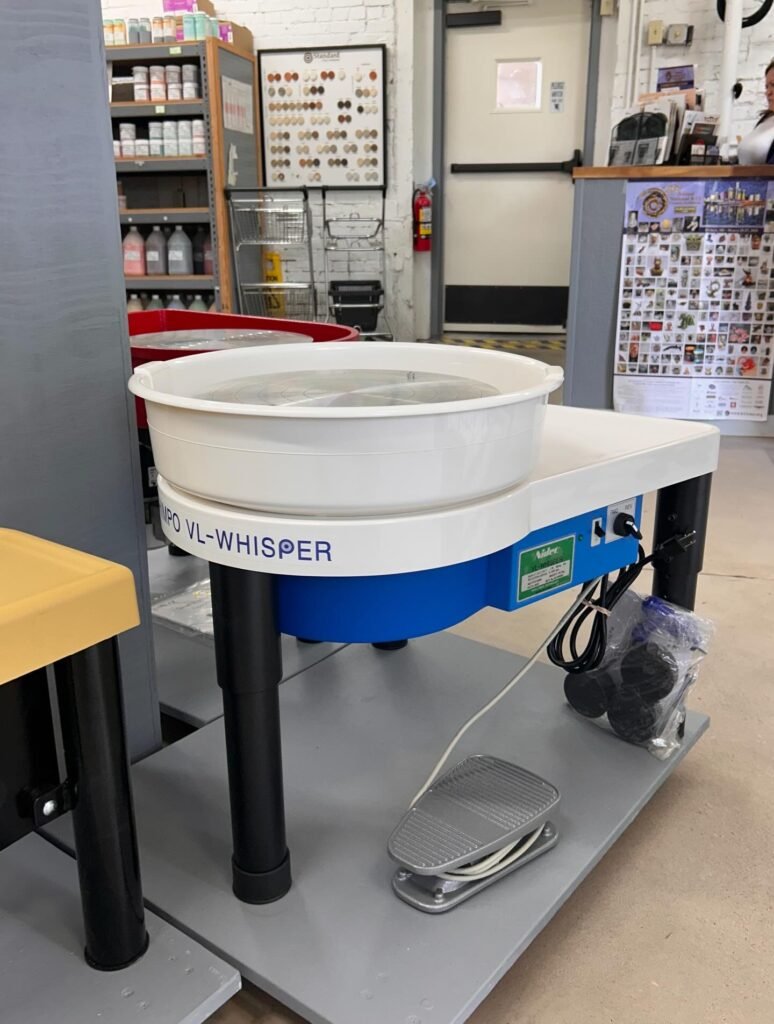
Shimpo’s Whisper line is particularly associated with quiet operation and direct-drive design.
However, do not assume every direct-drive wheel is automatically quieter than every belt-drive wheel.
The overall machine design matters.
A worn bearing can also make a normally quiet machine noisy.
That is particularly important when buying used or refurbished equipment.
Direct Drive vs Belt Drive
The drive system affects how a wheel transmits motor power to the wheelhead.
Belt drive
A belt-drive system uses a belt and pulleys to transmit rotation from the motor.
Potential advantages include:
- Familiar mechanical design
- Serviceable components
- Established technology
- Straightforward replacement of belts on applicable models
Potential disadvantages include:
- Belt wear
- Belt adjustment on some designs
- Additional mechanical components
Direct drive
A direct-drive wheel connects the motor more directly to the wheelhead.
Potential advantages include:
- No traditional drive belt
- Smooth speed control
- Compact mechanical transmission
- Potentially very quiet operation
Potential disadvantages can include more specialized motor or electronic components.
Neither system automatically makes a wheel superior.
The right choice depends on what matters most to you.
For a small studio, noise and footprint may push you toward one design.
For a production potter, serviceability and heavy-load performance may carry more weight.
How Much Does Noise Matter?
Ask yourself where the studio is located.
Garage
Noise may be relatively unimportant.
Basement
Noise can travel through the structure.
Spare bedroom
Noise may matter considerably.
Apartment
Noise can become a serious constraint.
Shared commercial studio
Noise may matter less unless multiple machines are operating simultaneously.
Teaching space
Durability and serviceability may matter more than absolute quietness.
The best pottery wheel for small studio use is therefore partly a location decision.
Stability Is More Important in a Compact Studio
A small wheel that moves around the floor is not really space-efficient.
You need a stable throwing platform.
During centering, your body applies force through the clay into the wheel.
A stable frame allows you to work without fighting the equipment.
This is one reason heavier studio wheels can remain attractive even when space is limited.
Weight can be inconvenient when moving equipment.
But weight can also contribute to stability.
That creates an important tradeoff:
Portable does not always mean better.
If your wheel never leaves the studio, a heavier machine may be perfectly practical.
If you need to put it away after every session, portability becomes more valuable.
Should You Choose a Portable Pottery Wheel?
Choose portability if you genuinely need it.
A portable wheel can make sense for:
- Apartment studios
- Shared rooms
- Teaching
- Demonstrations
- Mobile workshops
- Temporary studios
- Potters who work in multiple locations
But portability should not be confused with low quality.
A serious potter can use a portable wheel.
The issue is whether the machine provides enough stability and capacity for the work.
If your wheel needs to be carried upstairs after every session, weight becomes a major practical consideration.
If it stays permanently beside your wedging table, weight may hardly matter.
The Foot Pedal Deserves More Attention
The pedal is one of the most frequently used components of a pottery wheel.
You need to be able to control speed smoothly without thinking about the pedal.
A good pedal should provide predictable speed changes.
Look for:
- Smooth response
- Comfortable positioning
- Stable placement
- Adequate cord length
- Reliable construction
- Easy replacement if damaged
The pedal should not force you to twist your body.
This becomes especially important in a small studio where your seating position may be constrained by walls, shelves, or other equipment.
Plan the complete workstation around the pedal.
Reversibility
A reversible pottery wheel can rotate clockwise and counterclockwise.
This can be useful for:
- Trimming
- Left-handed throwing
- Certain decorating techniques
- Different working preferences
Not every potter needs reverse.
But if you know you prefer it, make sure the wheel you buy supports the function.
Some controllers use a neutral safety position between forward and reverse.
The current Brent Model B, for example, includes forward and reverse controls and a neutral safety position.
This is an example of why the controller deserves attention rather than treating it as a minor accessory.
Splash Pan Design Matters More in Small Studios
A small studio has less tolerance for messy cleanup.
A poorly designed splash pan can allow clay water to reach:
- The floor
- Walls
- Shelving
- Storage containers
- Electrical equipment
- Nearby tools
Look for a splash pan that is:
- Easy to remove
- Easy to clean
- Secure during throwing
- Large enough for your work
- Compatible with the wheel
Cleanup is not glamorous.
But in a small studio, poor cleanup design can become one of the biggest daily annoyances.
Pottery Wheel Height and Ergonomics
The wheel needs to fit your body.
If you are too tall for the wheel, you may spend hours leaning forward.
If the wheel is too high, your shoulders and arms may become uncomfortable.
This is particularly important if you throw for several hours at a time.
Some Brent accessories are specifically designed to modify wheel height. AMACO’s current leg extension system, for example, is compatible with several Brent models and can raise the wheel’s working height.
That illustrates an important principle for small studios:
Do not choose a wheel based only on its footprint.
You also need to consider how comfortably you can work at it.
A wheel that fits physically but forces poor posture is not a good use of limited space.
Can a Professional Pottery Wheel Work in a Small Studio?
Absolutely.
A professional wheel does not require a giant studio.
It requires enough space to operate safely and comfortably.
A compact professional setup might consist of:
- One professional wheel
- One wedging table
- Vertical shelving
- Clay storage
- A small cleanup station
- Drying racks
- Access to a kiln
The studio can be relatively small while still being highly functional.
The key is workflow.
Place equipment according to how you actually work.
For example:
Clay storage → wedging → throwing → drying → trimming → glazing → firing
The less unnecessary movement you create, the more usable your studio becomes.
Small Studio Layout: A Practical Example
Imagine a spare room with limited floor area.
Instead of placing equipment randomly, create zones.
Zone 1: Throwing
Place the wheel where you have enough room for your stool and pedal.
Zone 2: Wedging
Use a compact wedging surface near the wheel.
Zone 3: Drying
Use vertical shelving rather than spreading drying boards across the floor.
Zone 4: Storage
Store tools, bats, clay, and glazes vertically where possible.
Zone 5: Cleanup
Create a controlled area for washing tools and managing clay residue.
Zone 6: Firing
If you are installing a kiln, treat the kiln as a separate installation project with its own clearance, electrical, and ventilation requirements.
The Kiln Depot’s broader pottery studio equipment guide recommends choosing equipment around your workflow rather than buying every machine at once.
Don’t Put the Kiln Beside the Wheel Just to Save Space
This is where small studios require careful planning.
A wheel and a kiln have very different installation considerations.
A wheel is relatively simple to operate from a standard electrical outlet for many models.
A kiln can require dedicated electrical service, clearance, and ventilation.
The Kiln Depot’s existing home pottery-wheel guide and kiln setup resources cover these differences.
Do not sacrifice safe kiln installation simply to make your floor plan look cleaner.
Studio efficiency matters.
Safety matters more.
What Is the Best Pottery Wheel for Small Studio Production?
If you are producing pottery for sale, your requirements change.
You may need:
- Higher clay capacity
- More consistent speed under load
- Long operating life
- Stable construction
- Easy maintenance
- Replacement parts
- Comfortable ergonomics
- Fast cleanup
You may also need more than one wheel.
But buying two compact wheels is not automatically better than buying one high-quality professional wheel.
Think about production bottlenecks.
If throwing is your bottleneck, another wheel may increase output.
If trimming is your bottleneck, another wheel may not solve the problem.
If firing is the bottleneck, buying another wheel may simply create more unfired pottery.
Your equipment should solve the actual constraint in your studio.
Best Pottery Wheel for Small Studio vs Best Pottery Wheel for Home
These phrases sound similar but can represent different buying decisions.
A home studio may have:
- More permanent space
- A dedicated room
- Family noise concerns
- More storage constraints
A small commercial studio may have:
- Higher production
- More frequent throwing
- Multiple users
- More demanding maintenance
- Less concern about household noise
That means a small commercial studio may actually need a heavier professional wheel than a larger home studio.
Search intent matters because “small studio” describes physical space, not necessarily the potter’s experience or workload.
New vs Used for a Small Studio
Buying used can be particularly attractive when space is limited.
Why?
Because you can potentially buy a professional wheel rather than compromising on performance simply because you have a small room.
Established wheels can remain useful for many years when properly maintained.
The important thing is condition.
The Kiln Depot’s used-pottery-wheel guide recommends testing a used wheel under load rather than simply watching the wheelhead spin empty.
Check:
- Wheelhead wobble
- Motor sound
- Pedal response
- Speed consistency
- Bearings
- Belt condition where applicable
- Electrical components
- Splash pan
- Model number
- Replacement parts
- Previous usage
Do not buy a used wheel simply because it is cheap.
Buy it because the condition and price make sense together.
Refurbished Pottery Wheels for Small Studios
Refurbished equipment can be attractive when you want professional equipment but want to control capital costs.
A properly refurbished wheel may have undergone inspection, cleaning, repair, replacement of worn components, or testing.
But the word “refurbished” does not tell you exactly what work was performed.
Ask:
- What components were replaced?
- Was the motor tested?
- Was the pedal tested?
- Were bearings inspected?
- Was the wheelhead checked for wobble?
- Was the electrical system inspected?
- Is there a warranty?
- Are replacement parts available?
The Kiln Depot’s existing refurbished-pottery-wheel guide explains why the refurbishment process matters more than the label itself.
Brent Wheels in a Small Studio
Brent wheels are worth considering when you prioritize established studio construction and long-term serviceability.
The current Brent lineup includes models such as the B, C, and CXC.
The Model B is designed for school and studio use and is specified for continuous handling of up to 150 pounds of clay. AMACO also lists a controller designed to maintain wheel speed under varying loads.
That capacity is far beyond what most small-studio potters need.
But that does not make the wheel inappropriate for a small studio.
If the wheel has a permanent home and you value stability and professional construction, the additional capability can provide room to grow.
AMACO also maintains a parts ecosystem for Brent wheels, including belts, foot-pedal components, motors, cords, and other service parts.
For a long-term studio investment, serviceability deserves consideration.
Shimpo Wheels in a Small Studio
Shimpo wheels are another important category to consider, particularly when quiet operation is a priority.
The VL-Whisper is particularly relevant for small studios where noise matters.
A quiet wheel can make a meaningful difference if your studio is located in:
- An apartment
- A spare bedroom
- A basement
- A shared building
- A home office area
- A space used by other family members
However, do not buy a wheel purely because it has a reputation for being quiet.
Evaluate:
- Wheelhead size
- Clay capacity
- Drive system
- Speed range
- Stability
- Height
- Serviceability
- Price
The right wheel still needs to fit your throwing style.
Small Studio Pottery Wheel Comparison
| Feature | Compact/Tabletop Wheel | Mid-Size Studio Wheel | Professional Floor Wheel |
| Floor space | Very low | Moderate | Higher |
| Portability | Usually higher | Moderate | Low |
| Stability | Depends on support | Generally good | Generally excellent |
| Large clay capacity | Model dependent | Good | Usually strongest |
| Storage | Easier | Moderate | Requires permanent space |
| Noise | Model dependent | Model dependent | Model dependent |
| Best for | Tight spaces | Serious hobby studios | Production |
| Long sessions | Model dependent | Good | Excellent |
| Large forms | Limited on some models | Good | Best suited |
| Small apartment | Often practical | Depends on noise | Usually less practical |
| Dedicated studio | Useful | Excellent | Excellent |
This table should be treated as a buying framework rather than a claim that every wheel within a category performs identically.
Model-specific specifications always take priority.
What Should You Spend on a Small-Studio Wheel?
Do not set the budget solely by studio size.
Set it by how much you use the wheel.
A person throwing twice a month may not need the same equipment as someone throwing four hours every day.
Think about the cost per year of ownership.
A $1,500 wheel used three times a week for five years is a very different purchase from a $300 wheel that gets replaced after a year.
Also consider:
- Replacement parts
- Shipping
- Repairs
- Accessories
- Bats
- Splash pan
- Stool
- Wheel risers
- Maintenance
- Resale value
The cheapest purchase price is not always the lowest total cost.
The Smallest Wheel Is Not Always the Best Value
This deserves repeating.
A wheel that saves six inches of floor space but becomes unusable when you start throwing larger work can force you to buy another wheel later.
That creates:
First wheel + second wheel + shipping + lost time
instead of:
One appropriate wheel from the beginning
This does not mean you should overspend.
It means you should understand your likely development.
If you know you only want to make small pieces, a compact wheel can be completely appropriate.
If you are already throwing large forms, do not deliberately buy a miniature machine because the room is small.
Change the layout instead.
Five Questions to Ask Before Buying
1. What is the largest amount of clay I actually throw?
Not what you might throw someday.
What do you realistically use now?
2. Will the wheel stay in one place?
If yes, stability becomes more important than portability.
3. How sensitive is the studio to noise?
If the answer is “very,” prioritize quiet operation.
4. Do I need a tabletop design?
Only if the floor-space savings actually solve a problem.
5. How long do I expect to keep the wheel?
If you want five or ten years of use, buying around your expected workflow may make more sense than buying around your current skill level.
Seven Mistakes Small-Studio Buyers Make
Mistake 1: Measuring only the wheel
Measure the entire throwing station.
Mistake 2: Ignoring the stool
You need somewhere to sit comfortably.
Mistake 3: Forgetting the pedal
The pedal needs space too.
Mistake 4: Buying by horsepower
Horsepower does not tell the entire performance story.
Mistake 5: Ignoring noise
A wheel that sounds fine for five minutes can become annoying after three hours.
Mistake 6: Buying the smallest possible wheel
Small does not automatically mean efficient.
Mistake 7: Forgetting maintenance
A wheel is a machine.
It eventually needs maintenance and replacement components.
How to Test a Small Studio Wheel Before Buying
If you are buying new, review the manufacturer’s specifications and warranty.
If you are buying used, physically test the machine whenever possible.
Start the wheel.
Listen to it.
Run it slowly.
Increase the speed.
Change direction if the wheel supports reverse.
Place clay on the wheel.
Apply pressure.
Observe whether the wheel maintains speed.
Check the wheelhead.
Inspect the pedal.
Look underneath the machine.
Check the electrical components.
Ask about previous use.
If you cannot inspect the machine personally, ask for detailed photographs and video demonstrating operation under load.
The Kiln Depot’s used-wheel guidance specifically recommends testing the machine with actual clay rather than judging it from an unloaded spin.
Buying a Small-Studio Wheel Online
Online buying gives you access to a much larger equipment market.
That is useful when local pottery suppliers have limited inventory.
But it changes what you need to verify.
Before ordering, confirm:
- Exact model
- Dimensions
- Weight
- Wheelhead diameter
- Motor specifications
- Electrical requirements
- Clay capacity
- Warranty
- Return policy
- Shipping method
- Included accessories
- Replacement-parts availability
For used equipment, ask for:
- Serial/model information
- Current operating video
- Wheelhead close-ups
- Pedal photos
- Motor-area photos
- Splash-pan photos
- Controller photos
- Evidence of repairs
- Shipping dimensions
The more expensive the equipment, the more valuable this information becomes.
Should a Small Studio Have More Than One Wheel?
Eventually, possibly.
But one good wheel is enough for many studios.
A second wheel becomes useful when:
- Multiple people throw simultaneously
- You need a dedicated trimming station
- You teach classes
- Production volume has increased
- One wheel is constantly occupied
- You want a backup machine
If you are still building your studio, spend money where it removes the biggest bottleneck.
A second wheel is not automatically the next logical purchase.
What Other Equipment Should Fit Around the Wheel?
A pottery wheel is only one part of the workflow.
A compact studio may eventually need:
- Wedging table
- Clay storage
- Drying shelves
- Bats
- Hand tools
- Trimming tools
- Glaze storage
- Work tables
- Cleanup equipment
- Kiln
- Kiln furniture
- Slab roller
- Extruder
- Pugmill
Do not buy all of these simultaneously unless your workflow actually requires them.
The Kiln Depot’s studio-equipment guide recommends building equipment around the type and volume of pottery you make rather than filling a room with machinery simply because it is available.
Best Pottery Wheel for Small Studio: The Decision Framework
Use this simple sequence.
If your biggest problem is floor space:
Start with compact or tabletop designs.
If your biggest problem is noise:
Prioritize quiet operation and investigate direct-drive options.
If your biggest problem is heavy clay:
Prioritize torque and centering capacity over portability.
If your biggest problem is storage:
Look at portable or tabletop wheels.
If your biggest problem is stability:
A heavier floor-standing wheel may be more appropriate.
If your biggest problem is budget:
Compare used and refurbished professional wheels against new entry-level equipment.
If your biggest problem is future growth:
Buy enough capacity that you are unlikely to outgrow the wheel quickly.
If your biggest problem is multiple users:
Prioritize durability, serviceability, and replacement parts.
Frequently Asked Questions
What is the best pottery wheel for small studio spaces?
The best pottery wheel for small studio spaces is the model that balances footprint with the amount of clay you actually throw. Compact tabletop wheels can save floor space, while full-size wheels can be better for serious throwing when a permanent corner is available.
What size pottery wheel is best for a small studio?
There is no universal size. Choose based on the largest work you make, your clay volume, available floor area, and whether the wheel needs to be stored between sessions.
Are tabletop pottery wheels good for serious pottery?
They can be. Tabletop design does not automatically mean low performance. The important factors are motor performance, torque, stability, wheelhead size, and the type of pottery you make.
Is a small pottery wheel less powerful?
Not necessarily. Compact wheels vary considerably. Some are designed for lightweight work, while others provide substantial throwing capability despite their smaller footprint.
Is a direct-drive wheel better for a small studio?
Direct drive can be attractive when quiet operation, smooth speed control, and reduced mechanical transmission components matter. It is not automatically the best choice for every potter.
Is a belt-drive pottery wheel good for a small studio?
Yes. Belt-drive wheels can be excellent small-studio machines. The important considerations are the specific wheel’s torque, stability, noise, construction, and maintenance requirements.
How much space should I leave around my pottery wheel?
Leave enough room for the wheel, stool, foot pedal, comfortable body movement, clay handling, and cleanup. Do not design the station around the machine’s dimensions alone.
Can I use a professional pottery wheel in an apartment?
Potentially, provided the wheel fits the space and noise level is acceptable. Apartment users should pay particular attention to vibration, noise, floor loading, cleanup, and the ability to protect surrounding surfaces from clay and water.
Should I buy a used pottery wheel for a small studio?
A used pottery wheel can make sense if it is in good condition and the price reflects its age and condition. Test the wheel under load, inspect the wheelhead and pedal, listen for unusual noises, and verify parts availability.
Is a refurbished pottery wheel worth buying?
A refurbished pottery wheel can be worthwhile when the refurbishment work is clearly documented and the final price provides meaningful value compared with buying new. Ask exactly what was inspected, repaired, replaced, and tested.
What matters more, horsepower or torque?
For throwing, torque and the wheel’s ability to maintain speed under load are particularly important. Horsepower can provide useful context, but it should not be the only specification used to judge a pottery wheel.
Final Buying Checklist
Before buying the best pottery wheel for small studio use, measure your actual workspace.
Then check:
- Wheel footprint
- Throwing-station footprint
- Stool position
- Foot-pedal position
- Wheelhead diameter
- Centering capacity
- Torque
- Motor design
- Speed range
- Forward/reverse operation
- Noise
- Vibration
- Weight
- Throwing height
- Splash-pan design
- Cleanup access
- Storage requirements
- Warranty
- Replacement parts
- Used/refurbished condition
- Shipping requirements
- Total ownership cost
Do not skip the last item.
A wheel that costs less but requires expensive repairs may not be cheaper.
A larger wheel that initially costs more may provide better long-term value if it eliminates the need for an upgrade.
Final Thoughts: Choosing the Best Pottery Wheel for Small Studio Use
The best pottery wheel for small studio use is not determined by the smallest footprint.
It is determined by how effectively the machine fits your workflow.
A beginner throwing small mugs in an apartment may value portability, low noise, and compact storage.
A professional potter working in a 100-square-foot studio may care more about torque, stability, ergonomics, and long-term reliability.
A teacher may prioritize durability and serviceability.
A production potter may need a professional floor-standing wheel even though the studio itself is small.
That is why the buying process should start with your work rather than the machine.
Determine how much clay you throw.
Measure your largest pieces.
Measure the actual throwing station.
Decide whether the wheel will stay permanently installed.
Think about noise.
Then compare motor performance, torque, wheelhead size, drive system, speed control, stability, and maintenance.
If you are still deciding between models, The Kiln Depot’s pottery wheel buying guide provides broader model comparisons, while the guides to pottery wheel torque and variable speed explain two of the most important performance factors.
For buyers considering lower-cost professional equipment, compare the condition of used pottery wheels and refurbished pottery wheels before automatically assuming that new is the only sensible option.
The goal is simple:
Use as little space as possible without buying a wheel that limits the pottery you actually want to make.
A small studio can still be a serious studio.
The right wheel should make the space feel more capable, not more cramped.